


With the hopes of creating a nationwide public WiFi network, Comcast has been pushing new Xfinity WiFi routers into its customers’ homes that broadcast a public wireless network in addition to the home Internet connection. It’s an interesting idea that has been embraced by some, but has raised questions about security with others. As a bandwidth-obsessed engineer, my immediate inclination was to wonder where the heck the extra bandwidth for the public hotspot was coming from, and what kind of hidden electricity costs that might come with.
We ran some tests with one of these dual-signal routers in our office, and found that it was indeed costing Xfinity customers several dollars extra per month to support the public hotspot with this particular router. Not a huge deal on the individual level, but it’s worth noting that, when multiplied out by Comcast’s millions of residential customers, it seemed like subscribers might potentially be footing a bill in the tens of millions to roll out the ISP’s public WiFi network. A few weeks ago, we published a blog post with our findings, and we must have tickled the beast, because within an hour-or-two, I was on a call with Comcast.
Should you have a backup 4G, 5G, Starlink, or cable internet connection?
Yes — every internet connection goes down, including Starlink, which drops for ~34 minutes a day on average. A backup connection from a different provider means one outage never takes you fully offline. The most common options are a 4G/5G cellular hotspot, a cable or DSL line, or a second satellite dish.
4G/5G cellular
Works anywhere. Just a SIM or hotspot — no installation needed.
Learn more →Cable / DSL
Best for fixed locations. Different network, so outages rarely overlap.
Learn more →Second Starlink
Adds redundancy and throughput for remote sites or heavy usage.
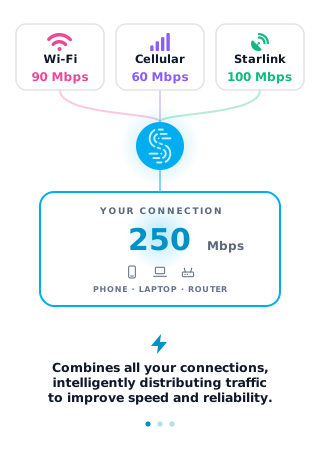
Learn more →Speedify bonds any two connections into one — automatic failover, more speed, no dropped calls.
Try Speedify free →Comcast Calling
The folks at Comcast reached out to let us know that we weren’t testing with their latest home router, and that they wanted to furnish us with the latest-and-greatest so we could re-test. Sure, why not? We wanted to present solid and accurate data, after all.
A few days later, an Xfinity tech replaced our existing hardware with a Cisco DPC3939B (XB3 is the residential variant, but we have the BWG business variant). We were told that the business and home versions are identical pieces of hardware that run slightly different software. This new Xfinity router box takes the place of four different components that we used to have:
- Cable modem for the Xfinity Hotspot
- WiFi access point for the Xfinity Hotspot
- Cable modem gateway for our business account
- Linksys access point that we provided
So, while they’ve certainly packed a lot in the new DPC3939B router, it’s also about the size of those four separate components duct-taped together!
The Data
Most importantly, the power usage of this box is certainly different than the older devices:
| Amps | Vrms | PF | KWh | KWh / year | Cost in Middle Atlantic (2013) | |
| Idle | 0.22 | 122 | 0.56 | 0.015 | 131 | $21.28 |
| Xfinity Under Load | 0.28 | 122 | 0.56 | 0.019 | 174 | $29.05 |
It Uses a Lot of Power Just Sitting There
The idle power is as high as the peak power from the old devices that I complained about last time. Meanwhile, the new router under Xfinity public WiFi load only translates to about $8 extra in electricity costs per year, which no longer seems like much next to the $20-28 per year it’s pulling while idle. The bottom-line is that the new box uses more electricity than a traditional router, but it’s worth noting that the new router is a combination of all the separate hardware components you used to need to get online. Maybe this points to a shift in how we think about routers themselves. Clearly, WiFi routers have become as necessary and ubiquitous an appliance in the home as your refrigerator or microwave. If they haven’t already, the electricity costs will just become part and parcel with the general necessities of modern living.
But, There’s More…
After testing out the new Xfinity router, we decided to use it as our main Internet connection to see how well it actually worked. That’s when the trouble started… Google Talk sessions were getting disconnected and Hangouts were being cut off mid-stream. It took hours on the phone, and multiple visits from Comcast techs to discover that IPv6, which was turned on by default in the router, did not work with Google. Oops.
But even with IPv6 deactivated, the Internet still seemed slow to us. We discovered that the router’s firewall, which was ‘inactive’ in the control panel, was actually logging hundreds of thousands of discarded packets from inside our network. It seems like there’s still some ways to go in making sure the new Xfinity routers are stable. But, in monitoring our Internet connection we noticed that the box rebooted itself twice over this last weekend, and once this morning (one of them was Comcast updating the software, which is good news).
Ultimately, this is the 1.0 version of the new Xfinity router, and we totally get that. It takes time and iteration to make sure a new product is working smoothly for all users. Despite these reservations, we think the public hotspot idea is an innovative one, but one that’s not quite there yet. Walt Mossberg put it well while discussing open home WiFi in a post for re/code a few days ago: “Companies like Comcast…are moving in the right direction. But there are strings attached.”
Alex and the Speedify team are always exploring the latest in networking and security technology—like 5G, 6G, WiFi 7, laser and satellite internet—and sharing it in new discussion content across YouTube, TikTok, Instagram, and LinkedIn every week.
Got a tech question? Let's go deeper! Pop into Speedify Office Hours live every Wednesday at 10 AM Eastern. Speedify CEO Alex Gizis and our network engineers are standing by to break down your questions about networks, tech updates, and Speedify features.


Speedify
Get started with Speedify today.
Combine Wi-Fi, 4G/5G cellular, Ethernet, Starlink, and more into one faster, steadier connection. Free to try — no credit card required.
🚀 Speed
Faster uploads and downloads by bonding all your connections at once.
📶 Stability
Automatic failover in under a second when any connection drops.
🔒 Security
AES-256 encryption on every connection, on every network you join.




15M+ downloads worldwide. 75K+ five-star reviews on iOS and Android.