


How to Keep Security Cameras Online When the Internet Goes Down
A power flicker or a downed line takes out the router, and every camera feed in the house goes dark at the exact moment footage matters most. Most IP cameras rely on a single broadband connection to reach the cloud, so one outage means no live view, no motion alerts, and a gap in the recorded timeline that can’t be recovered later.
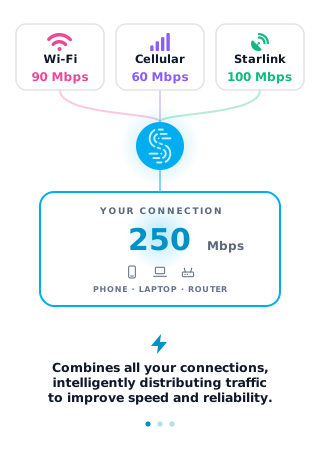
Speedify closes that connectivity gap by combining a home internet line with a cellular connection, using Speedify’s channel bonding technology to route camera traffic across whichever path is healthy. When the primary line drops, Speedify keeps the upload moving over the internet connection that’s still up, and the camera never actually loses its connection to the cloud.
Should you have a backup 4G, 5G, Starlink, or cable internet connection?
Yes — every internet connection goes down, including Starlink, which drops for ~34 minutes a day on average. A backup connection from a different provider means one outage never takes you fully offline. The most common options are a 4G/5G cellular hotspot, a cable or DSL line, or a second satellite dish.
4G/5G cellular
Works anywhere. Just a SIM or hotspot — no installation needed.
Learn more →Cable / DSL
Best for fixed locations. Different network, so outages rarely overlap.
Learn more →Second Starlink
Adds redundancy and throughput for remote sites or heavy usage.
Learn more →Speedify bonds any two connections into one — automatic failover, more speed, no dropped calls.
Try Speedify free →Why cameras go dark during outages
Security cameras are built around one assumption: the internet stays up. A single ISP outage, a modem reboot, or a construction crew slicing through a cable line severs that assumption instantly. Cloud-connected cameras stop pushing footage, mobile apps show a stale thumbnail, and any motion-triggered alert during the outage simply never fires. Battery backups keep the camera powered, but they don’t help the router or modem upstream, so the recording pipeline breaks at the same point regardless.
Adding a 4G/5G cellular backup connection
A cellular connection changes the equation because it doesn’t share a point of failure with wired broadband. A phone hotspot, a dedicated LTE modem, or a home router with a SIM slot gives the security system a second path that keeps working when the cable line or fiber drop goes out. For properties already leaning on satellite, the same logic explains why so many owners are pairing Starlink as backup internet with automatic failover, since satellite and cellular rarely go down at the same time as a wired line. Camera traffic is steady and latency-sensitive rather than bursty, which is exactly the profile Speedify’s Streaming Mode is built to protect, smoothing out the upload so footage doesn’t stutter or drop frames when conditions shift.
How Speedify fails over automatically to keep uploads from the security camera flowing
Speedify monitors every connection it’s bonding in real time and reacts in under a second when one path degrades or drops. Camera traffic that was flowing over the primary line shifts to the cellular path automatically, with no manual switch, no app restart, and no visible gap in the recording. Because Speedify bonds rather than simply switching after a failure is detected, footage keeps uploading continuously through the transition instead of pausing while a backup connection reconnects from scratch.
Internet bandwidth tips for multi-camera setups, and a setup checklist
Multiple cameras streaming simultaneously add up fast, especially with 4K sensors or high frame rates. Speedify uses up to 95% of the combined capacity across whatever connections are bonded, so a modest cellular backup can still carry several camera streams without saturating a data plan.
- Lower non-essential resolution. Keep entry points at full resolution and drop side-yard or garage cameras to a lower bitrate so backup bandwidth stretches further.
- Check upstream, not just downstream. Camera traffic is upload-heavy, so the backup connection’s upload speed matters more than its advertised download number.
Getting a bonded camera setup running takes less time than restoring a single dropped clip.
- Confirm the router or NVR supports a secondary WAN, or plan to run cameras through a dedicated bonding device.
- Download Speedify on the gateway device and connect both the wired line and the cellular connection.
- Add the cellular connection as a bonded path rather than a cold standby, so it’s already carrying traffic before anything fails.
- Test by unplugging the primary line and watching the camera feed for a gap.
- Set a data cap alert on the cellular plan so multi-camera streaming doesn’t cause bill surprises.
Bonding does have limits worth stating plainly: it needs at least two working connections to do anything, and it can’t manufacture bandwidth that isn’t there. A cellular backup with a weak signal will fail over reliably, but it won’t turn a 2 Mbps connection into a 20 Mbps one. Speedify makes the switch invisible; it doesn’t invent capacity that was never there to begin with.
Security Cameras: FAQ
Does Speedify work with any brand of security camera?
Speedify runs on the router, computer, or gateway device that carries camera traffic rather than on the camera itself, so it works with any brand as long as traffic passes through a bonded connection.
How much cellular data do security cameras use as a backup?
Speedify shifts meaningful traffic onto cellular mainly when the primary connection is down or struggling, so day-to-day use stays low; extended outages with multiple 4K streams drive usage up.
Will Speedify slow down normal camera streaming?
Speedify’s overhead is negligible next to typical camera bitrates, and combining connections generally gives camera traffic more headroom, not less.
Can Speedify protect a whole home security system, not just cameras?
Speedify bonds the connection at the network level, so any device relying on that gateway, including alarm panels, video doorbells, and NVRs, benefits from the same automatic failover.
Alex and the Speedify team are always exploring the latest in networking and security technology—like 5G, 6G, WiFi 7, laser and satellite internet—and sharing it in new discussion content across YouTube, TikTok, Instagram, and LinkedIn every week.
Got a tech question? Let's go deeper! Pop into Speedify Office Hours live every Wednesday at 10 AM Eastern. Speedify CEO Alex Gizis and our network engineers are standing by to break down your questions about networks, tech updates, and Speedify features.


Speedify
Get started with Speedify today.
Combine Wi-Fi, 4G/5G cellular, Ethernet, Starlink, and more into one faster, steadier connection. Free to try — no credit card required.
🚀 Speed
Faster uploads and downloads by bonding all your connections at once.
📶 Stability
Automatic failover in under a second when any connection drops.
🔒 Security
AES-256 encryption on every connection, on every network you join.




15M+ downloads worldwide. 75K+ five-star reviews on iOS and Android.