
A Slashdot User Asks…
Quick answer
Should you have a backup 4G, 5G, Starlink, or cable internet connection?
Yes — every internet connection goes down, including Starlink, which drops for ~34 minutes a day on average. A backup connection from a different provider means one outage never takes you fully offline. The most common options are a 4G/5G cellular hotspot, a cable or DSL line, or a second satellite dish.
4G/5G cellular
Works anywhere. Just a SIM or hotspot — no installation needed.
Learn more →Cable / DSL
Best for fixed locations. Different network, so outages rarely overlap.
Learn more →Second Starlink
Adds redundancy and throughput for remote sites or heavy usage.
Learn more →Speedify bonds any two connections into one — automatic failover, more speed, no dropped calls.
Try free →Speedify
Speedify gives you faster, steadier internet by combining Wi-Fi, cellular, and Starlink
Speedify bonds Wi-Fi, 4G/5G cellular, Ethernet, and Starlink into one connection at the same time, giving you more speed, automatic failover when one drops, and AES-256 encryption on every link.
Download Speedify ›More speed
Upload and download speeds combine across every active connection on your device.
Automatic failover
If a connection drops, Speedify moves your traffic to another in milliseconds. Calls stay connected.
Always encrypted
Every link runs through an encrypted tunnel, including public Wi-Fi, cellular, and Starlink.
Speedify Feature · Pair & Share
Speedify Pair & Share: share cellular between your devices, both ways
Most hotspots give. Speedify's Pair & Share gives and takes. Two devices running Speedify pair up and each uses the other's cellular connection simultaneously, so you both get faster uploads, faster downloads, and a steadier connection. No extra hardware, no new data plans, no setup beyond a tap.
Learn how Speedify's Pair & Share works ›More speed
Every device you pair with adds its cellular to yours, and yours to theirs.
Stays connected
If a paired device drops out, Speedify keeps you online on the remaining links.
Always private
Every shared connection runs through AES-256 encryption. Your traffic is yours.
No new gear
Runs on devices already running Speedify, over your local network. Pair once, reconnects automatically.



A New Feature is Born
Redundant Mode has been available to all users running the latest version of Speedify for just over a week now, and already folks have been writing to tell us how awesome the new feature is.
But, I wanted to dig a little deeper and see what’s happening under-the-hood. The obvious question is whether or not such a system can really help improve ping times. If pings are essentially measures of the speed of light, then you might expect little difference in performance from sending duplicate packets in parallel.
The Control (without Speedify)
Let’s look at some real ping times from a pair of 4G wireless cards in our office, first without Speedify at all.
Verizon 4G MiFi
Ping statistics for 74.125.29.147:
Packets: Sent = 47, Received = 47, Lost = 0 (0% loss),
Approximate round trip times in milli-seconds:
Minimum = 56ms, Maximum = 411ms, Average = 120ms
Clear 4G USB modem
Ping statistics for 74.125.29.105:
Packets: Sent = 45, Received = 45, Lost = 0 (0% loss),
Approximate round trip times in milli-seconds:
Minimum = 68ms, Maximum = 388ms, Average = 125ms
While there is a clear minimum ping time, there isn’t really a limit on the maximum ping time. 4G cards have ping times around 50 ms when everything works well, but sometimes they randomly delay packets by hundreds of milliseconds!
Now, with Speedify in Redundant Mode
To improve on this, I connect to Speedify, select Redundant Mode, and run the pings again. In Redundant Mode, each ping is sent on both connections, and whichever one gets through first is the one delivered. Here’s what I get:
Clear 4G + MiFi 4G through Speedify Redundant Mode:
Ping statistics for 74.125.29.103:
Packets: Sent = 41, Received = 41, Lost = 0 (0% loss),
Approximate round trip times in milli-seconds:
Minimum = 52ms, Maximum = 106ms, Average = 69ms
The average ping times of 125 ms and 120 ms by themselves, gets cut down to just 69 ms, almost twice as good. That’s a 40% improvement with Speedify in Redundant Mode.
In this case, Speedify’s Redundant Mode delivers because 4G networks suffer from jitter (variable latency). There are other scenarios where Speedify helps, too: packet loss, and of course, networks losing connectivity altogether.
So next time you’re gearing up Battlefield, or maybe trading stocks on the Internet, try taking Speedify for a spin.

Get started with Speedify today!
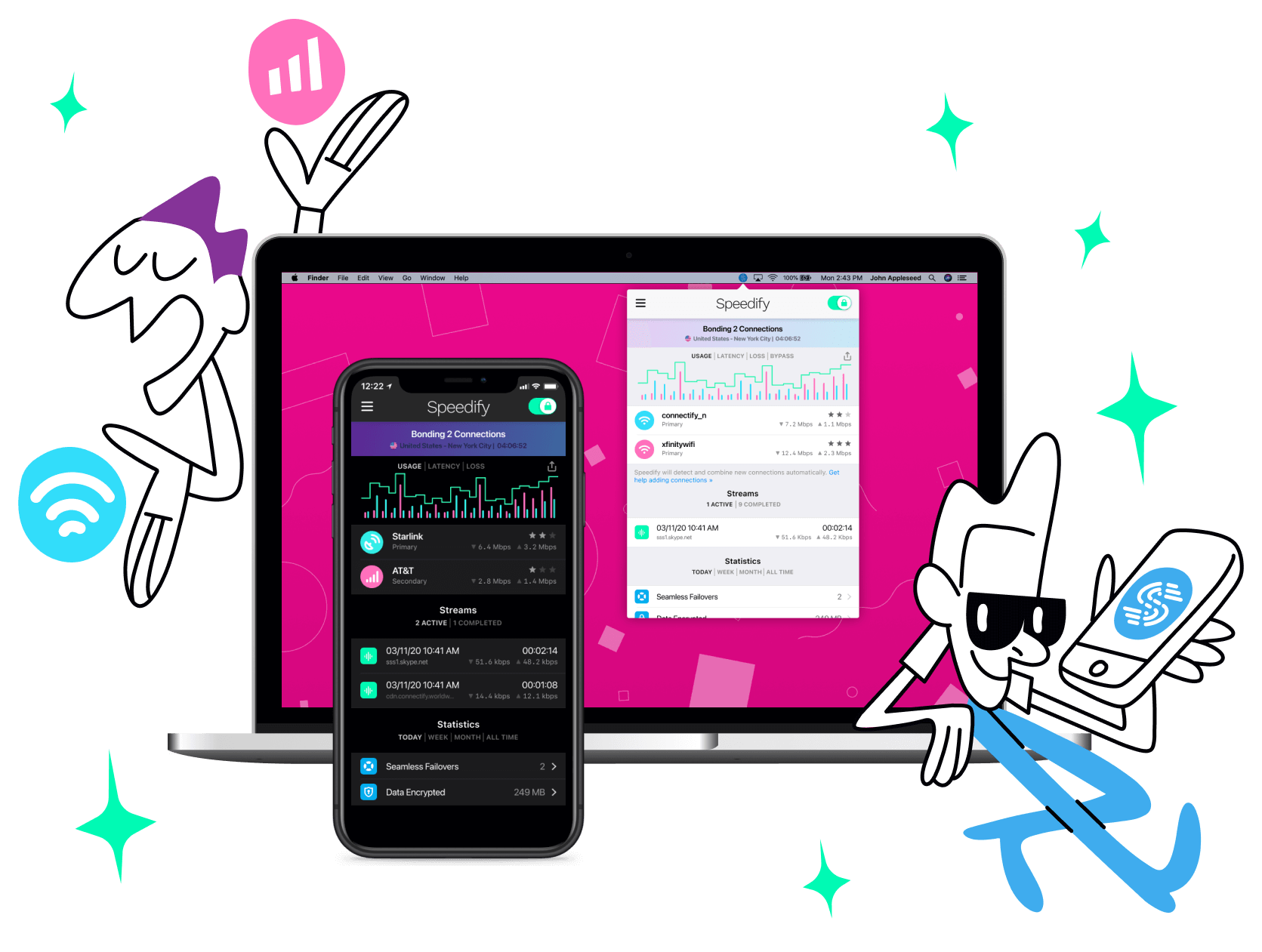
With Speedify you can combine Wi-Fi, 4G / 5G cellular, Ethernet, Starlink and other satellites into one bonded super-connection to improve livestreaming, video calling, gaming, web browsing, and everything else you do online.






Speed
Stability
Security
Speedify engineers love talking tech on YouTube, Tiktok, and Instagram!
Alex Gizis and the Speedify engineers discuss and explain technology including Starlink satellites, Wi-Fi 7 routers, Apple networking features, fiber optics, broadband internet, 5G mobile networks, AI, networking protocols, and much more. Follow Speedify on YouTube, TikTok, Instagram, and LinkedIn!
Alex and the Speedify team are always exploring the latest in networking and security technology—like 5G, 6G, WiFi 7, laser and satellite internet—and sharing it in new discussion content across YouTube, TikTok, Instagram, and LinkedIn every week.
Got a tech question? Let's go deeper! Pop into Speedify Office Hours live every Wednesday at 10 AM Eastern. Speedify CEO Alex Gizis and our network engineers are standing by to break down your questions about networks, tech updates, and Speedify features.