



Speedify Fails Over Instantly So Starlink Internet Dropouts Don’t Break Your Connection
This guide covers why a Starlink internet connection drops, how to find the cause, and how Speedify keeps your internet traffic moving across other internet connections – Wi-Fi, 4G/5G cellular, wired Ethernet, another Starlink or satellite dish – the moment Starlink disconnects.
Starlink disconnects all the time for ALL Starlink users. The Speedify Starlink Index report found that Starlink connections are down for an average of ~33 min per day. Plus, all Starlink dishes experience small drops and packet loss every 15 seconds, when the moving Starlink satellites hand off the connection to the next satellite overhead.
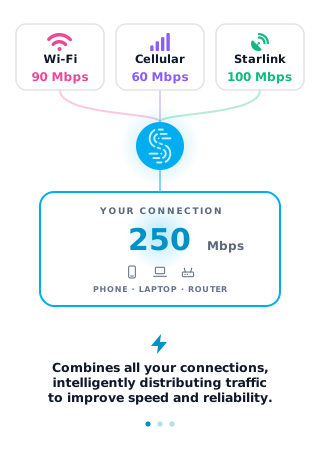
The best way to fix Starlink's connection drops is to combine your Starlink connection with another internet connection, such as 4G/5G cellular, cable, fiber, DSL, or another Starlink connection. Speedify makes this possible with channel bonding.
Daily Starlink downtime
~33 min
Starlink connections are unreachable for an average of 33 minutes every day — across 6,228 real-world dishes. That’s 2.3% of connected time.
Why a Starlink Internet Connection Keeps Dropping Out
- Obstructions. A tree branch or roofline that clips the dish’s view causes short, repeating dropouts on a regular cycle. The obstruction map in the Starlink app pinpoints the blocked direction.
- Overheating. A dish in direct sun on a hot day can throttle or shut down until it cools. Shade and airflow help.
- Loose or damaged cable. A connector that has worked loose, or a cable pinched or chewed, drops the link intermittently.
- Firmware updates. Starlink installs updates that briefly restart the dish, usually overnight. A short nightly drop at the same time is often this.
- Router or Wi-Fi. If the dish reports online but devices keep losing connection, the router or Wi-Fi is the more likely culprit.
How to Pin Down the Cause of Starlink Dropouts
Open the Statistics section in the Starlink app and look at the outage log. The app records each drop and labels it, for example obstructed, no signal received, or searching. A pattern of short obstructed entries points at the view of the sky. Drops clustered at one time each night point at firmware updates. Random drops on hot afternoons point at heat. Matching the timing to the label is the fastest way to separate a real fault from normal behavior.
Fixing Frequent Starlink Disconnects
Clear the obstruction the map flags, reseat or replace the dish cable, and give an overheating dish shade and airflow. Reboot the dish to clear a stuck state and let it reacquire the strongest satellites. If short drops continue after all of that, some are simply the satellite handoffs that come with low-earth-orbit internet, and the practical answer is a second connection that covers them.
Who Is Hit Hardest by Starlink Disconnects
- Anyone on video calls. A two-second drop ends a call, even if the connection returns right away.
- Gamers and live streamers. A single dropped packet at the wrong moment is enough to disconnect.
- RV and maritime users. A moving dish reacquires satellites constantly, so drops come more often than on a fixed roof.
Speedify and Starlink: Cover the Internet Dropouts You Can’t Eliminate
You can clear obstructions and tighten cables, but the handoff drops built into satellite internet remain. Speedify has got you covered. Speedify combines Starlink with 4G/5G cellular, wired Ethernet, Wi-Fi, or a second satellite dish into one bonded internet connection. The instant the Starlink dish drops a packet, Speedify’s automatic failover carries that traffic on the other connections before a call or stream notices.
Read more on how to monitor Starlink outages and uptime with Speedify, or learn how Speedify’s channel bonding technology works.
Alex and the Speedify team are always exploring the latest in networking and security technology—like 5G, 6G, WiFi 7, laser and satellite internet—and sharing it in new discussion content across YouTube, TikTok, Instagram, and LinkedIn every week.
Got a tech question? Let's go deeper! Pop into Speedify Office Hours live every Wednesday at 10 AM Eastern. Speedify CEO Alex Gizis and our network engineers are standing by to break down your questions about networks, tech updates, and Speedify features.


Speedify
Get started with Speedify today.
Combine Wi-Fi, 4G/5G cellular, Ethernet, Starlink, and more into one faster, steadier connection. Free to try — no credit card required.
🚀 Speed
Faster uploads and downloads by bonding all your connections at once.
📶 Stability
Automatic failover in under a second when any connection drops.
🔒 Security
AES-256 encryption on every connection, on every network you join.




15M+ downloads worldwide. 75K+ five-star reviews on iOS and Android.