


Channel Bonding vs Load Balancing: How Are They Different and How Do I Choose between Them?
Channel bonding and load balancing both use two or more internet connections to give you faster, more reliable internet, but they work differently. Load balancing sends each app or session down one connection; channel bonding splits traffic at the packet level across all connections, so even a single download or video call gets the combined speed.
Speedify is an app that uses channel bonding for faster upload and download speeds and automatic failover. Here is how the two compare and which to choose.
What is Load Balancing and When to Use It?
In computer networking, load balancing aims to optimize connectivity, maximize bandwidth, minimize latency, and avoid the overload of any single Internet connection. By using multiple connections with load balancing, users are able to improve reliability and availability through redundancy. Load balancing usually involves dedicated software or hardware, such as special routers or switches.
The load balancing setup for home users includes special networking hardware (routers), which are embedded with dedicated balancing software. Of course, the router has to be connected to at least 2 WAN Internet connections in order to employ its ‘balancing’ functionality.
How Load Balancing Works
When you use apps on your devices, information travels to the internet through network sockets – think of them as tubes. A load balancer works by distributing these sockets across all of the Internet connections you are currently using. In this way, load balancing prevents overloading a single connection, thereby increasing overall performance.
So, as long as your apps use lots of sockets, a load balancer does its job and you get faster Internet. General web browsing and torrenting are the most common scenarios for which load balancing should be sufficient.
However, other activities that use only a single network socket to connect to the Internet will not be optimized through load balancing. For instance, video streaming, VPN connections, and large file transfers are not sped up by a load balancer.
There is also nothing encrypted about load balancing. A load balancer decides which connection your traffic goes down; it does not protect that traffic. On a network you do not control – a hotel, a cafe, a venue – you still need a separate VPN running alongside it.
Broadband Bonding – What is it?
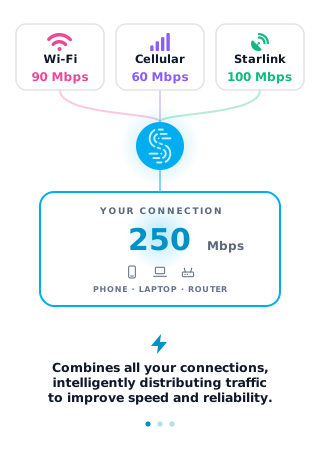
Channel bonding (also referred to as ‘broadband bonding’ and ‘link bonding’) is the process of combining two or more Internet connections into a single ‘pipe’ that has more bandwidth, lower latency and increased reliability (redundancy).
As in the case of load balancing, broadband bonding usually requires dedicated hardware, as well as software. Of course, there are also software-only solutions, which give you the same performance and flexibility but are also cost-effective when compared to the solutions that require a hardware element.
How Channel Bonding Works
As mentioned above, load balancing optimizes Internet traffic per sockets. Channel bonding, on the other hand, goes one step further and optimizes traffic into even smaller chunks of data called network packets. Following the ‘tubes’ analogy for sockets, we can think of these network packets as the ‘liquid’ that flows through those tubes.
Broadband bonding makes it possible to spread these individual packets across multiple Internet connections. By splitting all your web traffic at the packet level, even large, single-socket transfers, such as VPN connections, video streaming, and file transfers, can be given a major speed boost!
Bonding vs Load Balancing – Which to Choose?
Both channel bonding and load balancing improve your Internet connection by:
- Increasing available bandwidth
- Lowering latency
- Increasing the reliability of the connection
However, the two techniques work best in their specific scenarios.
Activity or requirement |
Load balancing |
Channel Bonding (Speedify) |
|---|---|---|
Browsing with a lot of tabs open |
Yes – separate pages get sent down separate connections, so the session as a whole feels faster |
Yes – and each individual page also loads at the combined speed of every connection |
BitTorrent and anything else that opens many connections at once |
Yes – hundreds of separate connections spread across the links on their own |
Yes – and no single peer connection is stuck on whichever link it landed on |
Downloading one large file |
No – the download is a single connection, so it is capped by the one link it was assigned |
Yes – packets from that one download travel over every link at once, so the speeds add up |
Uploading one large file, or running a cloud backup |
No – the same single-connection limit, on the direction that is already the slowest |
Yes – your upload speeds add together across every connection you have |
Video calls on Zoom, Microsoft Teams or Google Meet |
No – the call sits on one link and ends when that link does |
Yes – the call runs across all your connections and keeps going when one of them fails |
Live streaming over RTMP or SRT |
No – one socket to the streaming server means one link’s worth of bitrate |
Yes – your bitrate ceiling is the total of the connections you are streaming over |
Streaming a movie in 4K |
No – a video stream is a single connection, so it can only ever use one link |
Yes – the stream draws on every connection, so it has the headroom to stay at full quality |
Running a VPN |
No – a VPN tunnel is a single connection by definition, so it gains nothing |
Yes – Speedify is itself an encrypted tunnel, and it is spread across every connection |
A connection drops in the middle of a transfer |
No – whatever was running on that link fails and has to start over |
Yes – traffic moves onto the remaining links and the transfer carries on |
A connection stays up but starts losing packets |
No – the link still looks available, so traffic keeps being sent down it |
Yes – loss and latency are measured constantly and traffic is steered off the bad link |
Cutting lag and jitter for gaming or live calls |
No – splitting sessions between links does nothing for latency |
Yes – Redundant Mode sends the same packets over every connection and uses whichever copy arrives first |
What you have to install |
A router or appliance that supports load balancing, with every line wired into it |
The Speedify app on the device itself – no hardware and no wiring |
Where it works |
Only for devices sitting behind that router |
Wherever the device goes – home, a hotel, a cafe, a car, a venue |
Generally speaking, if you are looking for a winner for ‘bonding vs load balancing’ and, most importantly, you want to be fool-proof for the future, our recommendation is to go with channel bonding!
Speedify Fast Bonding VPN App – Much More than Regular Channel Bonding
If you’re looking for a reliable broadband bonding vs load balancing solution, you’ll definitely want to try Speedify. It is a fast bonding mobile VPN service that runs on the client devices for maximum flexibility. Speedify helps you combine:
- Wi-Fi and 4G or 5G cellular data on Android and iOS phones and tablets.
- Any connections at all on a Windows, macOS or Linux computer: Wi-Fi, wired Ethernet, 4G, 5G, Starlink, DSL and cable.
This way, you’ll get more bandwidth, lower latency and failover protection while being protected by an advanced, encrypted VPN service.
The bonding happens between your device and Speedify’s worldwide network of cloud Speed Servers. That is what makes it possible to combine connections with nothing in common – a hotel Wi-Fi network and a phone on a different carrier, say – rather than only two matched lines into the same building.
Speedify Fast Bonding VPN vs Other Channel Bonding Services
Channel bonding technology is not restricted to a single implementation architecture. You can choose between a mixed hardware-software solution from companies like Peplink and Mushroom Networks or go with the software-only implementation by Speedify.
Many people choose broadband bonding solutions that include dedicated bonding hardware pieces, such as bonding routers or multi-wan (SD-WAN) networking devices. If you’re planning to adopt a hybrid hardware-software solution, here are some things you should consider.
- Performance – You will be limited by the performance of your bonding hardware and sometimes even by the software. You may have smartphones or computers that can go faster, but it won’t make any difference.
- Flexibility – Will this solution still be usable if you change something in your current setup?
- Scalability – Hardware gets old quickly. Does the solution include free upgrades for hardware?
- Cost of implementation – Hardware adds a cost to the final solution.
On the other hand, if you choose a software-only VPN bonding solution like Speedify, the advantages are clear: the only limitations you’ll have are related to the devices you’re using and the speeds of the Internet connections you’re planning to combine. There are no flexibility or scalability issues. When it comes to cost, Speedify is only a fraction the price of mixed hardware-software solutions!
Performance of Channel Bonding Solutions – Speedify Case Study
Most channel bonding solutions aren’t intelligent; they blindly pass packets over each network connection in a ’round robin’ fashion, like dealing cards in a card game. This approach is only beneficial when you have connections that are identical in performance, like two matched DSL lines.
Using the round robin channel bonding approach with connections of varying capabilities limits the maximum possible combined performance drastically. Luckily, Speedify’s smart channel bonding technology is capable of detecting the capabilities of each network connection and intelligently distributing the traffic so that you can maximize all connections up to 95% efficiency of their combined throughput.
How to Set Up Channel Bonding with Speedify
Speedify runs on Windows, macOS, Linux, iOS and Android. Download it for your device, install it, then connect the second internet connection you want to use – Speedify picks both up and starts bonding them, with nothing to configure. Our guide to combining multiple internet connections walks through it step by step.
If you need this across a team, with dedicated servers and multiple seats managed from one admin interface, that is Speedify for Teams.
Speedify
Get started with Speedify today.
Combine Wi-Fi, 4G/5G cellular, Ethernet, Starlink, and more into one faster, steadier connection. Free to try — no credit card required.
🚀 Speed
Faster uploads and downloads by bonding all your connections at once.
📶 Stability
Automatic failover in under a second when any connection drops.
🔒 Security
AES-256 encryption on every connection, on every network you join.




15M+ downloads worldwide. 75K+ five-star reviews on iOS and Android.