Fix Internet Issues on Android with Speedify by Combining Wi-Fi with 4G / 5G Cellular
Do you have moments when internet is not working on your Android phone? Even a few seconds of a drop can ruin your video calls, online meetings and streaming.
You can avoid this by using Speedify to combine Wi-Fi and 4G / 5G cellular on your smartphone. You will get more bandwidth and a lower latency for all your internet traffic.
Use Speedify to increase your bandwidth: Combine internet connection sources like WiFi, 4G, 5G, & Starlink together


Combine multiple internet connections to fix slow Internet
Speedify is the only app that seamlessly combines all of your connections, including WiFi, 4G, 5G, Ethernet, and Starlink, into one stronger connection to keep you online and secure.
In most cases, Speedify will automatically detect and start using any available Internet connections on your device while intelligently distributing your online traffic between them for optimal performance. If you need help we have quick start guides available for most common set ups.

Combine personal hotspots for better bandwidth and signal strength
Speedify's Pair & Share is a feature that enables you to connect to multiple hotspots at the same time and wirelessly share LTE, 4G, and 5G cellular connections back and forth between multiple Speedify users on the same local network to create a faster, more reliable connection for everyone.
For the first time, it's possible to share cellular data between multiple devices, including PCs, Macs, iPhones and Androids. Use multiple phones as hotspots for internet access and get increased bandwidth and mobile failover for all paired devices.
Why Internet on Your Android Phone Keeps Dropping
Losing internet connectivity on Android devices like smartphones and tablets involves different mechanics than iOS, making Android-specific troubleshooting essential. Android's open architecture gives you more control over network settings but also creates more variables that can fail. When your phone appears connected but data won't flow, the issue usually is caused by one of several predictable technical problems.
The most common culprits when internet is not working on Android phones involve Wi-Fi state management, incorrect APN configurations, Android's aggressive background data restrictions, and firmware-level driver issues. Each requires a targeted fix rather than generic restart approaches.
Common Reasons an Android Phone Has No Internet Connection


Wi-Fi Radio State and Driver Issues
Android manages Wi-Fi through a radio driver that sometimes enters a dormant state without properly reconnecting. This differs from Wi-Fi being disabled in Settings; the radio physically exists but isn't communicating with your router. You'll see "Connected" status without actual data flow. Android versions 9 through 12 experienced this issue more frequently due to power management changes.
Incorrect APN Configuration
Your Android phone stores Access Point Name settings that tell it how to connect to your carrier's network. These settings can become corrupted during system updates or when switching carriers. Without correct APN credentials, LTE and 5G connections appear active in the status bar but won't transmit data. Each carrier has specific APN values that must match exactly.
Aggressive Data Saver and Background Restrictions
Android includes Battery Saver and Data Saver modes that restrict background data access. If enabled, these modes can block foreground applications from accessing data unexpectedly, particularly if triggered automatically at low battery levels. The connection itself remains valid; the operating system simply prevents data transmission.

Dual Network Stack Conflicts
Android manages both IPv4 and IPv6 simultaneously. If your router only supports one protocol but your Android device expects both, connection negotiation fails silently. The device remains connected to the network but can't complete the TCP/IP handshake for actual communication.
Bluetooth Interference and Tethering Conflicts
Active Bluetooth connections can interfere with Wi-Fi signals since both use the 2.4GHz spectrum. Additionally, if Bluetooth tethering was recently active, Android sometimes maintains phantom tethering rules that prevent normal Wi-Fi operation even after disconnecting the tethered device.
ROM and Firmware Degradation
Custom ROMs or incomplete system updates can leave networking drivers in an inconsistent state. Unlike iOS's unified ecosystem, Android device manufacturers implement proprietary networking code that sometimes conflicts with AOSP (Android Open Source Project) standard libraries.
How People Usually Fix Internet Connection Problems on Android Phones
Toggle Airplane Mode On and Off / Restart Your Android Phone
Open Settings > Network & Internet > Airplane Mode, enable it for 10 seconds, then disable it. This forces Android to reinitialize all radio connections simultaneously: Wi-Fi, 4G/5G cellular, and Bluetooth. The restart is more thorough than toggling Wi-Fi alone. You can also try restarting your Android device altogether.
Forget and Reconnect to Wi-Fi Networks
Navigate to Settings > Wi-Fi, long-press your network, and select "Forget". Reconnect by selecting the network and entering the password. This clears cached credentials and connection profiles that may have become corrupted.
Reset Network Settings on Your Android Phone
Go to Settings > System > Reset Options > Reset Wi-Fi, Mobile & Bluetooth. This removes all saved networks, paired Bluetooth devices, and cellular configurations. Android will require you to reconfigure everything, but this clears persistent driver state issues that survive reboots.
Check and Correct APN Settings
Access Settings > Network & Internet > Mobile Network > Advanced > Access Point Names. Verify your carrier's APN matches your provider's documented settings. A single incorrect digit prevents all cellular data. Contact your carrier for correct APN values if unsure.
Disable Data Saver and Battery Saver
Check Settings > Battery > Battery Saver and Settings > Network & Internet > Data Saver. Disable both to eliminate software-level data restrictions. These modes sometimes activate unexpectedly and block all background and foreground data transmission.
Update Android System and Apps
Navigate to Settings > About Phone > System Update to check for available updates. Network driver improvements and connectivity bug fixes ship regularly. Staying current prevents known connectivity issues affecting your specific device model.
Clear System Cache Partition
Power off your device, then boot into Recovery Mode (usually Power + Volume Down, depending on manufacturer). Select "Wipe Cache Partition" and confirm. This removes temporary system files that sometimes corrupt network driver initialization.
Getting Uninterrupted Internet on Android Using Speedify
How Speedify Fixes Internet Not Working on Android Phones
Speedify combines your Wi-Fi and 4G / 5G cellular connections into one stable pipeline. Instead of switching between internet connections, Speedify uses both simultaneously, splitting data traffic across both Wi-Fi and mobile data. If Wi-Fi drops during a video call, 4G / 5G cellular data continues the stream seamlessly. Your Android phone never loses internet.
Speedify Technical Implementation
Speedify monitors signal strength, latency, and packet loss on both connections in real-time. Speedify automatically routes traffic through whichever path offers better performance and reliability. If your Wi-Fi signal weakens, cellular compensation increases without dropping active connections. The entire process occurs in milliseconds so you won't skip a beat on your phone.
Speedify Installation and Configuration
Download Speedify from the Google Play Store and create an account. Open the app and slide the switch to connect. The interface shows real-time speeds on both connections, allowing you to monitor network performance instantly. Configure your preferences in settings, such as which network to prioritize when both are available.
Real-World Benefits of Speedify
Android users report maintaining HD video calls while switching locations, uninterrupted streaming during commutes, and faster download speeds by utilizing both network paths simultaneously. For both individuals and professionals requiring reliable connectivity, Speedify is a much needed tool for better internet.
Extending Reliability with Speedify's Pair & Share Feature
Beyond personal device bonding, Speedify's Pair & Share feature extends connection stability to other devices. This feature lets you combine multiple personal hotspots together to increase bandwidth and signal strength for everyone.
How Speedify's Pair & Share Feature Works
Speedify's Pair & Share works almost like a turbocharged personal hotspot. Instead of just one device sharing its connection with others, once paired, all devices can share and receive each other’s connections simultaneously. It's possible to share cellular data between multiple devices, including PCs, Macs, iPhones and Androids. Use multiple phones as hotspots for internet access and get increased bandwidth and mobile failover.
Who Can Benefit the Most from Speedify's Pair & Share Feature
For teams traveling together, Speedify's Pair & Share feature eliminates the need for multiple devices to maintain separate reliable connections. A journalist can use their bonded Android smartphone to share internet with a photographer's camera uploading images, or a consultant can maintain stable video conferencing on a laptop through their phone's connection. Everyone benefits from the same multi-network redundancy.
The feature proves particularly valuable in areas with inconsistent coverage, where no single network provides consistent throughput. Secondary devices no longer experience the dropouts that plague traditional personal hotspots.

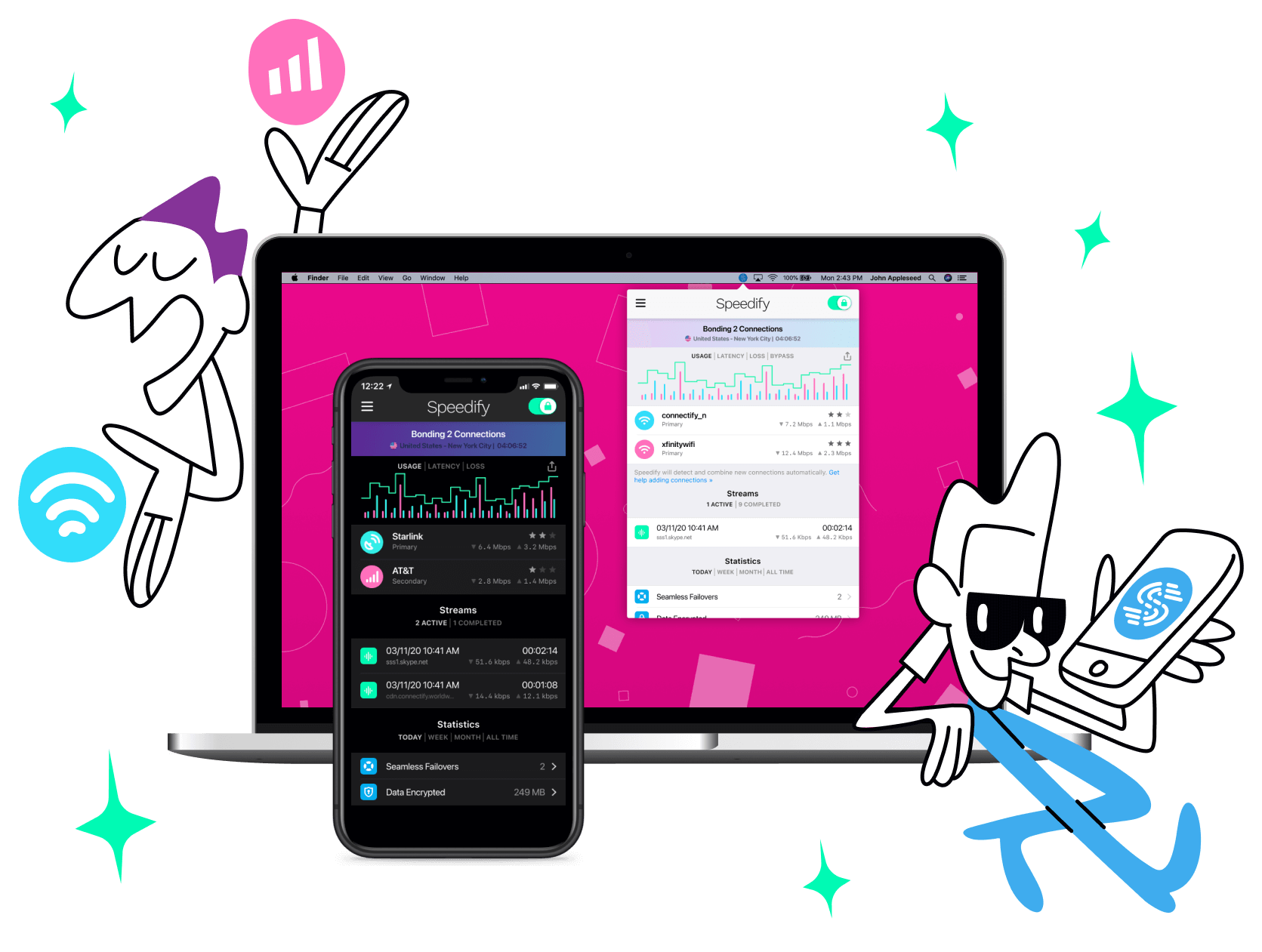
Get started today!
With Speedify you can combine multiple internet sources into one bonded super-connection to improve livestreaming, video calling, gaming, web browsing, and everything else you do online.
Speed
Stability
Security
We love talking about connectivity!
Alex and the Speedify team are always exploring the latest in networking and security technology—like 5G, 6G, WiFi 7, laser and satellite internet—and sharing it in new discussion content across YouTube, TikTok, Instagram, and LinkedIn every week.
Got a tech question? Let's go deeper! Pop into Speedify Office Hours live every Wednesday at 10 AM Eastern. Speedify CEO Alex Gizis and our network engineers are standing by to break down your questions about networks, tech updates, and Speedify features.