



Speedify Combines Starlink and 5G Home Internet Into One Faster, More Reliable Connection
This guide gives an honest comparison of Starlink and 5G home internet, then covers how Speedify combines the two into one connection so you stop living with the weak days of either.
Starlink disconnects all the time for ALL Starlink users. The Speedify Starlink Index report found that Starlink connections are down for an average of ~33 min per day. Plus, all Starlink dishes experience small drops and packet loss every 15 seconds, when the moving Starlink satellites hand off the connection to the next satellite overhead.
The best way to fix Starlink's connection drops is to combine your Starlink connection with another internet connection, such as 4G/5G cellular, cable, fiber, DSL, or another Starlink connection. Speedify makes this possible with channel bonding.
Most Starlink users already run a second connection.
From a sample of 6,228 Starlink users on Speedify, 71% ran at least one other internet connection while using Starlink. Cellular is the most common choice of backup connection.
What they pair with
Starlink vs 5G Home Internet: The Honest Comparison
- Coverage. Starlink works anywhere with open sky. 5G home internet needs a nearby tower with capacity to spare, which rules it out for many rural addresses.
- Latency. 5G is usually lower and steadier. Starlink averages well in 2026 but spikes during satellite handoffs.
- Cost. 5G home internet plans are often the cheaper monthly option. Starlink costs more and adds equipment.
- Reliability. Starlink dips with weather and obstructions. 5G dips with tower congestion and weak signal. Neither is reliable in the same conditions, which is exactly why they pair well.
Why Choosing One Means Living With Its Weak Days
A single connection comes with a single set of failure modes. Pick 5G and the evening it gets congested, the whole house slows down. Pick Starlink and the storm that rolls through takes the connection with it. There is no single connection that is strong in every condition, which is the real limit of the either-or question.
Bond Both Instead of Choosing
Speedify combines Starlink and 5G home internet into one bonded connection and splits traffic across both at the packet level. The low latency of 5G handles calls and games. The reach of Starlink adds bandwidth and keeps you online where the tower is weak. When 5G congests in the evening, Starlink picks up the slack. When weather hits Starlink, 5G carries the load. Neither weak day takes the house offline, and the same setup doubles as seamless backup internet when one line fails.
Who Benefits From Bonding Starlink and 5G
- Rural homes with marginal 5G. Where the tower is just barely in reach and Starlink fills the gaps.
- Remote workers. Anyone whose income depends on calls and uploads not dropping.
- Gamers. Players who want 5G latency with a backup that covers the spikes.
- Busy households. Homes where one connection runs out of capacity at peak hours.
Speedify and Starlink: Stop Choosing, Start Combining
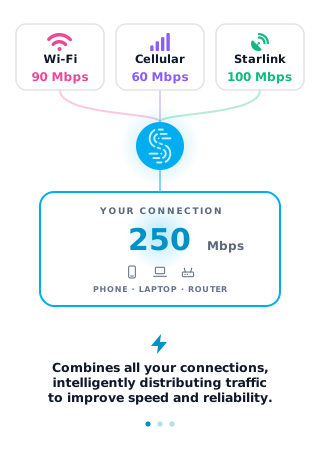
Starlink versus 5G assumes you only get one. Speedify combines Starlink with 4G/5G cellular, Wi-Fi, and wired Ethernet into a single connection that is faster, more reliable, and more secure than any one of them alone. The strengths of each connection cover the weak days of the other, and when one degrades, Speedify shifts traffic to the stronger link automatically. Running this for a business rather than a household? See Starlink vs 5G for business internet.
To see how it works, learn how Speedify’s channel bonding combines connections, or read whether a second internet connection is worth it.
Alex and the Speedify team are always exploring the latest in networking and security technology—like 5G, 6G, WiFi 7, laser and satellite internet—and sharing it in new discussion content across YouTube, TikTok, Instagram, and LinkedIn every week.
Got a tech question? Let's go deeper! Pop into Speedify Office Hours live every Wednesday at 10 AM Eastern. Speedify CEO Alex Gizis and our network engineers are standing by to break down your questions about networks, tech updates, and Speedify features.


Speedify
Get started with Speedify today.
Combine Wi-Fi, 4G/5G cellular, Ethernet, Starlink, and more into one faster, steadier connection. Free to try — no credit card required.
🚀 Speed
Faster uploads and downloads by bonding all your connections at once.
📶 Stability
Automatic failover in under a second when any connection drops.
🔒 Security
AES-256 encryption on every connection, on every network you join.




15M+ downloads worldwide. 75K+ five-star reviews on iOS and Android.