
Speedify Reduces Starlink Lag Spikes for Gaming by Using Starlink Together with 4G/5G Cellular, Wi-Fi or Ethernet
Yes, Starlink is good for most online gaming. Starlink says its latency, the delay gamers see as ping, is usually 25 to 60 milliseconds on land. That’s playable for Fortnite, Apex, Call of Duty and most online games. The problem isn’t the average ping. It’s the lag spikes.
Below: why Starlink lags in games, which games feel it most, what you can fix yourself, and how Speedify cuts the lag spikes by using Starlink together with a second internet connection, like 4G/5G cellular, Wi-Fi or a wired line.
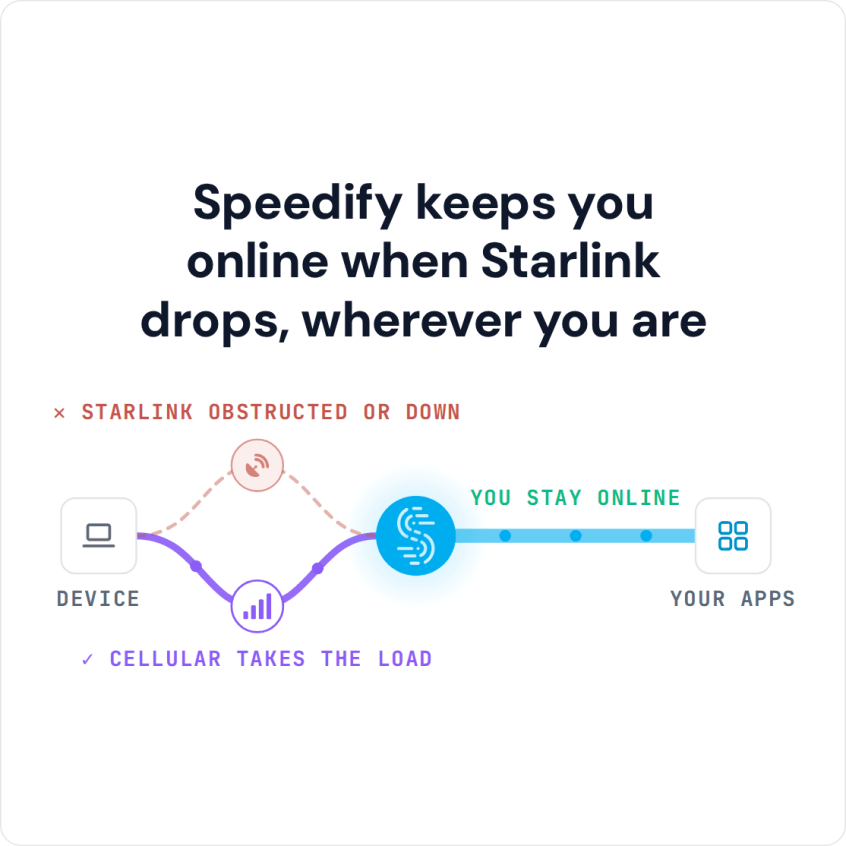
Speedify keeps you online when Starlink drops, wherever you are
Starlink Internet Connection Dropouts Happen to Everyone
Speedify measures thousands of Starlink users in more than 150 countries. From 29 September to 12 October 2026, fixed Starlink dishes went offline for about 37 minutes a day on average, and Starlink dishes on RVs and boats for about 61 minutes a day.
Starlink also switches each dish to a new satellite every 15 seconds, and a switch can cause a short dropout. Even a perfectly installed Starlink dish goes offline, and about 7 in 10 Starlink users on Speedify use Starlink together with a second internet connection, like 4G/5G cellular.
Why Starlink Lags During Online Games
- Satellite switches. Your Starlink dish switches satellites about every 15 seconds. Each switch can lose a little data, and in a fast game that shows up as a stutter.
- Jitter. Jitter means your ping jumping up and down. Even when your average ping looks fine, those jumps throw off your aim and timing.
- A busy Starlink network in the evening. Evening gaming lands right when the most people near you use Starlink, so your ping climbs and stays up.
- Obstructions and weather. Something partly blocking your Starlink dish’s view of the sky, or heavy rain, causes lost data that you feel as lag.
- Slow uploads. Starlink uploads are much slower than downloads, which hits voice chat and game streaming first.
Which Games Feel Starlink Lag the Most
Competitive shooters like Valorant and Counter-Strike feel every spike, because one short drop at the wrong moment loses the fight. Fighting games and rhythm games are just as unforgiving. Cloud gaming services like GeForce Now or Xbox Cloud Gaming, which stream the whole game to you as video, are the most sensitive of all. Casual games, turn-based games and most online role-playing games ride out the spikes without much trouble. If you game and live stream at the same time, Starlink’s slower uploads hurt as well. Video you watch is different: Netflix or YouTube plays from a buffer, which is why a stream survives a Starlink dropout and a game doesn’t.
Quick Fixes for Starlink Gaming Lag Before You Add a Second Internet Connection
Plug your console or PC into the Starlink router with an Ethernet cable instead of Wi-Fi, to cut the delay between your device and the Starlink router. If you use your own router, turn on its Quality of Service (QoS) setting to put game traffic first. Play outside busy evening hours when you can, clear anything the obstruction map in the Starlink app flags, and pause cloud backups and large downloads while you play.
These steps get you the best ping your Starlink internet connection can give. None of them remove the spike when your Starlink dish switches satellites, because that spike comes with using one satellite internet connection. To check your ping and work through each cause, see how to fix Starlink ping and lag spikes in games. Ping also differs a lot from one Starlink user to the next. Speedify measures thousands of Starlink internet connections: from 29 September to 12 October 2026, the typical Starlink user saw 85 ms end to end, one in four saw 45 ms or less, and one in ten saw more than 295 ms.
Cut Starlink Lag Spikes by Using Two Internet Connections, with Speedify
A lag spike hits one internet connection at a time. Speedify uses Starlink together with 4G/5G cellular, Wi-Fi or a wired line, and sends your game’s data over all of them at the same time. When Starlink loses data during a satellite switch, the other internet connection carries it, so your game usually doesn’t see the gap. A second Starlink dish can’t do this, because every Starlink dish switches satellites on the same 15-second schedule. For the games where every millisecond counts, Speedify can send the same data over two internet connections at once and use whichever arrives first, which cuts the spikes a single Starlink dish can’t avoid. Where 5G home internet is available, using Starlink together with 5G home internet covers those same spikes. Speedify needs that second internet connection: with Starlink alone, it can’t cover the spikes or lower your ping.
Get Speedify for Windows, macOS, iOS, Android or Linux. Game consoles can’t run the Speedify app, so for a PlayStation or Xbox, run Speedify on a router that works with Speedify and connect the console to that router.
To see why those gaps happen in the first place, read how Speedify handles the Starlink satellite switches every 15 seconds, then see how Speedify combines internet connections.
Speedify
Get started with Speedify today.
Speedify combines Wi-Fi, 4G/5G cellular, Ethernet, Starlink and satellite into one faster, more reliable internet connection. Free to try: 5 GB a month with a free account. No credit card required.
🚀 Speed
Faster uploads and downloads, because Speedify uses all your internet connections at once.
📶 Stability
If one internet connection drops, Speedify moves your traffic to the others in milliseconds.
🔒 Security
AES-256 encryption on every internet connection, on any network you join.


15M+ downloads worldwide. 75K+ five-star reviews on iOS and Android.