



Speed, Latency, Jitter, Packet Loss – the Elements that Define Connectivity
When you’re talking about an Internet connection and refer to it as “good” or “bad”, you generally mean how fast it is. Speed is the primary element we think of in the context of Internet connectivity. And there’s nothing wrong with that – usually the faster the connection, the better it is.
However, there are cases, especially in wireless networks (WiFi, cellular), where other elements influence the quality of the connection. These include latency (lag), jitter and packet loss. So, when you’re troubleshooting connection issues, you need to look at the whole picture so you know what to do without wasting unnecessary time. This article will explain the basics on each of those indicators and what to look for in each case. Plus a fast way to rate your Internet connectivity so you can go directly to the problem source. Like being your own IT person!
Should you have a backup 4G, 5G, Starlink, or cable internet connection?
Yes — every internet connection goes down, including Starlink, which drops for ~34 minutes a day on average. A backup connection from a different provider means one outage never takes you fully offline. The most common options are a 4G/5G cellular hotspot, a cable or DSL line, or a second satellite dish.
4G/5G cellular
Works anywhere. Just a SIM or hotspot — no installation needed.
Learn more →Cable / DSL
Best for fixed locations. Different network, so outages rarely overlap.
Learn more →Second Starlink
Adds redundancy and throughput for remote sites or heavy usage.
Learn more →Speedify bonds any two connections into one — automatic failover, more speed, no dropped calls.
Try Speedify free →Troubleshooting Connection Issues: Speed – the Source of It All
Everybody is talking about Internet speed. It’s the most common attribute for any connection. ISPs sell packages that promote maximum and guaranteed speeds. Clients like you and me are always interested in more bandwidth. Or at least the most we can afford.
Internet speed refers to how much data you can transfer to and from your devices every second. The more, the better. Do not confuse this with bandwidth, which is the maximum amount of data you can transfer through your connection. Speed varies a lot from one region to another and from one ISP to another. It is influenced by the other factors we’re going to talk about – latency, jitter and packet loss. When talking about countries stats, you can always check Speedtest’s Global Index.
Internet speed issues – symptoms:
- slow downloads / uploads
- buffering videos
- video calls that stutter
- websites / apps take forever to load or refresh
Speed connectivity issues – troubleshooting steps:
- Run a speed test on a wired connection or as close to the router as you can.
- Check the contract with your ISP – are the speeds you see close to what you’re supposed to get?
Solutions for Internet speed issues:
- Restart your device and the network equipment – modem, router – if possible.
- Use wired connections instead of Wi-Fi, as much as possible.
- Move closer to the Wi-Fi hotspot.
- Update router / modem firmware and your computer’s network adapter drivers.
- Using public Wi-Fi? It’s possible you’re stuck on a bad hotspot. Connect to another network.
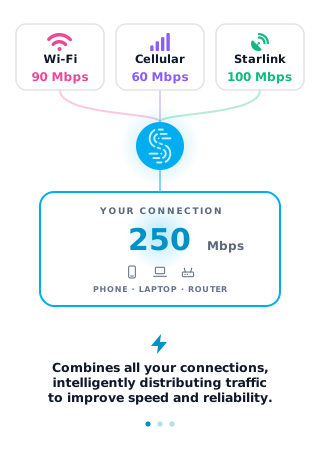
- Combine multiple connections at once using a channel bonding solution.
- Upgrade to a superior plan or change your ISP.
Troubleshooting Connection Issues: Latency (Lag) and Jitter – a Gamer’s Worst Enemies
Latency (or lag) refers to how much time it takes for data to travel to its destination and back. So, it’s a delay indicator measured in miliseconds. The lower, the better. Latency and bandwidth are the main components that influence Internet speed. Best case scenario: low latency, high bandwidth.
Jitter is the fluctuation of latency over time – the deviation from your average latency. It’s also measured in miliseconds, with lower being better. Think of jitter as lag spikes in gaming. It appears when network packets don’t arrive in the same order they were sent, so they’re queued up in a buffer.
Latency / jitter issues – symptoms:
- websites / apps take forever to load or refresh
- slow gaming
- latency spikes in games
- huge delays (with spikes, if jitter is high) between broadcaster and viewers in live streaming
- sync issues and freezing video calls
Troubleshooting latency and jitter issues:
- Measure your latency and jitter. Run a speed test that offers such data.
- Is the latency under 100ms as a general rule?
Solutions to minimize Internet latency (lag) and jitter:
- Restart your device and the network equipment
- Use wired connections instead of Wi-Fi or cellular, as much as possible
- Using satellite Internet? Try to switch to cable or DSL.
- Update router / modem firmware
- Connect to another Wi-Fi network
Packet Loss and How It Affects Internet Connectivity
Packet loss occurs when one or more network packets fail to reach their destination. It is measured as a percentage of packets lost vs. packets sent. You can read more details about the causes of packet loss.
Symptoms of packet loss:
- videos stuttering, buffering and even disconnecting
- unintelligible calls
- fragmented gaming experience
- dropped frames when live streaming
Troubleshooting packet loss:
- Depending on the symptoms, you might be able to get data from the apps / software you’re using to live stream, play games, etc.
- If you want to get a general idea on how lossy your connection is, check out this test.
How to fix packet loss:
- Restart your device and the network equipment.
- Use wired instead of wireless. Wi-Fi and cellular are more prone to packet loss because of their nature.
- Upgrade firmware for your modem / router.
- Eliminate any source of electromagnetic interference – other wireless devices, motors, etc.
- Set up your Wi-Fi network to a less crowded channel.
- Use 2 or more connections together at once.
Speedify Helps with Troubleshooting Connectivity Problems
As explained above, there are many factors that influence the quality of your Internet connectivity. And you have to spend quite some time to identify the issue in the first place. Unless you’re using Speedify, which can help both with troubleshooting and also become your solution to any of those issues.
Speedify is a fast bonding VPN that allows you to use all of your Internet connections at the same time, providing speed, stability and security. It allows you to keep track of how your Internet connections are performing and gain more understanding as to how Speedify uses them to intelligently provide better Internet:
- real-time graphs show you more details about the speed of each of your Internet connections.
- detailed connection information includes real-time data about latency, jitter and packet loss, as well as a MOS-typeconnection rating.
So, you have all the connectivity data in your pocket when running Speedify. And, best of all, Speedify also helps you avoid all these Internet connection issues by providing a fast, stable and secure Internet connection. But if something should go wrong and you notice one of the symptoms above, just open Speedify and check out the stats. You’ll know what to do!
Alex and the Speedify team are always exploring the latest in networking and security technology—like 5G, 6G, WiFi 7, laser and satellite internet—and sharing it in new discussion content across YouTube, TikTok, Instagram, and LinkedIn every week.
Got a tech question? Let's go deeper! Pop into Speedify Office Hours live every Wednesday at 10 AM Eastern. Speedify CEO Alex Gizis and our network engineers are standing by to break down your questions about networks, tech updates, and Speedify features.


Speedify
Get started with Speedify today.
Combine Wi-Fi, 4G/5G cellular, Ethernet, Starlink, and more into one faster, steadier connection. Free to try — no credit card required.
🚀 Speed
Faster uploads and downloads by bonding all your connections at once.
📶 Stability
Automatic failover in under a second when any connection drops.
🔒 Security
AES-256 encryption on every connection, on every network you join.




15M+ downloads worldwide. 75K+ five-star reviews on iOS and Android.