



Speedify Bonds Multiple Starlink Dishes into One Faster, More Reliable Connection When One Dish Isn’t Enough
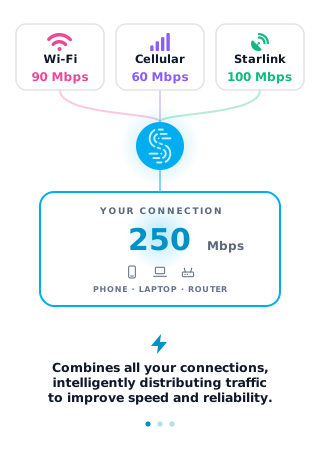
Speedify combines Wi-Fi, 4G/5G cellular, Ethernet, Starlink and satellite into a single bonded connection, including two or more Starlink dishes at once. This guide compares one dish against several, shows when the jump makes sense, and points out when a single Starlink dish is the right call.
Starlink disconnects all the time for ALL Starlink users. The Speedify Starlink Index report found that Starlink connections are down for an average of ~33 min per day. Plus, all Starlink dishes experience small drops and packet loss every 15 seconds, when the moving Starlink satellites hand off the connection to the next satellite overhead.
The best way to fix Starlink's connection drops is to combine your Starlink connection with another internet connection, such as 4G/5G cellular, cable, fiber, DSL, or another Starlink connection. Speedify makes this possible with channel bonding.
Most Starlink users already run a second connection.
From a sample of 6,228 Starlink users on Speedify, 71% ran at least one other internet connection while using Starlink. Cellular is the most common choice of backup connection.
What they pair with
One Starlink Dish vs. Multiple Starlinks with Speedify: Which Is Better
| One Starlink Dish | Multiple Dishes with Speedify | |
|---|---|---|
| Speed | Capped at one dish’s upload and download speed | Up to 95% of combined upload and download speeds |
| Satellite handoffs | Brief drops every 15 seconds or so | Covered by the second dish and other backup connections – 4G/5G cellular, Wi-Fi, wired Ethernet |
| Hardware failure | Offline until replaced | Automatic failover to the other dish |
| Upload stability | Single path, a drop ends the transfer | Two paths carry the upload together |
| Cost | One subscription | Two subscriptions plus Speedify |
How Speedify Makes Multiple Starlink Dishes Faster and More Reliable
On their own, two Starlink dishes still answer to the same 192.168.100.1 address, so a standard router uses one at a time. Speedify’s channel bonding technology talks to every dish in parallel and spreads traffic across them at the packet level. If one dish drops, Speedify’s automatic failover holds the connection on the others. To monitor and align several dishes from one place, Speedify includes a Starlink Control Center that shows each dish’s status and obstruction map side by side.
When Multiple Starlink Dishes Make Sense
The rural online gamer. A competitive gamer outside cable and fiber range lives on low latency and a connection that never blinks. A single Starlink handoff at the wrong second loses a match. Two Starlink dishes bonded with Speedify keep a steady path open so a drop on one dish doesn’t end the session.
The telehealth clinician. A clinician running remote appointments from a rural practice can’t have a call freeze mid-consult. Patient video and records demand a connection that stays up. Two Starlink dishes bonded with Speedify keep appointments running through handoffs and weather, with AES-256-GCM encryption protecting the session.
The maritime operator. A fishing vessel or yacht at sea has no fallback when its one dish loses lock in heavy swell or cloud. Two Starlink dishes pointed at different slices of sky, bonded with Speedify, give the vessel throughput and redundancy that a single dish at sea can’t match. For fleets pooling data across terminals, see Starlink data pooling for business.
When One Starlink Dish Is Enough
A second dish isn’t free, and plenty of setups don’t need one. If your work survives the occasional brief drop, or you’re a light user browsing and streaming one screen at a time, a single Starlink dish is the sensible choice. In areas with reliable cellular, one Starlink dish bonded with a 4G/5G cellular connection through Speedify often gives better redundancy than two dishes, because the two connections run on separate networks: a Starlink outage doesn’t touch the cellular link, and vice versa.
Multiple Starlink Dishes Are Worth It When the Connection Can’t Blink
The case for multiple Starlink dishes comes down to what an outage costs you. For a gamer between matches it’s an annoyance; for a clinician mid-appointment or a vessel offshore it’s a real problem. When that’s the stakes, two or more Starlink dishes bonded with Speedify turn a single fragile link into a connection that’s faster, more reliable, and more secure. When it isn’t, one dish does the job.
Alex and the Speedify team are always exploring the latest in networking and security technology—like 5G, 6G, WiFi 7, laser and satellite internet—and sharing it in new discussion content across YouTube, TikTok, Instagram, and LinkedIn every week.
Got a tech question? Let's go deeper! Pop into Speedify Office Hours live every Wednesday at 10 AM Eastern. Speedify CEO Alex Gizis and our network engineers are standing by to break down your questions about networks, tech updates, and Speedify features.


Speedify
Get started with Speedify today.
Combine Wi-Fi, 4G/5G cellular, Ethernet, Starlink, and more into one faster, steadier connection. Free to try — no credit card required.
🚀 Speed
Faster uploads and downloads by bonding all your connections at once.
📶 Stability
Automatic failover in under a second when any connection drops.
🔒 Security
AES-256 encryption on every connection, on every network you join.




15M+ downloads worldwide. 75K+ five-star reviews on iOS and Android.