



Speedify Increases Upload and Download Speed for Any Starlink Antenna by Bonding It with Another Internet Connection
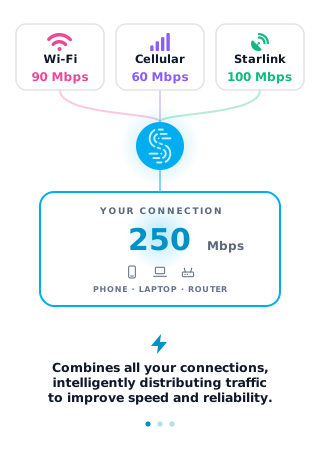
Speedify combines Wi-Fi, 4G/5G cellular, Ethernet, Starlink and satellite into a single bonded connection, including two Starlink antennas at once, for up to 95% of their combined throughput.
Starlink disconnects all the time for ALL Starlink users. The Speedify Starlink Index report found that Starlink connections are down for an average of ~33 min per day. Plus, all Starlink dishes experience small drops and packet loss every 15 seconds, when the moving Starlink satellites hand off the connection to the next satellite overhead.
The best way to fix Starlink's connection drops is to combine your Starlink connection with another internet connection, such as 4G/5G cellular, cable, fiber, DSL, or another Starlink connection. Speedify makes this possible with channel bonding.
Most Starlink users already run a second connection.
From a sample of 6,228 Starlink users on Speedify, 71% ran at least one other internet connection while using Starlink. Cellular is the most common choice of backup connection.
What they pair with
Starlink Antenna Types Compared
| Starlink Mini | Starlink Standard (Gen 3) | Starlink Performance (Gen 3) | |
|---|---|---|---|
| Best for | Travel and portable use | Home and full-time use | Business, maritime, and mobility |
| Router | Built-in Wi-Fi 5 | Separate Wi-Fi 6 router | No router included |
| Typical download | Around 50 to 150 Mbps | Tens to low hundreds of Mbps | Up to 400 Mbps |
| Obstruction handling | Smaller aperture, narrower view | 110° field of view | Widest view, best in marginal sky |
| Build | Backpack-sized, low power | Fixed install, manual aiming | Rugged, weather-resistant |
Real-world speeds vary by service plan, location, and network congestion, so the figures above are ranges rather than guarantees.
Why a Bigger Starlink Antenna Doesn’t Always Mean More Internet Upload and Download Speed
The Starlink Performance antenna has a larger aperture and handles obstructions better than the Starlink Standard or Starlink Mini. But side-by-side tests show the latest Performance hardware often delivers little real-world speed gain over earlier models, because your speed is capped by your Starlink service plan and how congested the network is in your area, not only by the antenna. Pay for a Performance kit expecting double the throughput and you may be disappointed.
A second connection is a more dependable way to add speed. Speedify’s channel bonding technology splits your traffic across two links at the packet level and uses both at once. Bond two Starlink antennas, or a Starlink antenna and a 4G/5G cellular connection, and Speedify combines their upload and download throughput instead of relying on one antenna to carry everything. If one link drops, Speedify’s automatic failover keeps you online on the other.
Which Setup Fits Which Starlink User
The rural household. A family choosing between a Standard antenna and paying extra for Performance often gets more out of keeping the Standard antenna and bonding it with cellular through Speedify, which adds a second network for both speed and backup.
The content creator. A creator who needs more upload than a single antenna delivers can bond two Starlink antennas with Speedify, so live streams and large file uploads run on combined upload throughput.
The maritime operator. A vessel weighing one Performance antenna against two antennas gets redundancy a single dish can’t offer by running two and bonding them with Speedify, so losing one antenna in heavy weather doesn’t mean losing the connection. For fleets sharing data across terminals, see Starlink data pooling for business.
How to Bond Two Starlink Antennas with Speedify
Install Speedify on your device or a Speedify-compatible router, connect both antennas so each appears as a separate connection, and set both to Always mode. Speedify starts distributing traffic across both Starlink antennas right away.
The Right Starlink Antenna Plus Speedify Beats a Pricier Antenna Alone
Pick the Starlink antenna that fits how you’ll use it: the Mini for travel, the Standard for a home or full-time setup, the Performance for demanding or offshore conditions. Then add the speed and reliability a single antenna can’t, by bonding a second internet connection with Speedify. Speedify makes your Starlink faster, more reliable, and more secure, whichever antenna you start with.
Alex and the Speedify team are always exploring the latest in networking and security technology—like 5G, 6G, WiFi 7, laser and satellite internet—and sharing it in new discussion content across YouTube, TikTok, Instagram, and LinkedIn every week.
Got a tech question? Let's go deeper! Pop into Speedify Office Hours live every Wednesday at 10 AM Eastern. Speedify CEO Alex Gizis and our network engineers are standing by to break down your questions about networks, tech updates, and Speedify features.


Speedify
Get started with Speedify today.
Combine Wi-Fi, 4G/5G cellular, Ethernet, Starlink, and more into one faster, steadier connection. Free to try — no credit card required.
🚀 Speed
Faster uploads and downloads by bonding all your connections at once.
📶 Stability
Automatic failover in under a second when any connection drops.
🔒 Security
AES-256 encryption on every connection, on every network you join.




15M+ downloads worldwide. 75K+ five-star reviews on iOS and Android.