



Do You Really Need to Bypass Captive Portal?
Remember those splash pages you get when connecting to a Wi-Fi network from the airport or your favorite cafe? Those are captive portals. They allow network administrators to block Internet access for users until they complete a defined process. You are usually required to accept some Terms and Conditions or log in before accessing the Internet.
Why would you want to bypass a captive portal like that? For one, they might require authentication which you might not have. We’re sorry, but this article is not about circumventing such restrictions. Rather, you will learn how to stay safe online while connecting to any network that runs a captive portal out there.
Should you have a backup 4G, 5G, Starlink, or cable internet connection?
Yes — every internet connection goes down, including Starlink, which drops for ~34 minutes a day on average. A backup connection from a different provider means one outage never takes you fully offline. The most common options are a 4G/5G cellular hotspot, a cable or DSL line, or a second satellite dish.
4G/5G cellular
Works anywhere. Just a SIM or hotspot — no installation needed.
Learn more →Cable / DSL
Best for fixed locations. Different network, so outages rarely overlap.
Learn more →Second Starlink
Adds redundancy and throughput for remote sites or heavy usage.
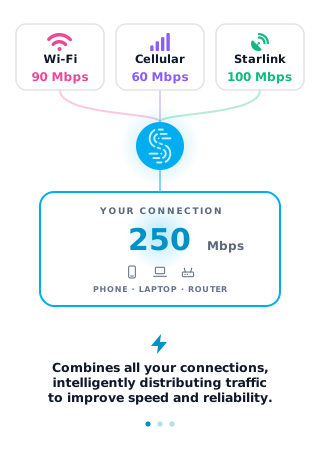
Learn more →Speedify bonds any two connections into one — automatic failover, more speed, no dropped calls.
Try Speedify free →Bypassing Captive Portals While Using a VPN
When you’re out and there’s a free Wi-Fi hotspot nearby, you can always connect to it. But, as you know, using public Wi-Fi can be a risky thing, especially if you’re doing business activities on it. When a public Wi-Fi uses a captive portal (a “login” page), the security risks you’re exposed to can be higher. That’s because captive portals don’t work seamlessly with VPNs. You always have to disconnect your VPN, access the Wi-Fi login page and then turn on your VPN again. Whenever the VPN is off while you’re connected to public Wi-Fi, you may be exposed to:
- Malware installation – a hacker can inject a code snippet in your device to infect it with malware. Criminals may want to intercept your data. Malware generators can install anything from a keylogger to ransomware in your device.
- Man-in-the-middle (MITM) attack – the hacker sits between the user and the server and reads everything that’s being transmitted. This is like eavesdropping where a third person can see all your activities without you knowing about their presence.
- Snooping / sniffing – again, a hacker can eavesdrop on your connection. However, it’s different than an MITM attack since the attacker doesn’t sit in the middle. Instead, they use special devices and software to snoop on the conversation.
- Malicious Wi-Fi networks – there are chances that a hacker might have hacked the Wi-Fi of your local café. There can also be instances that Wi-Fi is set up by a hacker. These honeypot Wi-Fi connections are generally named similar to local cafés or airports so unsuspecting customers will connect to them.
So, what can you do to be able to connect and use a network with a captive portal while running your VPN?
Bypassing Captive Portal Errors While Running a VPN
If you don’t use a VPN with public Wi-Fi networks, at least consider taking these steps to be less exposed:
- Don’t allow your device to auto-connect to open Wi-Fi networks.
- Don’t access http websites. Only access https websites as they are more secure.
- Log out of all account once you’re done using them.
Without any doubt, the best way to keep your information safe while accessing a public Wi-Fi is to use a VPN. A VPN encrypts your data so if there is someone monitoring the network, they won’t be able to read the information you’re sending. However, there are two problems with most VPNs:
- they need to be disconnected while accessing the captive portals (Wi-Fi login pages), otherwise those won’t work.
- most VPNs make the connection slower. And since public Wi-Fi networks are generally pretty slow, using a VPN with them becomes difficult.
Make Your Life Easier when Connecting Networks with Captive Portals: Use Speedify!
Speedify is the only VPN app that can help you combine multiple internet connections (Wi-Fi, 4G, 5G, Ethernet, Starlink, Satellite and more) to improve the stability, speed and security of your online experiences. Moreover, Speedify handles captive portals better than any other VPN:
- when it detects a captive portal, it automatically moves the traffic to and from the captive portal login page outside of the encrypted VPN tunnel
- once you successfully log onto the network, Speedify moves that direct traffic back to the VPN tunnel
- you can always use the split tunneling feature (Bypass) for specific services – this will put traffic to and from those outside of the bonded VPN tunnel.
When you join a WiFi hotspot with a captive portal, you don’t have to disconnect Speedify to leave you exposed or bypass the captive portal:
- Speedify will show you a notification asking you if you want to login.
- In the meantime, your other ongoing online activities (like Skype / Slack calls, streaming, gaming) will continue to work via the cellular connection, protected by Speedify
- If you click the notification (or the message in the app), Speedify will pop up the login screen in a window.
- After you login successfully, Speedify will immediately start using the WiFi connection.
Apart from the channel bonding services, Speedify also encrypts your data and redirects it through one of its speed servers so you stay secure and anonymous online.
Want to use a VPN on public Wi-Fi with captive portals, but need to be 100% protected against security risks and slow speeds? Get Speedify!
Alex and the Speedify team are always exploring the latest in networking and security technology—like 5G, 6G, WiFi 7, laser and satellite internet—and sharing it in new discussion content across YouTube, TikTok, Instagram, and LinkedIn every week.
Got a tech question? Let's go deeper! Pop into Speedify Office Hours live every Wednesday at 10 AM Eastern. Speedify CEO Alex Gizis and our network engineers are standing by to break down your questions about networks, tech updates, and Speedify features.


Speedify
Get started with Speedify today.
Combine Wi-Fi, 4G/5G cellular, Ethernet, Starlink, and more into one faster, steadier connection. Free to try — no credit card required.
🚀 Speed
Faster uploads and downloads by bonding all your connections at once.
📶 Stability
Automatic failover in under a second when any connection drops.
🔒 Security
AES-256 encryption on every connection, on every network you join.




15M+ downloads worldwide. 75K+ five-star reviews on iOS and Android.