

Making Worldwide Broadband a Reality
This post was written before SpaceX launched Starlink, and it predicted four hurdles for SpaceX internet: limited radio spectrum, high latency, speed and latency that change as satellites move, and the need for a clear view of the sky. Starlink cleared the first two hurdles: Starlink now says it delivers 45 to 280 Mbps download and 25 to 60 ms latency on land. The last two still cause short drops, because every Starlink dish switches satellites on a 15-second schedule and anything blocking its view interrupts the signal. Speedify, an app that combines Starlink with Wi-Fi, 4G/5G cellular or Ethernet, keeps you online through those drops.
Starlink Internet Connection Dropouts Happen to Everyone
Speedify measures thousands of Starlink users in more than 150 countries. From 29 September to 12 October 2026, fixed Starlink dishes went offline for about 37 minutes a day on average, and Starlink dishes on RVs and boats for about 61 minutes a day.
Starlink also switches each dish to a new satellite every 15 seconds, and a switch can cause a short dropout. Even a perfectly installed Starlink dish goes offline, and about 7 in 10 Starlink users on Speedify use Starlink together with a second internet connection, like 4G/5G cellular.
Starlink Index: what thousands of real Starlink connections measure
Sep 29 to Oct 12, 2026Daily downtime
46 min
3.2% of connected time, across all dishes
Median latency
55 ms
the worst 10% of users see 295 ms
Avg packet loss
0.19%
vs 0.07% on T‑Mobile
Avg jitter
1.2 ms
vs 6.8 ms on Verizon
What Starlink users pair with
Four Hurdles Predicted for SpaceX Satellite Internet Before Launch
Before launch, Elon Musk’s record with Tesla, SolarCity, and SpaceX showed he could deliver on big ideas, but details of the SpaceX satellite internet project were still thin. Based on what was known then, this post predicted four hurdles:
1. Limited Spectrum
SpaceX claims that they’re going to deliver fiber-like speeds via satellite. The truth is, there isn’t enough available space on the wireless frequency spectrum for that to be possible. Pretty much all of the “good” bands have already been bought by big telecom companies or government interests. So, there’s simply no giant set of frequencies available, fast enough to deliver 100 megabit Internet all over the world. Even 20 Mbps in the real world would be an impressive result.
2. High Latency
Even if they do manage to offer decent throughput, latency will be bad. Signals need to be sent into space and back. Depending on the implementation, the signal might even need to bounce between satellites before coming back down to Earth. A 100 ms ping would be a surprise; 250 ms (quarter-second) averages are more likely. That kind of latency can make even a fast Internet connection feel slow. Farther out, the delay gets much worse: see how the internet could work on Mars.
3. Speed and Latency That Change as Satellites Move
The satellites are moving over your head, and signal strengths will get better and worse as they zip by. On top of that, there will be finite bandwidth. As the number of users on the satellite network goes up, your connection speed will inevitably go down.
4. A Clear View of the Sky
Tiny satellites simply don’t have the power to transmit through buildings. From the sounds of it, the SpaceX satellite Internet won’t work when you’re inside a coffee shop. Antennas should be fixed to roofs where they can see a lot of sky, and are more likely to have line-of-sight to a satellite.
How Speedify Handles a Changing Satellite Internet Connection
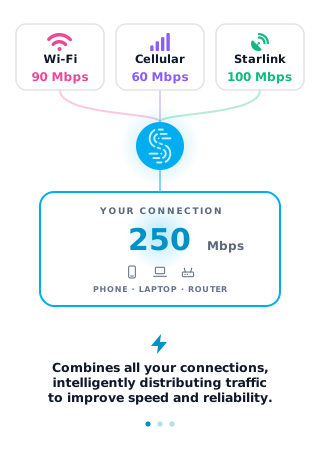
Latency, changing speeds and a blocked view of the sky all make a satellite internet connection less predictable, and Starlink has since passed 10 million users who deal with that every day. Speedify adjusts to changes in latency and lost packets as they happen. With a second internet connection, Speedify makes a Starlink internet connection faster and more reliable. With Starlink alone, Speedify can’t add speed.
Even a slow DSL or cellular connection is worth adding to Starlink. Speedify combines Starlink with DSL, 4G/5G cellular, Wi-Fi or Ethernet into one faster, more reliable internet connection, and checks how well each one is working at every moment. When Starlink is strong, more traffic goes over Starlink. When Starlink latency rises or its speed drops, Speedify sends more traffic over the other internet connection.
Speedify
Get started with Speedify today.
Speedify combines Wi-Fi, 4G/5G cellular, Ethernet, Starlink and satellite into one faster, more reliable internet connection. Free to try: 5 GB a month with a free account. No credit card required.
🚀 Speed
Faster uploads and downloads, because Speedify uses all your internet connections at once.
📶 Stability
If one internet connection drops, Speedify moves your traffic to the others in milliseconds.
🔒 Security
AES-256 encryption on every internet connection, on any network you join.


15M+ downloads worldwide. 75K+ five-star reviews on iOS and Android.