


Is Go still the right choice for backend development in 2025 or has its concurrency model become a performance liability? Alex and Brian from Speedify break down the real-world engineering tradeoffs between Go, Rust, Node.js, and C++. They dive into Golang’s goroutines, mutex locking, race conditions, and synchronization overhead, explaining how these issues surfaced at scale inside Speedify’s infrastructure. Using Docker as a case study, they describe how container startup times ballooned from ~80 ms to over a second as Go-based components accumulated locking, cleanup inconsistencies, and goroutine leaks.
Go started at Google with Ken Thompson and Rob Pike. Golang quickly became popular for microservices and cloud-native tooling, powering Docker, Traefik, Caddy, but thousands of goroutines touching shared state can create unpredictable performance under load. Alex and Brian outline Speedify’s backend stack: Node.js/TypeScript for server-side apps, high-performance C++ daemons for packet processing, and Rust modules for memory-safe dataflow.
Should you have a backup 4G, 5G, Starlink, or cable internet connection?
Yes — every internet connection goes down, including Starlink, which drops for ~34 minutes a day on average. A backup connection from a different provider means one outage never takes you fully offline. The most common options are a 4G/5G cellular hotspot, a cable or DSL line, or a second satellite dish.
4G/5G cellular
Works anywhere. Just a SIM or hotspot — no installation needed.
Learn more →Cable / DSL
Best for fixed locations. Different network, so outages rarely overlap.
Learn more →Second Starlink
Adds redundancy and throughput for remote sites or heavy usage.
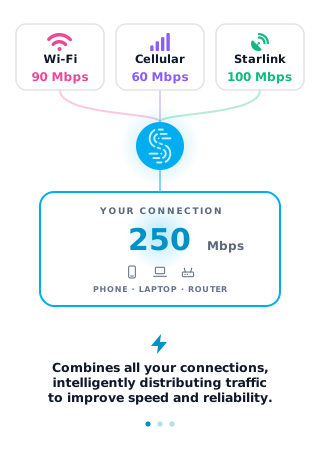
Learn more →Speedify bonds any two connections into one — automatic failover, more speed, no dropped calls.
Try Speedify free →Alex and the Speedify team are always exploring the latest in networking and security technology—like 5G, 6G, WiFi 7, laser and satellite internet—and sharing it in new discussion content across YouTube, TikTok, Instagram, and LinkedIn every week.
Got a tech question? Let's go deeper! Pop into Speedify Office Hours live every Wednesday at 10 AM Eastern. Speedify CEO Alex Gizis and our network engineers are standing by to break down your questions about networks, tech updates, and Speedify features.

Speedify
Get started with Speedify today.
Combine Wi-Fi, 4G/5G cellular, Ethernet, Starlink, and more into one faster, steadier connection. Free to try — no credit card required.
🚀 Speed
Faster uploads and downloads by bonding all your connections at once.
📶 Stability
Automatic failover in under a second when any connection drops.
🔒 Security
AES-256 encryption on every connection, on every network you join.


15M+ downloads worldwide. 75K+ five-star reviews on iOS and Android.