
A VPN wraps your traffic in encryption, scrambling it so nobody along the way can read it, and pushes it through a single tunnel. One internet connection, one point of failure: when the Wi-Fi wobbles, that tunnel breaks and your real location is briefly exposed.
Speedify runs the same kind of encrypted tunnel over your Wi-Fi and a phone’s 4G/5G cellular data at once, so the tunnel holds when one internet connection falters. Read on for why encryption alone is not enough, and how using Speedify keeps your browsing private and quick even when one internet connection fails.
Speedify protects your privacy without slowing you down
Why Online Privacy Needs More Than Just Encryption
Most people turn to VPNs for one simple reason: to keep their internet activity private. A VPN encrypts your data and routes it through secure servers, shielding it from:
- Internet Service Providers (ISPs) who track your browsing to sell data or throttle speeds
- Hackers on unsecured public Wi-Fi networks
- Advertisers building detailed behavioral profiles through trackers
- Government surveillance and mass data collection
While these are important protections, traditional VPNs fall short in one crucial area — reliability under pressure.
If you’ve ever used a VPN on a spotty connection, you know the frustration. One second you’re protected. The next, your Wi-Fi flickers or your mobile signal weakens, and your VPN tunnel breaks. Your connection drops. Your IP leaks. Your privacy vanishes.
The Problem with Most VPNs: Fragile Tunnels
Traditional VPNs are built on single-channel connections. That means they rely entirely on a single internet source, like Wi-Fi or cellular, to maintain the encrypted tunnel. When that source falters, so does your protection.
This is where Speedify flips the script.
Introducing Speedify: A VPN That Doesn’t Break
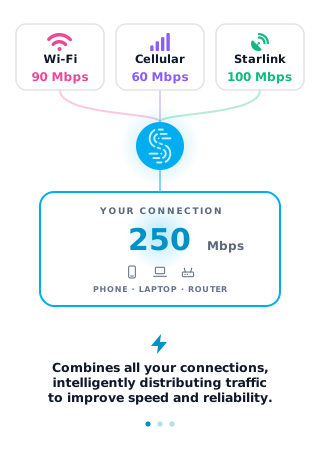
Speedify is the only VPN built on channel bonding, a technology that combines multiple internet connections (Wi-Fi, 4G/5G, Ethernet, etc.) into a single, stronger, and more reliable connection.
More importantly, Speedify’s tunnel stays open even when one of those connections fails. That means:
- No IP leaks during connection drops
- No interruptions in data encryption
- No need to manually reconnect your VPN
In other words, your privacy stays intact, even when your internet doesn’t.

This makes Speedify an ideal choice for:
- Remote workers who depend on Zoom, Teams, or Slack
- Travelers jumping between hotel Wi-Fi and mobile data
- Journalists and activists who need unbreakable privacy in hostile environments
Everyday users who just want to know their data is safe. Always.
Don’t Settle for Half Privacy. Use Speedify for Unbreakable VPN Tunnels
If your VPN tunnel can break at any moment, how private are you really?
Speedify redefines what a VPN should be. It’s secure, fast, and above all, unbreakable. For anyone serious about online privacy — whether you’re working from a café, streaming on the go, or just browsing at home — Speedify gives you the peace of mind that your VPN is doing its job, even when your internet isn’t.
Speedify is committed to keeping your information truly private:
- No logs policy: Speedify doesn’t record what you do online. Period.
- Advanced encryption: Uses ChaCha or AES encryption based on your hardware for speed and security.
- Anonymity-friendly design: You don’t need to provide sensitive information to use the service.
But where most VPNs emphasize anonymity, Speedify adds something rare in the VPN space: resilience.
Speedify
Get started with Speedify today.
Combine Wi-Fi, 4G/5G cellular, Ethernet, Starlink, and more into one faster, steadier connection. Free to try — no credit card required.
🚀 Speed
Faster uploads and downloads by bonding all your connections at once.
📶 Stability
Automatic failover in under a second when any connection drops.
🔒 Security
AES-256 encryption on every connection, on every network you join.


15M+ downloads worldwide. 75K+ five-star reviews on iOS and Android.