
Get Stable Internet with a Raspberry Pi Bonded LTE Wi-Fi Hotspot
One cell tower carries your whole YouTube Live broadcast when you stream from a single modem, and the moment that tower gets busy the stream stutters. A better answer is to build your own hotspot – a small box that shares internet with your camera over Wi-Fi – and feed it more than one internet connection.
Speedify is software that runs on a Raspberry Pi and uses several cellular data links and Wi-Fi together, spreading the upload so no single link can break the stream. Step by step, this article shows the parts list and the build, ending with a hotspot that keeps your YouTube Live feed on air.
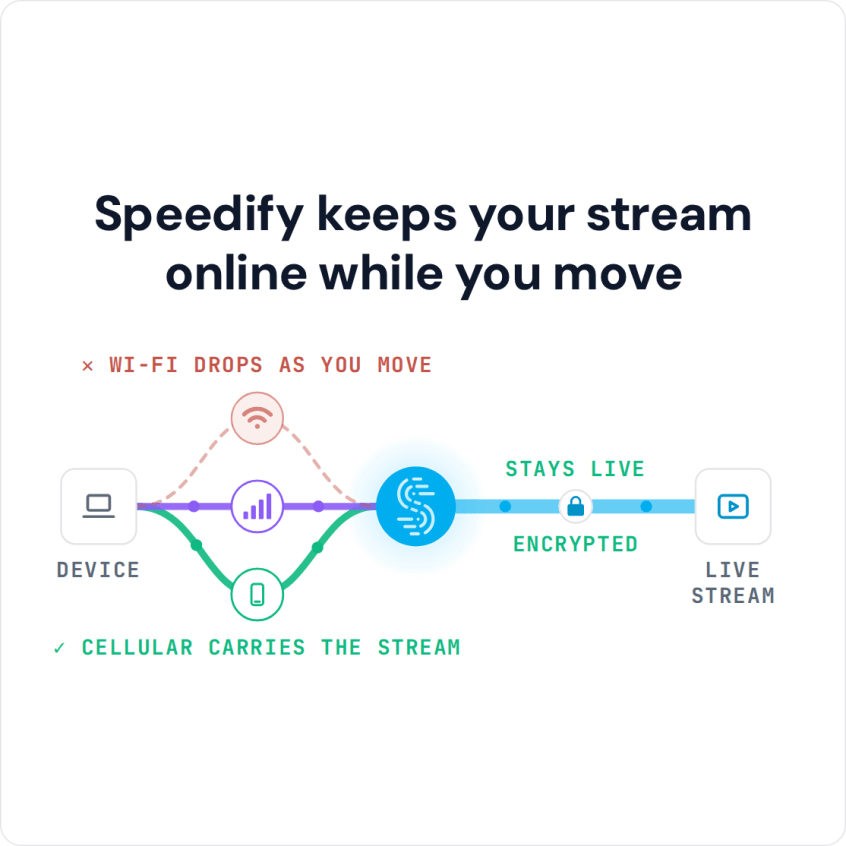
Speedify keeps your stream online while you move
Issues with IRL Streaming on YouTube Live
Many will argue that IRL live streaming on YouTube can be done with just your smartphone. You could use cellular data or your smartphone as a Wi-Fi hotspot for your Go-Pro or video camera. This is true in some cases, but not in all of them.
Cellular coverage is not homogenous or ubiquitous, especially when you’re at the outskirts of a city, or in an area that’s prone to poor mobile signal, like an underground passage or inside a building. That’s why it’s important to get your Internet from at least 2 different cellular carriers. This way, if one’s network fails, you can use the other.
But there’s one more thing: suppose you have 2 Internet sources with you. What will you do when one of them fails? Stop the YouTube IRL stream, setup the other connection and then resume it? That’s a big no! You need a channel bonding service that can combine BOTH sources into one solid and stable connection. Speedify bonding VPN is the answer to the question of how to IRL stream on YouTube without issues. You can bond connections from 2 smartphones on a Raspberry Pi, for example, and get uninterrupted connectivity!
What You Need for Your Raspberry Pi Powered Bonded LTE Wi-Fi Hotspot
To get uninterrupted IRL streaming on YouTube Live, we used the following parts:
- Raspberry Pi 4
- Smartphones that you will tether to the Pi via USB
- Portable USB-C battery pack – to power the Raspberry Pi and, if needed, the smartphones you’ll use for connection bonding
- Smartphone or other WiFi-enabled camera to record – Go-Pro, etc.
- Backpack to carry the devices
How to Get Stable Internet for Your LiveIRL Stream on YouTube
We will turn the Raspberry Pi into a bonding Wi-Fi router. Here’s what you have to do:
- Setup the Raspberry Pi by installing Speedify.
- Ready to IRL stream on YouTube Live? Plug the Raspberry Pi into the battery pack.
- Connect as many smartphones or cellular adapters as you can to the Pi and enable tethering. Make sure you leave the Pi’s internal Wi-Fi card not connected so you can use it as a connection sharing interface.
- Start the Wi-Fi hotspot – turn on Speedify and enable sharing.
To share over a Wi-Fi hotspot, select wlan0 as the sharing interface. Set a custom SSID and password for your hotspot and restart Speedify to apply the changes. If you’re using Speedify on the Pi graphically, you should see the connections show up as connection bubbles on the Speedify dashboard. - Connect your YouTube Live video streaming device to the Wi-Fi hotspot.
If you’re using a smartphone as your YouTube streaming device, you can also run Speedify on it. This way, you’ll combine the bonded connection from the Raspberry Pi via Wi-Fi with your cellular connection!
Use the YouTube app to customize your live streaming settings. While connected to the hotspot, you should be able to IRL stream in HD on the go, without worrying about weak signal.
Speedify
Get started with Speedify today.
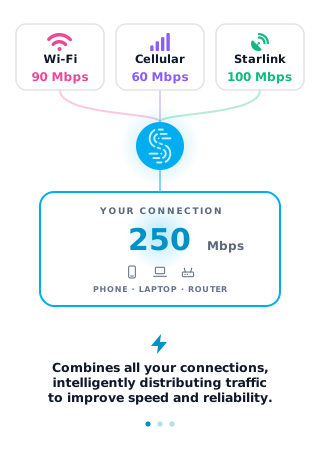
Combine Wi-Fi, 4G/5G cellular, Ethernet, Starlink, and more into one faster, steadier connection. Free to try — no credit card required.
🚀 Speed
Faster uploads and downloads by bonding all your connections at once.
📶 Stability
Automatic failover in under a second when any connection drops.
🔒 Security
AES-256 encryption on every connection, on every network you join.

15M+ downloads worldwide. 75K+ five-star reviews on iOS and Android.