

Which Server CPU Is Right for You?
Use Speedify to Increase Your Upload and Download Speeds: Combine Wi-Fi, 4G / 5G Cellular, Ethernet, Starlink and Other Satellites

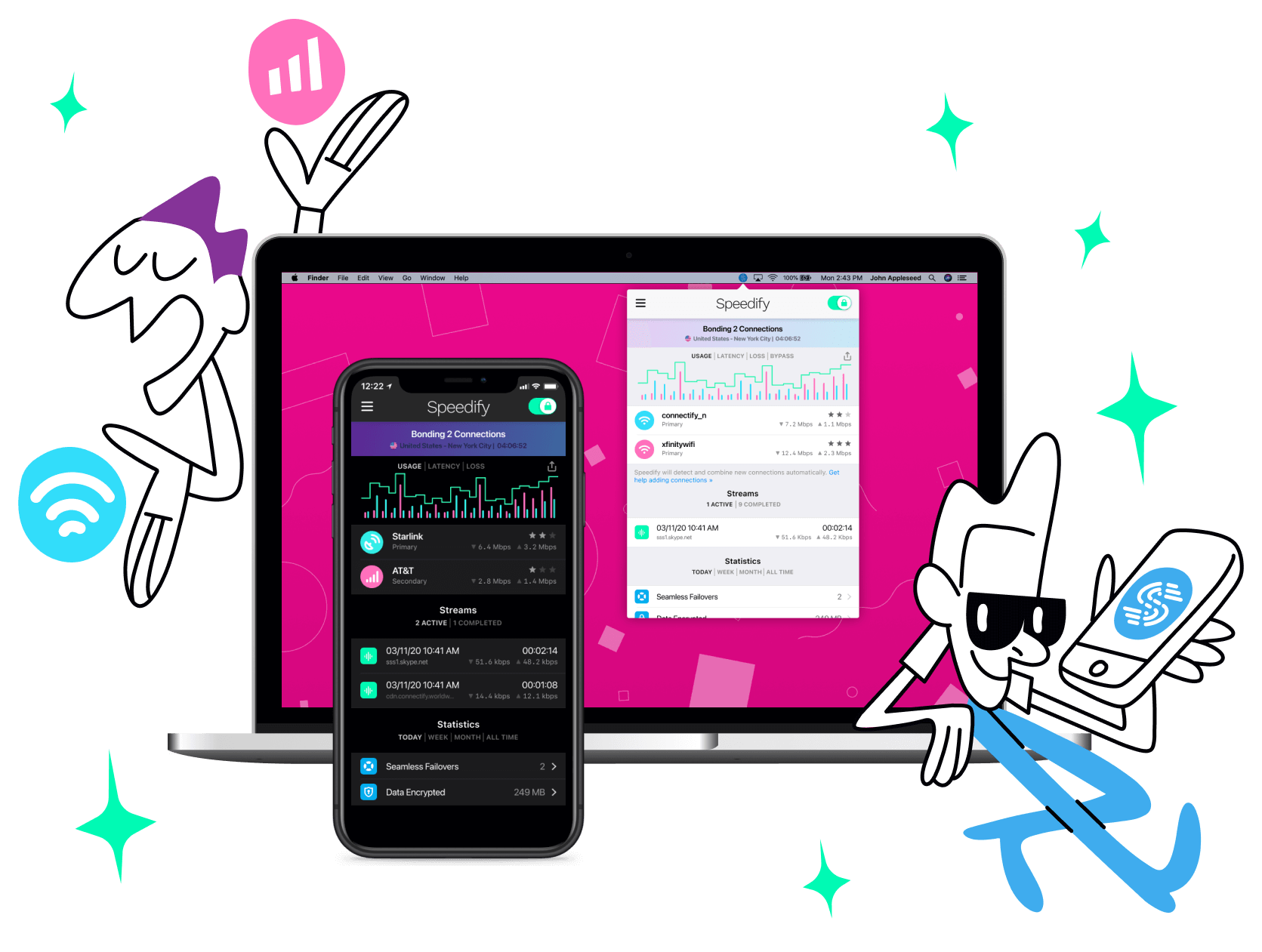
Speedify combines Wi-Fi, 4G / 5G cellular, Ethernet, Starlink, and other satellites for faster internet uploads and downloads
Speedify is the only software app that combines Wi-Fi, 4G / 5G cellular, Ethernet, Starlink and other satellites at once for secure, faster, and more reliable internet uploads and downloads so you stay online without interruptions.
Speedify will automatically detect and start using any available Internet connections on your device while intelligently distributing your online traffic between them for optimal performance. If you need help we have quick start guides available for most common set ups.

Speedify combines multiple personal hotspots for faster internet upload and download speeds
Speedify's Pair & Share feature enables you to connect to multiple hotspots at the same time for faster upload and download speeds and more reliable internet for everyone. Speedify's Pair & Share feature allows you to wirelessly share 4G / 5G cellular connections back and forth between multiple Speedify users on the same local network when live streaming from an event, calling from the commute or sharing from the field.
Speedify is the only app that allows you to share 4G / 5G cellular data between PCs, Macs, iPhones and Androids. Use multiple iPhones and Android phones as hotspots for internet access and get faster upload and download speeds and mobile failover for all paired devices.
Use Speedify to combine...
Combine these connections on:


The Gold Standard: Intel Xeon
Alex Gizis: Brian, I know you are currently managing a couple thousand servers in the cloud. So, what is the deal with Intel versus AMD versus these new ARM servers I've been hearing about? How do you pick which one to use?
Brian Prodoehl: So yeah, there's a lot of options as far as server CPUs. So, we End up running mostly on Intel Gold and AMD Epyc.
Alex Gizis: What is Intel Gold?
Brian Prodoehl: So Intel Xeon Gold is a line of their newer Xeon CPUs from Intel. They're really nice and really fast and really expensive.
Rising Star: AMD's EPYC Processors
Alex Gizis: And what about these AMD Epycs?
Brian Prodoehl: Similar, they're sort of comparable, I think. Price performance ratio is a little bit better on the AMD side, but they're both really fantastic.
Alex Gizis: So why do I hear so much about, you know, AMD beating Intel? What's going on there?
Brian Prodoehl: So AMD is getting a lot of market share and they're doing really well. I think the price performance ratio they're hitting is really good. They're able to iterate nicely and Intel is struggling a bit. They're in a tough time right now.
Alex Gizis: Yeah, I was reading that Qualcomm rejected their latest batch of chips. Did you see this?
Brian Prodoehl: Yeah, they're in a tough spot. And I think what they're trying to do with their contract manufacturer to compete with TSMC. It's not doing so well. Intel's not going to go away anytime soon, but they sort of lost their spot as a kind of the market leader and driving where things are going.
Market Shift: ARM-Based Server CPUs Take Center Stage
Alex Gizis: So what about ARM? I mean, you hear people talk a lot about ARM on the server, but I'm not sure I've seen much of it.
Brian Prodoehl: Right. So price performance ratio on ARM is typically really, really nice. And for somebody like Amazon, who's running thousands and thousands and thousands of servers, getting the same performance per watt is huge, and that's what's pushing them to do really cool things, like the Graviton line from Amazon, really nice performance per watt.
Alex Gizis: So when you say performance per watt, I think, am I right that what's implied there is that it's actually a little bit slower than the Intel and the AMD machines. I mean, it uses much less power, right?
Brian Prodoehl: Yes. So if you have a database server, you know, the amount of work that one core can do. It's probably going to be lower on ARM, especially than these Intel, you know, Xeon Gold or AMD Epic CPUs. But you can get 64 cores of ARM. And if you have something that you can parallelize really well, you can hit sort of the same multi core performance with way less power outputs, way less watts per chip.
Alex Gizis: So why do the Intel and the AMD get higher performance on a single core? What's different about their architecture?
Brian Prodoehl: So they can be bigger, they can have a lot more transistors. And so they can do things like, you know, all this pre fetching and sort of look ahead stuff, where they can kind of be, no matter what sort of flow it's going to take, they can be executing stuff way ahead, and they just can throw transistors at making performance way higher.
And they can also dial up the speed and get, you know, upwards of 4 GHz or something, where And ARM chip might be sitting at 2 GHz.
Alex Gizis: So for Speedify, are you using any of these ARM servers?
Brian Prodoehl: We are not using any ARM servers on our production fleet for Speedify stuff.
Alex Gizis: Why not? I heard they have great performance per watt.
Brian Prodoehl: They do have great performance per watt. So for us, if we're running really the same set of applications across a bunch of hosts, it's easy for us to spread that across AMD and Intel because they're all essentially the same. They're all x86, same architecture, same instruction set. That's easy. Same binaries you just drop on every single computer.
To throw ARM in the mix, we would need to then build and run the same sort of software on ARM, and it's just a little bit of a headache. It's not insurmountable, but I think it's more of a headache than it would be worth for us. But there are a lot of times where running one piece of that on ARM might be really handy if somebody wants to, for instance, run part of our back end on a really nice ARM router.
What Server CPUs Does Speedify Use for Dedicated Servers?
Alex Gizis: So with Speedify, you can get dedicated servers. Can people choose which kind of processor they want for that? Can they say, I want an ARM, I want AMD? How does that work?
Brian Prodoehl: So the dedicated server is a really nice option where people get their own server that only they or their family or team can connect to. And so it's really dedicated memory, dedicated CPU. It's Dedicated IP address. It's their own. Speed server in the cloud that only they have access to. And so for those, we use the same Intel or AMD that we use on the rest of our production fleet. If somebody really has a preference, they can ask, but we don't support them yet.
Alex Gizis: Okay. And how do you pick between Intel or AMD?
Brian Prodoehl: It really varies by location and data center. So in a lot of locations, we'll have maybe two or three data centers in a big city. So sometimes one of those is Intel and one of those is AMD. Some providers just have a ton of options across. And so we'll just kind of take our pick and go with the best price performance ratio that we find there.

Connectivity Tech Discussions
Our Connectivity Tech Discussions Between Two Palms video series shines the spotlight on Alex and technical guests, diving deep into caonversations about the latest Internet technology, including Starlink satellite, WiFi 7, Apple, fiber optics, new routers, remote connectivity, and networking protocols.
Join us and let's talk tech!