

Why Your Internet Cuts Out on Video Calls, and How to Stop It
Zoom, Teams, or Google Meet, video calls cut out for the same reason on all of them: a momentary gap in a single connection. Speedify closes those gaps by bonding two internet connections, so a brief drop on one never ends your call.
A video call freezes for two seconds, the audio garbles, and then the whole meeting kicks a participant out entirely, right in the middle of a sentence that mattered. The usual suspect is packet loss, small gaps where data never arrives, which video conferencing software tolerates poorly compared to something forgiving like email or a webpage load.
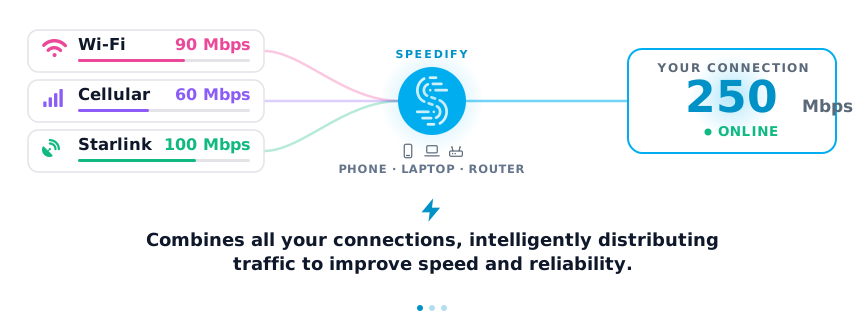
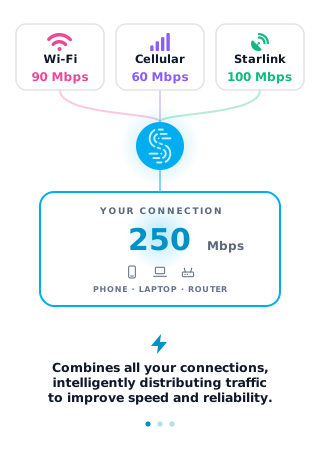
Speedify stops that pattern by bonding a primary internet connection, like Wi-Fi, with a second one, like a 4G/5G cellular connection, so a brief packet loss event or a momentary Wi-Fi handoff never has the chance to take the whole call down. That bonding runs on Speedify’s channel bonding technology, which uses up to 95% of the combined capacity of both connections rather than treating the second one as a rarely used spare.
With Speedify, your internet stays on when one connection fails.
When one of your connections drops, Speedify automatically routes your traffic to your remaining connections — so calls don't cut out and downloads don't stall.
How do I use WiFi and 4G/5G cellular at the same time with Speedify?
Pick your two internet connections and your device below and we'll take you to the step-by-step setup guide.


What actually drops a call: Wi-Fi handoffs, packet loss, and ISP micro-outages
- Wi-Fi handoffs. A laptop moving between access points, or a router briefly reassigning channels, creates a short gap that a call cannot always absorb.
- Packet loss. Congested networks drop small percentages of packets constantly, and video calls are far more sensitive to that loss than a typical file download.
- ISP micro-outages. Short outages lasting a few seconds rarely show up on a status page, but they are long enough to disconnect a live call.
Why rebooting the router doesn’t fix mid-call drops
Rebooting a router resets a connection that has become unstable over hours or days, but it does nothing for the packet loss or micro-outage happening in the exact minute of a call. A reboot also takes the connection fully offline for a minute or more, which guarantees a dropped call rather than preventing one. The actual fix is having a second connection ready to carry traffic the instant the first one falters, which is the problem reliable internet while working from anywhere is built around solving.
How Speedify keeps Zoom, Teams, and Meet connected with seamless internet failover
Speedify monitors both bonded connections continuously during a call and fails over in under a second when one degrades, well before a video conferencing app notices anything is wrong. Zoom, Microsoft Teams, and Google Meet all react badly to sudden drops, but Speedify shields them from ever seeing one by keeping the underlying transport intact even as the specific connections carrying it change.
Adding a 4G/5G cellular backup so calls never drop
The simplest upgrade for a home office is pairing existing Wi-Fi with a phone’s cellular hotspot or a dedicated cellular modem. Speedify bonds that cellular connection in alongside Wi-Fi, so a home ISP outage or a neighborhood-wide slowdown does not end a call, it just shifts more traffic to cellular for as long as needed. That pairing covers the two most common home internet failure modes, a Wi-Fi router issue and an ISP-side outage, with a single backup connection.
Settings for call quality, and a checklist before your next meeting
Speedify’s redundant mode sends identical, time-sensitive traffic across both connections simultaneously rather than splitting it, which trades some bandwidth efficiency for maximum protection against loss, a worthwhile swap for an important call.
Speedify’s Streaming Mode handles the more common case, prioritizing video and audio packets over background downloads so a call stays smooth without needing full redundant mode. Before an important meeting, a short checklist keeps surprises out of it:
- Download Speedify and connect both a Wi-Fi and a cellular connection.
- Confirm Speedify shows both connections active and bonded.
- Switch to redundant mode for high-stakes calls, or leave Streaming Mode on for routine ones.
- Join the call a few minutes early to confirm audio and video look stable.
One honest limit applies here: bonding needs at least two working connections to protect a call, and Speedify cannot fail over to a connection that does not exist. A single-connection household still needs to add that second link, even something as simple as a phone’s hotspot, before failover has anything to fail over to.
Video Call Drops: FAQ
Why do video calls specifically suffer from packet loss more than other apps?
Speedify addresses this sensitivity by bonding connections so a lost packet on one path gets covered by the other, keeping real-time audio and video intact.
Does Speedify work with Zoom, Teams, and Google Meet?
Speedify runs underneath any video conferencing application, bonding and protecting the connection those apps use without requiring app-specific configuration.
What is redundant mode and when should it be used?
Speedify’s redundant mode duplicates traffic across both bonded connections at once, best reserved for calls where a drop would be especially costly.
Can a phone’s hotspot serve as the backup internet connection?
Speedify bonds a phone’s cellular hotspot alongside home Wi-Fi, turning an ordinary phone into a reliable failover path for video calls.
Speedify
Get started with Speedify today.
Combine Wi-Fi, 4G/5G cellular, Ethernet, Starlink, and more into one faster, steadier connection. Free to try — no credit card required.
🚀 Speed
Faster uploads and downloads by bonding all your connections at once.
📶 Stability
Automatic failover in under a second when any connection drops.
🔒 Security
AES-256 encryption on every connection, on every network you join.


15M+ downloads worldwide. 75K+ five-star reviews on iOS and Android.