
Why Packet Loss Occurs and What to Do About it
What causes packet loss is usually one of three things: a network carrying more traffic than it can handle, aging routers or damaged cables that mangle data on the way through, or a bug in networking software that throws data away. Packet loss is data you sent or expected that never arrives, and it is why calls freeze, video turns blocky and games jump. Speedify is an app that sends your internet traffic over Wi-Fi, wired Ethernet and 4G/5G cellular at the same time, so data lost on one internet connection still arrives on another. That needs two or more internet connections: on a single connection, Speedify works as an encrypted VPN and cannot fix a fault in that connection. Each cause is explained below in plain words, along with what Speedify does about packet loss.
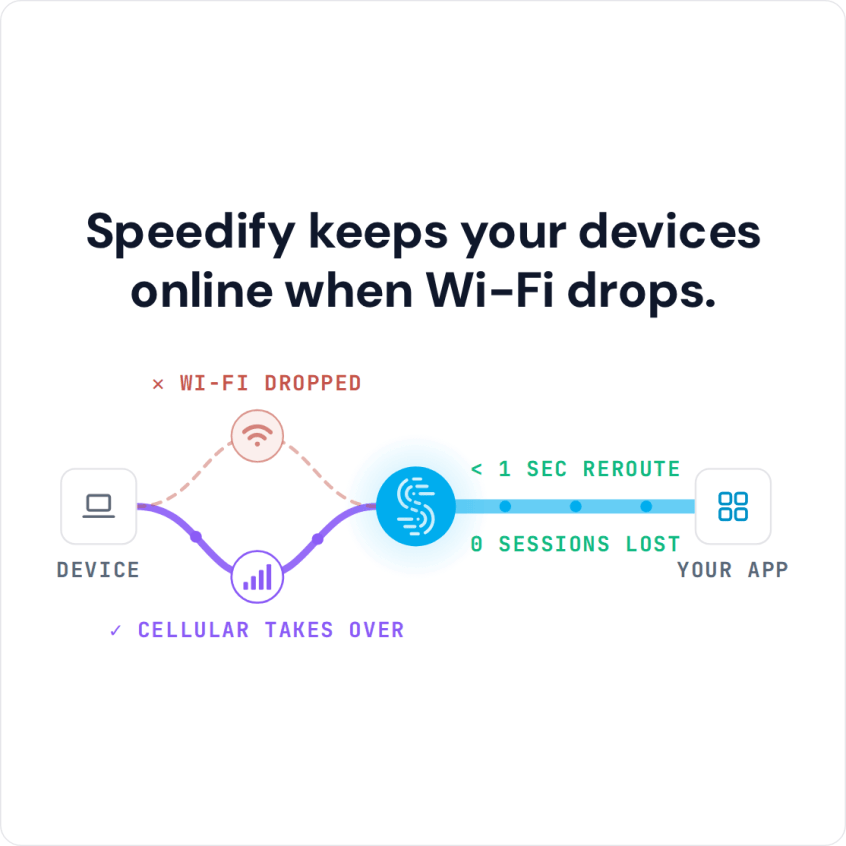
Speedify keeps your devices online when Wi-Fi drops.
What Packet Loss Is and Why Calls and Games Suffer
Packets are the small units of data your devices send and receive on the internet. Packet loss happens when one or more of these packets never reach their destination. For you, that means slowdowns, interruptions or a connection that stops working altogether.
Real-time audio, video calls and online games handle packet loss worst, because there is no time to wait for missing data.
On a WhatsApp, Zoom or other internet (VoIP) call over a lossy connection, there is no time to resend missing packets, because the conversation happens in real time. As packet loss rises, you hear distortion and audio dropouts, and the call can end. On a video call, packet loss turns the picture blocky and the sound garbled or muted. Packet loss has devastating effects on online video gaming too: lag spikes and rubber-banding that make a game close to unplayable.
What Causes Packet Loss: Congestion, Hardware, Software and Weak Wi-Fi
Network Congestion
When you send or receive information across the internet, your data travels through multiple computers and connections on the way to you or to its final destination. If any of these connections along the way are at maximum capacity when your packets arrive, then they must wait their turn before being passed on to the next step. But, if one of these computers or connections falls very far behind, it won’t have enough room in its memory to hold onto your packets and will ignore or discard them so it can catch up. This level of network congestion is the most common cause of packet loss.
Faulty or Outdated Networking Hardware
It’s possible that with age your router, firewall, or any network switches simply can’t keep up with the demand you’re placing on it. This is especially true the faster your Internet connection becomes.
The end result is that any traffic that exceeds the capacity of the device will result in packet loss as you’ve hit the maximum throughput your hardware can provide.
Software Bugs
Developers work hard to ensure their code is well-tested, but nonetheless software bugs persist often leading to unintended and unexpected behaviors. Sometimes rebooting your devices, or updating firmware and networking drivers is all it takes to resolve issues with packet loss.
Weak Wi-Fi Signal and Interference
Wi-Fi loses packets when the signal is weak or crowded. Distance from the router, walls and floors, and neighboring networks on the same channel all cause lost packets that a wired Ethernet connection would not see. Moving closer to the router, switching to the 5 GHz band or plugging in an Ethernet cable are the quickest checks.
How Speedify Reduces Packet Loss, Including Upload Packet Loss
Whatever the cause, Speedify detects lost packets on every internet connection it uses and resends them before the internet protocol notices, and it adds forward error correction so some missing data can be rebuilt without a resend. With two or more internet connections, such as Wi-Fi plus 4G/5G cellular or Ethernet plus a phone, Speedify sends lost packets over another connection, so a fault on one connection does not freeze your call or game. On a single internet connection, Speedify works as an encrypted VPN: it still resends lost packets, but it cannot repair a faulty connection; with two connections in Redundant Mode, your ping follows whichever connection is faster at that moment.
Upload packet loss is the kind people notice on calls and live streams: data you send never reaches the other end, so your voice breaks up for everyone else while you hear them fine. With Wi-Fi and Ethernet, or Wi-Fi and 4G/5G cellular, connected at once, Speedify sends your upload traffic across both, so loss on one connection does not cut you off.
Learn more about how to fix packet loss with Speedify
Speedify
Get started with Speedify today.
Speedify combines Wi-Fi, 4G/5G cellular, Ethernet, Starlink and satellite into one faster, more reliable internet connection. Free to try: 5 GB a month with a free account. No credit card required.
🚀 Speed
Faster uploads and downloads, because Speedify uses all your internet connections at once.
📶 Stability
If one internet connection drops, Speedify moves your traffic to the others in milliseconds.
🔒 Security
AES-256 encryption on every internet connection, on any network you join.



15M+ downloads worldwide. 75K+ five-star reviews on iOS and Android.