Reading the Starlink Connectivity Card in Speedify’s Starlink Control Center

The Starlink Connectivity Card in Speedify Shows How Each Dish Holds Up Over Time

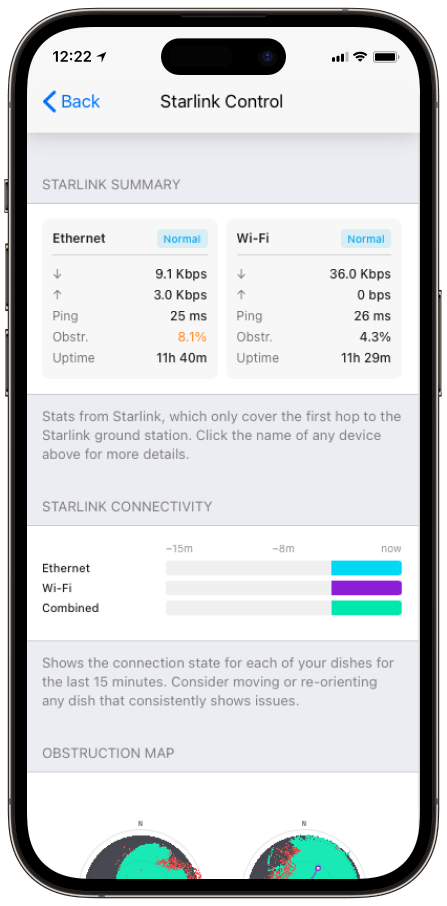
A single throughput reading only tells you about this second. The Starlink Connectivity card in Speedify’s Starlink Control Center plots a rolling 15-minute timeline for every connected dish, so you can see whether a dish drops out in a steady pattern or holds a clean connection.

This article explains how to read the Connectivity card, what the Combined row tells you, and how Speedify uses the timeline to keep you online.

Quick answer

Should you get a backup connection for Starlink?

Yes. Starlink goes down every day — an always-on dish averages about 34 minutes of downtime daily from routine satellite handoffs. A second connection keeps you online when Starlink drops.

What’s the best backup connection for Starlink?

A 4G/5G cellular hotspot or SIM is the most practical backup for most Starlink users — it works anywhere Starlink works, requires no installation, and uses a different network so outages rarely overlap. Cable or DSL broadband is a strong option if you have it at a fixed location. A second Starlink dish is also possible if you need maximum throughput.

How do you use two internet connections at once with Starlink?

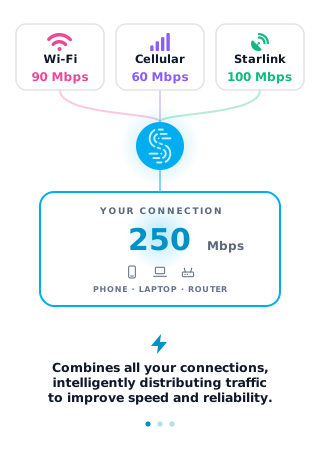
Speedify combines Starlink with any other connection — cellular, cable, Wi-Fi, or a second dish — into one bonded connection. Speedify runs on your phone, laptop, or router. When Starlink drops, Speedify moves your traffic to the backup instantly, so calls don’t cut out and downloads don’t stall. Speedify is free to try.

71% of Speedify’s Starlink users already run a second connection. The data below shows why.

Try Speedify free →

Speedify Starlink Index — real-world performance from 6,209 Starlink users: 2.4% downtime, about 34 minutes a day for always-on connections

Speedify Starlink Index
May 28 – Jun 10, 2026 · 14-day window

Starlink goes down every day.
Here’s what that actually looks like.

Speedify passively monitors every connection it bonds. These figures come from 6,209 Starlink users over 14 days — compared in real time against the other connections on the same devices. No speed tests, no lab conditions.

Median latency

60 ms

p90 spikes to 257 ms

Avg packet loss

0.17%

vs 0.08% on T-Mobile

Jitter measures how much latency varies moment to moment — high jitter causes choppy calls and frozen video even when average latency looks fine.
Starlink28.1 ms
Comcast22.4 ms
T-Mobile15.9 ms
Verizon14.9 ms
AT&T11.3 ms
71%
of users

71% ran at least one other connection simultaneously — 4,381 of 6,209 users. Cellular is the most common backup.

Cellular 51% Cable / DSL 38% Corporate 11%
6,209 users · 144 countries · 1.26M records · passive measurement, aggregates only Full dataset →

Use Speedify to stay online during satellite handoffs every 15 seconds

Research confirms Starlink switches between satellites every 15 seconds on a fixed schedule.  Each satellite handoff is a potential dropout, and on a congested network or with any obstruction, those Starlink dropouts become real interruptions.

Speedify fixes Starlink connection drops by combining your Starlink internet connection with another satellite dish, Wi-Fi, 4G/5G cellular, or wired Ethernet at the same time. When Starlink drops, Speedify keeps your traffic moving on the backup internet connection instantly. 

ImageImage
ImageImage

Speedify alerts you about your Starlink dish status

Speedify software alerts you about your Starlink dish status as soon as your dish experiences an issue - e.g. when your actuator motor is stuck, the mast is not vertical or there's a thermal throttle. 

Speedify's Starlink Control Center helps you monitor all your Starlink dishes, read obstruction maps, and align multiple dishes all in the Speedify app. Get a real-time view of each dish's health and optimize the position of each Starlink dish, so you get the best possible performance out of your Starlink connections. 

Speedify

Speedify gives you faster, steadier internet by combining Wi-Fi, cellular, and Starlink

Speedify bonds Wi-Fi, 4G/5G cellular, Ethernet, and Starlink into one connection at the same time, giving you more speed, automatic failover when one drops, and AES-256 encryption on every link.

Download Speedify ›

More speed

Upload and download speeds combine across every active connection on your device.

🔄

Automatic failover

If a connection drops, Speedify moves your traffic to another in milliseconds. Calls stay connected.

🔒

Always encrypted

Every link runs through an encrypted tunnel, including public Wi-Fi, cellular, and Starlink.

Speedify Feature · Pair & Share

Speedify Pair & Share: share cellular between your devices, both ways

Most hotspots give. Speedify's Pair & Share gives and takes. Two devices running Speedify pair up and each uses the other's cellular connection simultaneously, so you both get faster uploads, faster downloads, and a steadier connection. No extra hardware, no new data plans, no setup beyond a tap.

Learn how Speedify's Pair & Share works ›

More speed

Every device you pair with adds its cellular to yours, and yours to theirs.

📱

Stays connected

If a paired device drops out, Speedify keeps you online on the remaining links.

🔒

Always private

Every shared connection runs through AES-256 encryption. Your traffic is yours.

🎉

No new gear

Runs on devices already running Speedify, over your local network. Pair once, reconnects automatically.

How do I use Wi-Fi and 4G/5G cellular at the same time with Speedify?

Pick your two internet connections and your device below and we'll take you to the step-by-step setup guide.

I want to combine

Use the selectors below to find the setup guide for your exact combination of connections.

Or view articles for

Get started with Speedify today

Free to try on every device. No credit card required.

15M+ downloads worldwide · 75K+ five-star reviews · 500TB+ bonded per week

What Speedify’s Starlink Connectivity Card Shows

  • One row per dish. Each row is a single Starlink dish, with color showing its connection state across the last 15 minutes.
  • A Combined row. The bottom row shows whether your dishes fill in each other’s gaps or drop out together.
  • Pattern over time. A dish that flickers on a regular interval points to a recurring satellite handoff or a fixed obstruction, not a one-off.

Why the Combined Row Is the One to Watch in Speedify’s Starlink Control Center

If the Combined row shows frequent yellow or gaps even when each individual dish looks healthy, your dishes are likely pointed at the same slice of sky and hitting the same obstructions at the same moments. That defeats the point of running more than one.

The fix is to re-aim one dish so the two cover different sky, which Starlink’s guidance on running multiple dishes with a clear field of view backs up: each antenna needs roughly 20° elevation clearance across a full 360° azimuth. Speedify’s Dish Orientation card and Alignment Wizard handle the re-aiming.

How Speedify Uses the Timeline

The Connectivity card is the visible side of what Speedify is already doing underneath. Speedify’s channel bonding technology measures latency, packet loss, and throughput on every connection continuously, and moves traffic off a degrading dish before it fully drops.

Because Speedify works at the packet level, a gap on one row in the timeline doesn’t have to mean a gap in your video call. If you want to track drops over a longer window, see how to monitor Starlink outages and uptime with Speedify.

Who Benefits from Speedify’s Starlink Connectivity Card

  • Multi-dish operators. The Combined row is the fastest way to tell whether two dishes are genuinely redundant or just duplicating each other.
  • Live streamers and remote workers. A repeating drop pattern on the timeline explains stutters that a speed test would miss.
  • Anyone repositioning a dish. The timeline shows within minutes whether a move actually reduced dropouts.

Speedify and Starlink: From Timeline to Uninterrupted Connection

The Connectivity card shows where each Starlink dish struggles. Speedify’s channel bonding technology spreads your traffic so those struggles stay off your screen, and the Combined row tells you when it’s time to re-aim. For the full dashboard walkthrough, see how to use Speedify’s Starlink Control Center.

Image

Get started with Speedify today!

With Speedify you can combine Wi-Fi, 4G / 5G cellular, Ethernet, Starlink and other satellites into one bonded super-connection to improve livestreaming, video calling, gaming, web browsing, and everything else you do online.

Download Speedify
Download Speedify on the Apple App StoreGet Speedify on the Google Play Store

Speed

Get faster uploads and downloads for everything you do online.

Stability

Avoid buffering and disconnects while streaming, gaming, and browsing.

Security

Keep your personal data safe from hackers, snoops and cyber criminals

Speedify engineers love talking tech on YouTube, Tiktok, and Instagram!

Alex Gizis and the Speedify engineers discuss and explain technology including Starlink satellites, Wi-Fi 7 routers, Apple networking features, fiber optics, broadband internet, 5G mobile networks, AI, networking protocols, and much more. Follow Speedify on YouTube, TikTok, Instagram, and LinkedIn!

Alex and the Speedify team are always exploring the latest in networking and security technology—like 5G, 6G, WiFi 7, laser and satellite internet—and sharing it in new discussion content across YouTube, TikTok, Instagram, and LinkedIn every week.

Got a tech question? Let's go deeper! Pop into Speedify Office Hours live every Wednesday at 10 AM Eastern. Speedify CEO Alex Gizis and our network engineers are standing by to break down your questions about networks, tech updates, and Speedify features.

Image