

Starlink Standard and Mini Dishes Combined for Faster, More Reliable Internet
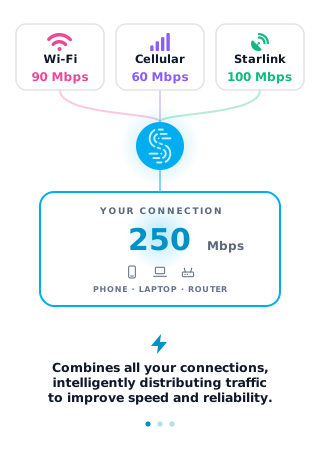
Yes, you can use Starlink and Starlink Mini together, and Speedify makes them work as one faster internet connection. Speedify uses your main Starlink dish and your Starlink Mini at the same time, so you get close to the download and upload speed of both combined, and you stay online when one of them drops.
Starlink Mini is Starlink’s small, portable Starlink dish. On its own, a second Starlink dish only gives you a second, separate internet connection, and your devices still use one at a time. Below: why a Starlink Mini makes a good second Starlink dish, how to add it to your Starlink account, and how to use both at once.
Speedify combines multiple Starlink dishes for failover and faster uploads and downloads
Starlink Internet Connection Drops Happen to Everyone
Speedify measures thousands of Starlink users in more than 140 countries. In September 2026, fixed Starlink dishes went offline for about 38 minutes a day on average, and Starlink dishes on RVs and boats for about 46 minutes a day.
All Starlink dishes also see short dropouts roughly every 15 seconds as the Starlink internet connection switches from one moving satellite to the next. Even a perfectly installed Starlink dish goes offline, and about 7 in 10 Starlink users on Speedify use Starlink together with a second internet connection, like 4G/5G cellular.
Why Use Your Starlink Dish Together with a Starlink Mini
Starlink says its service gets downloads of 45 to 280 Mbps and uploads of 10 to 30 Mbps. Uploads are the weak point on every Starlink dish, and they’re what video calls, live streams and cloud backups depend on. Your main Starlink dish may also slow down in the evening, or drop for a moment when it switches satellites or when rain moves in.
Used together with Speedify, a Starlink Mini adds its download and upload speed to your main Starlink dish, and it keeps you online when your main Starlink dish drops. That matters most for video calls, work in cloud apps and streaming, where every interruption costs you.
Why Your Main Starlink Dish Slows Down or Drops
A busy Starlink network. When many people near you use Starlink at the same time, usually in the evening, everyone’s speed drops.
Something blocking the view of the sky. Trees, buildings or snow on your Starlink dish cause short, repeated drops.
Weather. Heavy rain and storms weaken the satellite signal for a while.
Satellite switches. Your Starlink dish switches satellites about every 15 seconds, and each switch can cause a short drop.
Heat. A Starlink dish works normally below 50 C (122 F) outside air. In hotter weather it can slow down.
Where you live. In some areas, fewer satellites pass overhead, so speeds are lower and the delay is longer.
You can’t fix most of these by changing settings on your Starlink dish, and a second Starlink dish doesn’t stop them either: busy evenings, weather and satellite switches hit both. What a Starlink Mini used together with your main Starlink dish does is add its speed to yours, and keep you online when something blocks or breaks your main Starlink dish.
How to Add a Starlink Mini to Your Starlink Account
Starlink lets you have more than one Starlink dish on the same account.
To order another Starlink dish, log in to your Starlink account, open the “Subscriptions” tab and click “Add Subscription” in the top right, or open the “Shop” tab and select “Order another Starlink”. Each Starlink dish needs its own subscription, and you manage all of them from one Starlink account.
The Starlink Mini works well as a second Starlink dish because it uses less power than a standard Starlink dish and is easy to move. Since it’s small, you can put it wherever it sees the most open sky, without the mounting work a larger Starlink dish needs.
How Speedify Uses Starlink and Starlink Mini at the Same Time
Speedify is an app that uses all your internet connections at the same time, including two or more Starlink dishes. When one internet connection has a problem, Speedify moves your traffic to the other one, without interrupting what you’re doing.
Speedify measures your main Starlink dish and your Starlink Mini all the time and sends more of your traffic over whichever one is doing better at that moment. When both are doing well, you get close to the speed of both combined. When one drops, the other keeps you online.
Both Starlink dishes use the same Starlink network, so an outage of the whole Starlink network still takes both down. For that, add a different kind of internet connection, like 4G/5G cellular, Wi-Fi or DSL. Speedify uses them together with your Starlink dishes in exactly the same way.
What to Plan for When You Use Starlink and Starlink Mini Together
Power and placement. The Starlink Mini uses less power than a standard Starlink dish, so running both doesn’t double your power use. Put it in a different spot from your main Starlink dish, so a tree or roofline that blocks one doesn’t block both.
Data use. If one of your Starlink plans has a data allowance, like Roam 100GB, Speedify lets you set a data limit for each internet connection, so you don’t go over.
Which Starlink dish does what. In Speedify, set both Starlink internet connections to Always to use them at the same time. If you’d rather keep the Starlink Mini as a spare, set it to Backup: Speedify then uses it only when your main Starlink dish drops.
Connecting both. Connect each Starlink router to your computer or router separately, for example one with an Ethernet cable and one over Wi-Fi. Speedify takes care of splitting your traffic between them.
Speedify
Get started with Speedify today.
Combine Wi-Fi, 4G/5G cellular, Ethernet, Starlink, and more into one faster, steadier connection. Free to try — no credit card required.
🚀 Speed
Faster uploads and downloads by bonding all your connections at once.
📶 Stability
Automatic failover in under a second when any connection drops.
🔒 Security
AES-256 encryption on every connection, on every network you join.


15M+ downloads worldwide. 75K+ five-star reviews on iOS and Android.