

Setting Up Multiple Starlink Dishes for Better Internet
Yes, you can have 2 or more Starlink dishes on one Starlink account. You either add a new subscription in your Starlink account, or activate a Starlink kit you already own. On Residential and Roam plans, each Starlink dish needs its own subscription.
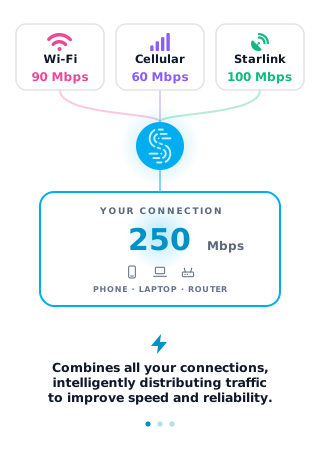
A second Starlink dish on its own doesn’t make your internet faster. To use both Starlink internet connections at the same time, for more speed and fewer drops, you need an app that combines them, like Speedify.
Speedify combines multiple Starlink dishes for failover and faster uploads and downloads
Starlink Internet Connection Drops Happen to Everyone
Speedify measures thousands of Starlink users in more than 140 countries. In September 2026, fixed Starlink dishes went offline for about 38 minutes a day on average, and Starlink dishes on RVs and boats for about 46 minutes a day.
All Starlink dishes also see short dropouts roughly every 15 seconds as the Starlink internet connection switches from one moving satellite to the next. Even a perfectly installed Starlink dish goes offline, and about 7 in 10 Starlink users on Speedify use Starlink together with a second internet connection, like 4G/5G cellular.
How to Add a Second Starlink Dish to Your Account
You can add more Starlink subscriptions to your account in one of two ways.
Method 1: Order a Second Starlink Dish Through Your Starlink Account
- Log in to your Starlink account at starlink.com
- Open the “Subscriptions” tab
- Click “Add Subscription” in the top right corner
- Pick your plan and complete the purchase
Method 2: Activate a Starlink Kit You Already Own
If you already have a second Starlink kit, you only need to activate it. Activating it doesn’t cancel or change your current Starlink subscriptions.
- Go to starlink.com/activate
- Select “Existing Account” during setup
- Follow the steps to activate your second Starlink dish
- The new Starlink dish is added to your current account
Why Add a Second Starlink Dish to Your Account
The main reason to use two Starlink dishes together is faster, more reliable internet, instead of internet that slows down and keeps disconnecting.
Most Starlink problems come from things you can’t fix at home:
A busy Starlink network: in the evening, many people near you use the same satellites, so everyone’s speed drops, whatever you try.
The top speed of one Starlink dish: moving the Starlink dish or restarting it can’t push it past its own top speed.
Weather: rain and snow weaken the satellite signal at every Starlink dish nearby. A second Starlink dish won’t stop that, but the two together still give you more speed than one.
Moving the Starlink dish, checking cables and restarting fix small problems, but they can’t add speed the Starlink network doesn’t have.


Using two Starlink dishes at the same time with Speedify gets you:
More speed: your internet traffic uses both Starlink dishes at once, so downloads and uploads can use the speed of both. Upload speed, the weak point of a single Starlink dish, gains the most.
Fewer drops: if something blocks one Starlink dish, or it has a problem, the other keeps you online. Both use the same Starlink network, so a Starlink outage in your area still affects both.
Two views of the sky: two Starlink dishes in slightly different spots see the sky differently, so at least one usually has a clear view.
How to Use Two Starlink Dishes at the Same Time with Speedify
Having two Starlink dishes doesn’t combine them automatically. You need an app that combines internet connections. Speedify is the only app that combines all of your internet connections, including two Starlink internet connections, to keep you online when it matters most:
Both Starlink dishes at once: Speedify sends your internet traffic over both Starlink dishes at the same time, based on how each one performs at that moment.
No setup: Speedify finds both Starlink internet connections and starts combining them on its own.
Automatic switching: when one Starlink dish starts to struggle, Speedify moves your traffic to the other one, without dropping your calls or downloads.
Encryption: Speedify encrypts all your internet traffic across both Starlink dishes.
To see the status of both Starlink dishes side by side, see how to manage two Starlink dishes at once with Speedify.
What a Second Starlink Dish Costs
The Starlink kit: each extra Starlink dish is a full Starlink kit purchase. Check starlink.com for the price in your country.
A second subscription: each Starlink dish needs its own monthly plan, so you pay a second monthly Starlink bill. To weigh that cost, see whether a second Starlink is worth it.

Power: a second Starlink dish uses more electricity, which matters if you are off the grid.
A second mounting spot: each Starlink dish needs its own spot with a clear view of the sky.
Who Gets the Most from Two Starlink Dishes
People who work from home and lose money when the internet drops.
Video creators and streamers, who get the upload speed of both Starlink dishes.
Busy households with several people working, studying and streaming at the same time in the evening.
Get Started with Your Second Starlink Dish
Once the second Starlink dish is on your account, download Speedify on your computers and phones to start using both Starlink dishes together.
To cover your whole home with both Starlink dishes, use a router that runs Speedify, like the Miri X510.
Speedify
Get started with Speedify today.
Combine Wi-Fi, 4G/5G cellular, Ethernet, Starlink, and more into one faster, steadier connection. Free to try — no credit card required.
🚀 Speed
Faster uploads and downloads by bonding all your connections at once.
📶 Stability
Automatic failover in under a second when any connection drops.
🔒 Security
AES-256 encryption on every connection, on every network you join.


15M+ downloads worldwide. 75K+ five-star reviews on iOS and Android.