

Unbreakable VPN Connection by Combining Starlink, Wi-Fi, 4G, 5G, and DSL with Speedify
A mobile VPN is a VPN that keeps your encrypted connection open while your phone or laptop changes networks, so nothing has to restart when Wi-Fi drops away and 4G/5G cellular takes over. The term describes how the VPN behaves, not the device it runs on.
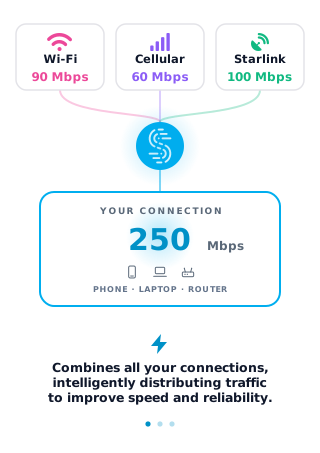
Speedify is an app that does this and goes further: it combines Wi-Fi, 4G/5G cellular, Ethernet, Starlink and satellite internet connections and uses them at the same time instead of hopping from one to the other, while encrypting your traffic like a VPN. The speed and failover gains need two or more internet connections; on a single connection, Speedify works as an encrypted VPN and can be a little slower. The test below put popular VPN apps through a Wi-Fi to 4G/5G cellular hand-off to see which ones kept the connection open.
Speedify is a VPN that adds failover and faster uploads and downloads
Wi-Fi Drop Test: Speedify vs. Ten Popular VPN Apps on an iPhone
When this test was run, most VPN apps on phones used protocols such as OpenVPN, IKEv2 or IPSec over one network connection at a time. To show the difference, Speedify’s team took an iPhone 7, installed Speedify and the 10 most popular other VPN apps in the App Store, and checked how each one handled a Wi-Fi hotspot that stopped working:
- The iPhone joined a Wi-Fi hotspot,
- The VPN app was connected,
- A Speedtest.net speed test was started, and
- The Ethernet cable was pulled from the Wi-Fi router while the test was still running.
Ideally, a VPN switches to 4G/5G cellular without a break, or at least reconnects over 4G/5G cellular after a short pause.
Each app got one of two results, shown in the Maintain Connection column:
- Yes: the VPN switched from Wi-Fi to 4G/5G cellular without changing IP address or stopping the speed test in progress (best result).
- No: the VPN lost its connection when the Wi-Fi failed. Some apps reconnected on their own after a pause; others did not recover until the user left the Wi-Fi network or disconnected and reconnected in the VPN app.
Where the VPN’s protocol was known, it is listed in the Protocols column.
Test Results: Which VPN Apps Kept the Connection When Wi-Fi Failed
| VPN Top 10 App Store | Maintain Connection | Comments | Protocols |
| Speedify | Yes | The Ethernet cable to the router was pulled, leaving a dead hotspot in the middle of the speed test. Speedify recovered almost immediately and finished the speed test. Read how this works for live streaming. | Speedify’s own protocol |
| VPN Go (Yan Zhang) | No | Turning Wi-Fi off Killed the VPN | IKEv2 |
| X-VPN (TBU CO., Limited) | No | Turning Wi-Fi off Killed the VPN | |
| Free VPN Proxy (Betternet) | No | Manually Killing Wi-Fi allowed persistent connection, speeds decreased to <1MB | IKEv2 |
| Hotspot Shield (AnchorFree Inc) | No | Turning Wi-Fi off killed the VPN, it did reconnect | IPSec |
| Free VPN Proxy Master (ALL Connected Co., Ltd) | No | Turning Wi-Fi off killed the VPN, it did reconnect | IKEv2 |
| Free VPN Hexatech (Betternet) | No | Dead Hotspot killed the VPN. VPN was stuck in the connecting state unable to access internet and showed no Wi-Fi icon. Had to disconnect to get internet back | |
| Security VPN (Yang Shi) | No | Dead Hotspot killed the VPN. VPN was stuck in the connecting state unable to access internet and showed no Wi-Fi icon. Had to disconnect to get internet back | |
| Free VPN Unlimited (Free VPN LLC) | No | Did not notice Wi-Fi had been killed, had to manually disconnect to get internet back | |
| Opera Free VPN (Opera Software) | No | When Wi-Fi was turned off, the VPN quickly reconnected | IPSec |
| SurfEasy | No | Turning Wi-Fi off Killed the VPN | IPSec |
In this test, every other VPN app either stopped working or had to reconnect when the Wi-Fi hotspot failed, and several never recovered until the user stepped in. That may be tolerable on a desktop computer, but not on a phone that moves from one hotspot to another.
Speedify was the only app in the test that kept the phone online and encrypted when the Wi-Fi stopped working.
When a Mobile VPN Is Worth Having
A mobile VPN pays off when you travel or commute on spotty Wi-Fi and 4G/5G cellular, when you work remotely on calls or screen sharing sessions that must not drop, and when you stream music or video on the move. Use one whenever your phone, tablet or laptop is on a public Wi-Fi hotspot, so your traffic stays encrypted.
APN vs. VPN: Two Different Settings on a Phone
An APN (access point name) is the setting your phone uses to reach your carrier’s 4G/5G cellular network; the carrier supplies it, and it decides how the phone gets online over cellular. A VPN runs on top of whatever connection the phone has, Wi-Fi or 4G/5G cellular, and encrypts the traffic to the VPN server. You do not need to change your APN to use a VPN.
How to Get and Use a Mobile VPN on iPhone and Android
In everyday use, “mobile VPN” also simply means a VPN app on a phone. To use Speedify as one, download Speedify from the App Store (iOS 17 or later) or Google Play (Android 9 or later), open it and create a free account or sign in, then tap Allow when the phone asks to add a VPN configuration. Speedify connects to a Speedify server automatically and uses Wi-Fi and 4G/5G cellular together when both are turned on. The free tier includes 5 GB per month; paid plans cost $89.99 a year, or as little as $4.99 a month on a 3-year plan.
Next: VPN speeds, and other ways Speedify differs from conventional VPNs.
Speedify
Get started with Speedify today.
Speedify combines Wi-Fi, 4G/5G cellular, Ethernet, Starlink and satellite into one faster, more reliable internet connection. Free to try: 5 GB a month with a free account. No credit card required.
🚀 Speed
Faster uploads and downloads, because Speedify uses all your internet connections at once.
📶 Stability
If one internet connection drops, Speedify moves your traffic to the others in milliseconds.
🔒 Security
AES-256 encryption on every internet connection, on any network you join.


15M+ downloads worldwide. 75K+ five-star reviews on iOS and Android.