
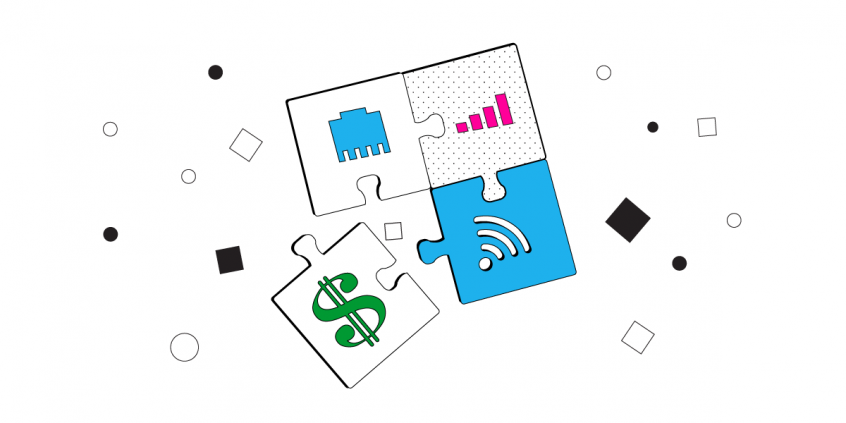
How to Find Cheap Internet and Lower Your Bill
In 2016, the United Nations declared internet access a basic human right. Unfortunately, that doesn’t stop internet companies from increasing their rates every year. Getting burned by your internet service means it’s time to take a close look at your provider. If you’re ready to stop treating your internet cost like it’s set in stone, these tips will help you reduce your bill while increasing your connection speed.
Should you have a backup 4G, 5G, Starlink, or cable internet connection?
Yes — every internet connection goes down, including Starlink, which drops for ~34 minutes a day on average. A backup connection from a different provider means one outage never takes you fully offline. The most common options are a 4G/5G cellular hotspot, a cable or DSL line, or a second satellite dish.
4G/5G cellular
Works anywhere. Just a SIM or hotspot — no installation needed.
Learn more →Cable / DSL
Best for fixed locations. Different network, so outages rarely overlap.
Learn more →Second Starlink
Adds redundancy and throughput for remote sites or heavy usage.
Learn more →Speedify bonds any two connections into one — automatic failover, more speed, no dropped calls.
Try Speedify free →Tip #1: Choose the Right Internet Plan
All internet service plans are not created equally. There are several broadband connection types, and the service you’re paying for may not necessarily be the best fit for your usage habits. Understanding your internet connection is the first step toward picking the service and speed that work best for you.
Broadband Connection Types
Internet service providers (ISPs) use several different broadband connection types. These connection types vary in availability and cost, depending on where you live. Each connection has a different maximum bandwidth (the amount of data that can be transferred between you and the web). Here’s a quick rundown:
- Asymmetric Direct Subscriber Line, or ADSL, connections use your copper phone lines to transmit data in both directions. This connection type is asymmetric because it has a faster download speed than upload speed, so it’s not ideal for anyone who creates and uploads a lot of web content. Download speeds usually top out at 100 Mbps.
- Cable connections work over a coaxial cable and are faster than the copper wires used in an ADSL connection. Cable networks are shared across neighborhoods, and speeds will be throttled based on the number of users on at a given time. Most cable connections are in the ballpark of 300 Mbps. If you use a lot of devices in your home, this plan is a good pick price-wise.
- Fiber Optic connections offer the fastest download and upload speeds at around 1,000 Mbps. This makes it the best connection for data-hungry users. Fiber optic cables are installed regionally by ISPs, but many rural areas still don’t have access to the technology. This connection type generally isn’t cheap, so it’s best for people who use lots of smart devices or prefer the highest-quality video streaming and are fine cutting down their costs in other ways.
Tip #2: Measure Your Internet Usage and Speed
Once you understand the service options available to you, you’ll want to measure your current internet speed and see if it’s a good match for your usage. By running a speed test, you can get a snapshot of your connection speed right from your browser.
Once you’ve measured your connection speed, it’s time to estimate your usage. Most ISPs have usage trackers available through your account page (especially if they’re capping your data). If your ISP won’t provide you with a usage estimate, you can track your own data use with a program like GlassWire. This bandwidth monitor track your data amounts and identify malicious software that might be inflating your usage.
If your data usage is well below your limit, you could drop down to a cheaper plan to save some money without running into any problems.
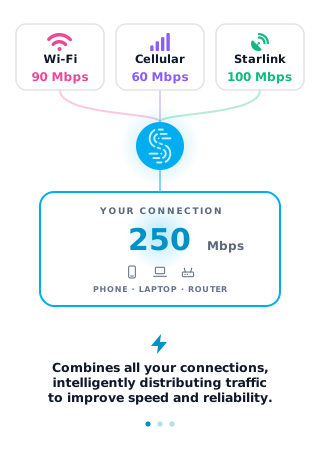
Or if you’re hitting your data limit but don’t want to pay for more bandwidth, try a bonding VPN (Virtual Private Network) like Speedify. This app combines multiple connection types (wireless, Wi-Fi, Bluetooth, and wired connections) and optimizes data transfer across all of them for a big speed boost. Speedify connects to the cloud to spread out your data and not use all the bandwidth of one connection. And your combined connection types keep you connected even if one type goes down.
Tip #3: Bundle Your Internet or Cut the Cord
If you’re paying separately for your mobile plan, cable TV, and internet plan, bundling could save you a small fortune. A bundled plan provides a discount since you get all your services from a single provider, and most providers love offering incentives to encourage you to bundle with them.
Another option is dropping your satellite or cable TV plan altogether. Streaming services like Netflix, Hulu, Google Play, and Amazon Prime offer enough variety and programming to satisfy almost everyone’s entertainment needs, driving more people to cut the cord on their TV service in favor of an internet-only plan.
Tip #4: Reduce Your Mobile Data
Your phone’s data plan and your internet plan might be redundant. If you tend to use your phone on your living room couch (and let’s be honest – who doesn’t?), your LTE service isn’t the best way to do it. Switching your phone to a Wi-Fi connection will eliminate a ton of data usage, allowing you to go with a cheaper data plan.
Wi-Fi is also a great option when you’re on the go. It’s worth taking a few minutes to connect to the free Wi-Fi at your job, your local coffee shop, or your favorite bar. You can also limit your data needs by downloading your favorite podcasts and playlists over Wi-Fi before you leave the house.
Tip #5: Upgrade Your Router
Your sluggish internet connection may have nothing to do with your plan. An old, outdated router often struggles to provide the connection speed you’re getting from your ISP. Older single-band routers can’t distribute an 802.11ac signal, the latest generation of Wi-Fi. Upgrading your router is usually worth the expense since it can increase your internet speed while also extending your Wi-Fi’s range and consistency – all while saving you from a hefty monthly router feeon top of your service costs.
Find What Works for You
Data usage and connection speeds are moving targets, so plan on assessing your internet package at least once every year or two. High-quality video, interactive website designs, and increasing graphic resolution are quickly making the internet less forgiving of a slow connection. With these tips, you can stay ahead of the technology curve without breaking your bank.
About the author: this guest blog post is brought to you by highspeedinternet.com – helping you find the best internet options in your area within the US.
Alex and the Speedify team are always exploring the latest in networking and security technology—like 5G, 6G, WiFi 7, laser and satellite internet—and sharing it in new discussion content across YouTube, TikTok, Instagram, and LinkedIn every week.
Got a tech question? Let's go deeper! Pop into Speedify Office Hours live every Wednesday at 10 AM Eastern. Speedify CEO Alex Gizis and our network engineers are standing by to break down your questions about networks, tech updates, and Speedify features.

Speedify
Get started with Speedify today.
Combine Wi-Fi, 4G/5G cellular, Ethernet, Starlink, and more into one faster, steadier connection. Free to try — no credit card required.
🚀 Speed
Faster uploads and downloads by bonding all your connections at once.
📶 Stability
Automatic failover in under a second when any connection drops.
🔒 Security
AES-256 encryption on every connection, on every network you join.


15M+ downloads worldwide. 75K+ five-star reviews on iOS and Android.