
Feature · Channel Bonding
Every link. All at once.
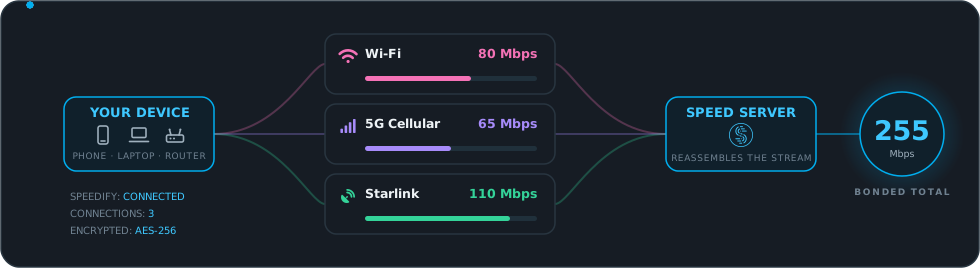
Speedify's channel bonding technology combines every internet connection you have into a single bonded network. Everything else Speedify does runs on top of that.
Benefits
SPEED
The combined throughput of every link.
Every packet is split across all active connections simultaneously. Single video calls, file transfers, and live streams use the combined bandwidth of every link, not just one.
STABILITY
Sessions that don't drop when a link does.
If a connection drops, traffic reroutes to the remaining links in milliseconds. No dropped calls, no failed uploads, no session resets.
SIMPLICITY
One bonded network. No app changes.
All bonded traffic passes through an encrypted tunnel on every link. Strict no-logs policy, hardware acceleration where available.
01 · The Basics
One network. Every link working at the same time.
Most networks treat extra connections as backups. They pick one to use, and switch only when the primary fails. Channel bonding takes a different stance. Every connection carries traffic concurrently, the bonded throughput is the sum of every active link, and individual paths can degrade or vanish without taking the session with them.
| Multiple active links | Per-packet split | Combined speed per session | Survives link failure | Survives path degradation | |
|---|---|---|---|---|---|
|
SPEEDIFY
Channel Bonding
A single session is split at the packet level across every available link, then reassembled at the server.
|
|||||
|
Load Balancing
Sessions are handed to whichever link looks healthiest. Each session is locked to its link for its lifetime.
|
|||||
|
Failover
One link active, one waits. Traffic switches over on failure, and live sessions break during the handover.
|
Deep Dive · Watch
How Speedify's channel bonding technology actually works.
Walk through the protocol, the per-packet distribution model, the failover logic, and the encryption layer in one detailed explainer. The architecture and the engineering tradeoffs that make Speedify different from a load-balancer or a regular VPN.
02 · Under the Hood
Packet-level distribution, not connection-level.
Conventional aggregation hands whole flows to whichever link looks healthiest. Speedify operates one layer below that. Inside a single TCP connection or UDP stream, individual IP packets are distributed across whichever links are currently best. That granularity is what lets a single download saturate every available link, and what lets a live session survive a path failure without the application noticing.
Algorithmically decided Per packet, per millisecond.
01
Latency-aware routing
Lower-latency paths are favored to minimize out-of-order arrival and reduce reassembly overhead at the server.
02
Asymmetric capacity weighting
Paths with higher throughput receive proportionally more traffic. Capacity is measured continuously, not assumed from link type.
03
Loss adaptation
Paths showing elevated packet loss have their share reduced. In Redundant Mode, they receive duplicate packets instead.
04
Cost-aware policy
Metered cellular can be capped, used only as overflow, or reserved strictly for failover. Per-interface rules apply across every device.
03 · Modes
Three modes for three priorities.
Different traffic needs different treatment. A 50GB camera dump wants raw throughput. A live broadcast wants every packet to land. A two-way call wants the network to keep working when conditions change underneath it. Speedify exposes three modes, and the default combines the other two automatically.
MODE 01
Speed Mode
Packets are distributed across every available link to maximize aggregate throughput. Combined speed scales close to the sum of every active path.
Best For
Large file transfers, cloud backup, bulk data movement, batched uploads, software distribution.
MODE 02
Redundant Mode
Every packet is sent on every link at the same time. Whichever copy arrives first is used, the rest are discarded. Effective bandwidth is the speed of the fastest single link, traded for the lowest possible loss and jitter.
Best For
Mission-critical signaling, telemetry, life-safety connectivity, control channels, anything where a single dropped packet is unacceptable.
MODE 03 - DEFAULT
Streaming Mode
A smart hybrid. Speedify watches traffic patterns and automatically identifies real-time streams: video calls, live streaming, VoIP, online gaming, IRL streaming. Those streams get QoS priority over everything else, and each one is switched on the fly between Speed-style bonding and Redundant-style duplication based on what the network is doing right now. Bulk traffic continues to get Speed-mode treatment in parallel.
Best For
Anywhere real-time streams matter, which is most enterprise deployments. This is why it's the default.
04 · Deployment
Where Speedify installs.
Speedify is software. It installs either on individual devices or on a router that handles every device behind it. Most enterprise deployments use both, depending on the use case.
A · Device Level
Run Speedify as an app.
Install the Speedify app on Windows, macOS, Linux, iOS, or Android. The device bonds whatever connections are attached to it: built-in Wi-Fi, Ethernet, cellular, USB tethering, additional adapters. Every device manages its own bonding.
Licensing
For businesses, this is provided through a Speedify Teams subscription, which centralizes billing, user provisioning, permissions, and usage analytics across your organization.
Best For
Mobile workforces, livestream and creator rigs, individual workstations with multiple WAN sources, single-user remote setups.
B · Network Level
Run Speedify on a router.
Run Speedify on a supported router and every device on the LAN gets bonding and failover automatically, with no per-device install.
Licensing
Network-level deployment is licensed via Speedify for Routers, available two ways:
Speedify for Routers
Add Speedify to a supported OpenWrt router you already own.
Powered by Speedify routers
Hardware with Speedify preinstalled and licensed out of the box. Miri, GL.iNET, and other partners.
Best For
Offices, retail locations, vessels, aircraft, remote sites, and any deployment with multiple users or unmanaged devices.
Note
Many businesses run both at once. A router covers everyone in the building. The app travels with people who leave it. For OEMs and software vendors, Speedify's channel bonding can also be licensed as an SDK that embeds into your own iOS, Android, Windows, macOS, Linux, or QNX product. See Powered by Speedify.
04 · In production
Where Speedify earns its keep.
Bonding makes the biggest difference where any single connection is either unreliable or insufficient on its own. A short list of where it's already running.
Spotlight
Speedify + Starlink
Bond multiple Starlink dishes — plus cellular and any wired link — into one resilient network that survives obstructions, satellite handoffs, and weather. Built for vessels, aircraft, remote sites, and live broadcast.
Learn more →
BONDED THROUGHPUT · LIVE
DISH 01
142 Mbps
DISH 02
128 Mbps
5G LTE
87 Mbps
BONDED TOTAL
357 Mbps
Maritime
Vessels, yachts, and offshore platforms
Whole-vessel bonded networks for commercial fishing, workboats, charter yachts, and offshore platforms. One resilient network across the entire vessel.
Learn more →
Aviation
Inflight Wi-Fi that doesn't drop
Bonded Starlink Aero terminals plus existing Ku/Ka and ATG, for business and commercial aviation. Make satellite handoffs invisible at altitude.
Learn more →
Remote Operations
Mining, oil & gas, construction, defense
Whole-site bonded coverage with mobile and vehicular deployments, fully managed at the network edge for enterprise-grade reliability anywhere.
Learn more →
Live Broadcast
Field, sports, and breaking news
Live remote production that doesn't drop on air. Works alongside LiveU, TVU, Dejero, and Haivision for IRL streaming and broadcast.
Learn more →
Get in touch with Speedify
Get in touch today to discuss your business’s needs and discover how Speedify can help deliver, faster, more reliable, and more secure online experiences.