
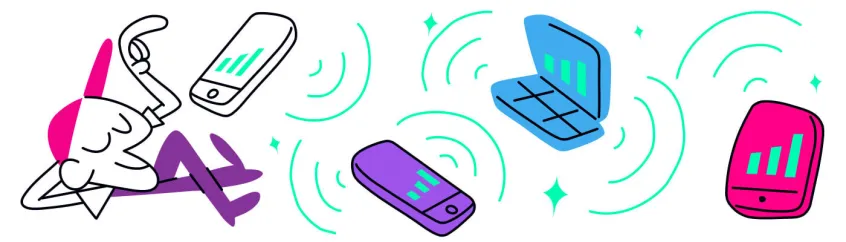
Using a VPN on iPhone Duo: Speedify Gives Split View Two Connections Instead of One
The iPhone Duo opens to a 7.6 inch display and runs two apps side by side. Photos on one half and Mail on the other, or a video call next to a browser. What the Duo does not open is a second internet connection to go with the second app. iOS 27 still picks one link, Wi-Fi or cellular, and everything on both halves of the screen queues behind it.
Speedify is a VPN that uses the iPhone Duo’s Wi-Fi and cellular data at the same time. The encryption is still there. The difference is that Speedify pays for it out of two connections instead of one, so a FaceTime call on the left and a 4K upload on the right are not fighting over the same link.
Speedify runs on every device you already use
Split View Puts Two Apps Online at Once, Through One Internet Connection
Apple demonstrates Split View by dragging a picture out of Photos and into Mail. Follow that all the way through and the last step is an upload. A 48MP photo is not small, and the Duo shoots 4K video at 120 frames a second, so the files people drag across are large ones.
Now run it the way a working day looks. The call is open on one half while the file goes out on the other. Both halves are on the same Wi-Fi. The upload takes whatever bandwidth it can reach, the call gets what is left, and the person on the call hears the difference before you see it.
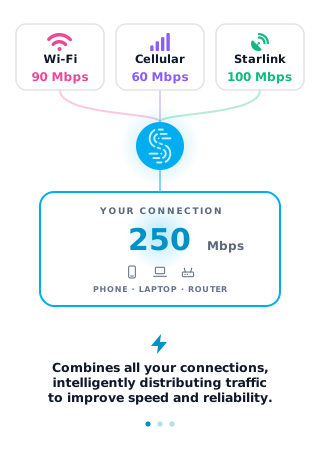
An ordinary VPN makes this worse rather than better, because it has the same one connection to work with and adds a server hop on top of it. Speedify splits the traffic across Wi-Fi and cellular and sends it in parallel, so what the two apps draw from is the two connections added together instead of whichever one the phone happened to choose.
Wi-Fi 7 does not solve this either. Wi-Fi 7 is the hop between the Duo and the router. It leaves the broadband behind the router exactly as it was, and it does not change the fact that the phone uses one connection at a time.
What Happens When Your iPhone Duo Switches From Wi-Fi to Cellular
An iPhone holds on to a Wi-Fi network by signal strength, not by whether that network is still carrying data. It will stay on a router two rooms away, or on the cafe’s access point as you walk out of the door, long after nothing is getting through.
The iPhone Duo runs into this more often than a normal phone does, because the Duo is built to be put down. It stands on its own for hands-free FaceTime, and StandBy keeps it useful while it sits there. A phone in your hand gets carried somewhere better when the call stutters. A phone propped on the kitchen counter stays in the weak spot for the whole call.
With an ordinary VPN the switch costs more than a few dropped seconds. The tunnel goes down with the connection underneath it and does not come back until the phone has settled somewhere new and the VPN has negotiated again.
Speedify has nothing to switch. Wi-Fi and cellular are both already up and both already carrying your traffic. When the Wi-Fi fades, cellular is already doing the work, and nothing on either half of the screen shows that anything happened.
Why a VPN Usually Slows a Phone Down, and Why Speedify Does Not
The complaint is fair and it has very little to do with encryption. Scrambling data costs almost nothing on an A20 Pro chip. What costs you speed is the shape of an ordinary VPN: one connection, everything wrapped inside it, all of it routed through a single distant server. Your ceiling becomes whatever that one connection manages on its worst second.
Speedify changes the shape rather than the encryption. Speedify splits your traffic across every connection the phone has, sends it in parallel, and reassembles it at the far end. Two connections carry more than one, which is why the encrypted connection can end up faster than the unencrypted one you started with.
Speedify also handles the thing that ruins calls more often than low speeds do: packet loss. When a connection starts dropping data, Speedify sends the same packets over both connections and keeps whichever copy arrives first.
Speedify’s Cellular Sharing Feature Adds the 5G From the Phones Around You
Combining Wi-Fi and 5G works when the iPhone Duo has both. In a packed stadium or at a rural campsite it may only have a weak version of each, and two weak internet connections are still two weak internet connections. Speedify’s Pair & Share cellular sharing feature covers that case by pulling in the cellular from other devices running Speedify nearby.
This is not a personal hotspot. A hotspot runs one direction: one phone broadcasts its signal as Wi-Fi, everyone else consumes it, and the whole group shares that one internet connection. Pair & Share runs both ways. When two devices pair, each one uses the other’s cellular and lends its own, so both come out faster. Pair with a third and a fourth and every device added is another lane into the same bonded session.
The Duo is the phone where this earns its keep, because Apple built the Duo around the people in the room. Duo FaceTime brings the people beside you into the call, the Duo stands on its own so a group can watch the 7.6 inch display, and every one of those people is holding a phone with idle 5G on it. Pair & Share puts that idle capacity behind the one screen everybody is looking at.
Pairing happens over the local network the devices are already on, and only after both sides accept it. Each device shares up to 10 Mbps of its cellular by default, and you can change that, switch sharing off, or mark a connection as backup only at any time. Every paired connection runs inside an AES-256 encrypted tunnel, so a phone lending you its 5G has no view of what you do with it, and you have no view of theirs.
Speedify’s cellular sharing is built into Speedify on every platform, so the Duo can pair with an iPad, an Android phone, a Windows laptop or a Mac. Different carriers help here rather than get in the way. When one tower is jammed, pairing across two or three carriers is far likelier to find capacity than three phones queueing on the same one.
How to Set Up a VPN on iPhone Duo in Two Taps
There is no configuration profile to install and nothing to type. Download Speedify from the App Store, open it, and allow the VPN permission iOS 27 asks for once. That is the whole setup, and it is the same on any iPhone or iPad running iOS 27.
The second connection is already in the phone. The iPhone Duo uses a built-in eSIM, so the cellular line is there and on your bill whether an app touches it or not. Most of the day it sits idle behind Wi-Fi. Speedify puts it to work alongside.
After that Speedify runs in the background across every app rather than one browser tab, with nothing to configure per app and no per-network setup to redo when you join a new Wi-Fi. There is a free tier with a monthly data allowance, so you can watch what Speedify does on your own connections before deciding anything. Speedify does not log what you do online, and one account covers your other devices as well, including Android, Windows, macOS and Linux.
What Changes Day to Day on Your iPhone Duo
Most of the time nothing announces itself, which is the intended outcome. What you notice is which annoyances stop:
- A FaceTime call that holds steady while a large file uploads in the other half of Split View.
- A group FaceTime on the stand, running on your 5G and on the 5G of everyone paired with you.
- A 48MP photo or a 4K clip that finishes sending instead of restarting.
- A hands-free call from the kitchen counter, where the Wi-Fi is weakest and you are not holding the phone to move it somewhere better.
- Maps that redraw at the moment you need the turn rather than thirty seconds after it.
- Streaming that keeps its picture on a crowded hotel network instead of going soft on a 7.6 inch display.
- Public Wi-Fi in an airport or on a train that is encrypted and usable at the same time, rather than one or the other.
None of that asks you to think about which connection is in use, or to switch anything on and off as you move around. An ordinary VPN cannot do it, because an ordinary VPN only ever has one connection to work with.
Get Speedify free from the App Store and give iPhone Duo’s Split View two internet connections to work with: both Wi-Fi and 5G cellular.
Speedify
Get started with Speedify today.
Combine Wi-Fi, 4G/5G cellular, Ethernet, Starlink, and more into one faster, steadier connection. Free to try — no credit card required.
🚀 Speed
Faster uploads and downloads by bonding all your connections at once.
📶 Stability
Automatic failover in under a second when any connection drops.
🔒 Security
AES-256 encryption on every connection, on every network you join.


15M+ downloads worldwide. 75K+ five-star reviews on iOS and Android.