
Why Do iPhones Overheat when Live Streaming?
Your iPhone gets hot mid-broadcast, the screen dims, and the stream quits. Heat is not a glitch – the chip compressing your video and the radios sending that video out both work hard, and sun or a thick case traps the warmth.
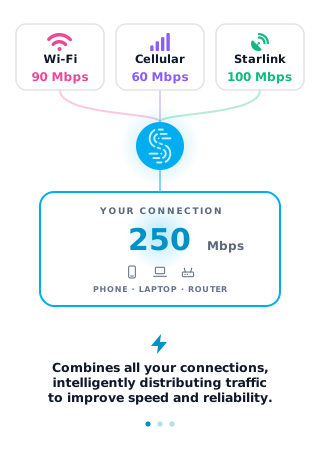
Speedify is an app that sends a live stream over Wi-Fi, 4G/5G cellular data, wired Ethernet, Starlink and other internet connections at once, so a stumble on one never ends the broadcast. You will find our temperature test results, the reasons iPhones overheat, and practical advice below; using Speedify keeps the broadcast running when a phone throttles, though no app can cool an iPhone.
- the ambient temperature where you’re using the device;
- what you are using the device for.
According to Apple, an iPhone, iPad or iPod touch should be used at temperatures between 0 and 35 degrees C / 32 to 95 degrees F. The device might get warm at times, when you:
- Set up your device the first time;
- Restore from a backup;
- Wirelessly charge your device;
- Use graphics-intensive or processor-intensive apps, games, or features, including augmented-reality apps;
- Stream high-quality video.
If the device will get too warm, the built-in overheating protection will jump in and start alerting you with a temperature warning screen going all the way to shutting down.
In the interest of offering valuable information to all live streamers out there using iPhones, we put it to the test to see how long it can last while live streaming in different temperatures and conditions. Here’s what we got.
Speedify gives you the upload headroom a clean stream needs
iPhone Live Streaming Temperature Testing
We put an iPhone 13 to the test under different conditions and exposure to sunlight. All tests were ran outside on a sunny Philadelphia day with an outside temperature of 29 C / 85 F.
We tested live streaming for an hour or until the iPhone shut off due to critical temperature. We used Zoom as our streaming platform, while using Wi-Fi and cellular data together at once with Speedify.
As the iPhone only pops up the temperature warning when its state is Critical, we used the Speedify app’s internal developer mode to display Apple’s thermal state – nominal, fair, serious or critical.
Here’s what we got:
| iPhone 13 live streaming | Start | 15 min | 30 min | 45 min | 1 hour |
| With case | Nominal | Fair | Fair | Fair | Serious |
| Without case | Nominal | Fair | Fair | Fair | Serious |
| Direct sun, with case | Fair | Critical |
iPhone shuts off
|
||
| Direct sun, without case | Nominal |
iPhone shuts off
|
|||
| Direct sun with cooling strip | Nominal | Critical |
iPhone shuts off
|
iPhone Overheating when Live Streaming Testing Conclusions
As you can see above, exposure to direct sun, as well as the ambient temperature greatly influences how long an iPhone can live stream:
- there wasn’t any notable temperature state difference when using it in the shade with and without a protective case – the iPhone managed to live stream for an hour.
- worst case: direct sun exposure while phone is without a protective case – only 15 minutes of live streaming. The case can keep it cool for another 15 minutes of live streaming.
- When using a cooling strip on the iPhone, it also got some 30 minutes of live streaming before it shut off.
A note on the above, from our experience live streaming IRL: if you’re using your phone with a gimbal, it will act like a case in terms of thermal insulation for the back of the phone. So it is not necessary to use a protective case when you’re using a gimbal.
Takeaways and Our Advice
We’ve been running Speedify LIVE since 2021 and have done quite a few of IRL streams. One of them was a live stream from inside Dracula’s Castle. Each of those came with its own learnings. Avoiding iPhone overheating when live streaming has been one of our concerns – that’s exactly why we ran these tests internally.
One thing is for sure: if you can avoid using your iPhone as a live streaming phone directly in the sun – do it! It’ll make the biggest impact to avoid overheating. But there are cases when that is not possible – that’s when we recommend you use the iPhone without any case on a gimbal and, as much as possible, with a cooling solution – cooling strips. Using an active cooler that includes a fan will drain your battery faster.
Speedify
Get started with Speedify today.
Combine Wi-Fi, 4G/5G cellular, Ethernet, Starlink, and more into one faster, steadier connection. Free to try — no credit card required.
🚀 Speed
Faster uploads and downloads by bonding all your connections at once.
📶 Stability
Automatic failover in under a second when any connection drops.
🔒 Security
AES-256 encryption on every connection, on every network you join.


15M+ downloads worldwide. 75K+ five-star reviews on iOS and Android.