

The Speedify Starlink Index Measures Starlink All Day, Without Speed Tests
Starlink internet connections on the Speedify Starlink Index worked 96.75% of the time from 24 September to 7 October 2026, about 47 minutes a day offline, across 5,823 Starlink users, 4,147 Starlink dishes and 155 countries. A speed test can’t show that number.
A speed test measures a Starlink internet connection for about 20 seconds, on request. The problems Starlink owners notice happen in the other 86,380 seconds of the day: a dropout when a branch blows into the Starlink dish’s field of view, rain fade during a storm, and congestion in the evening when everyone in the same Starlink cell is streaming.
Speedify, an app that combines Starlink with other internet connections such as 4G/5G cellular, measures Starlink internet connections around the clock, on every device running Speedify. This article explains how the Speedify Starlink Index turns those measurements into numbers, where the numbers have limits, and how a second internet connection covers the minutes Starlink is offline.
The short version: the Speedify Starlink Index reports latency, jitter, packet loss and reliability, not speed, and 72% of Starlink users on Speedify ran a second internet connection, usually 4G/5G cellular, to stay online through the minutes Starlink was offline.
The live Speedify Starlink Index updates every day, so today’s Speedify Starlink Index figures will differ from the numbers in this article.
Where the Speedify Starlink Index Numbers Come From
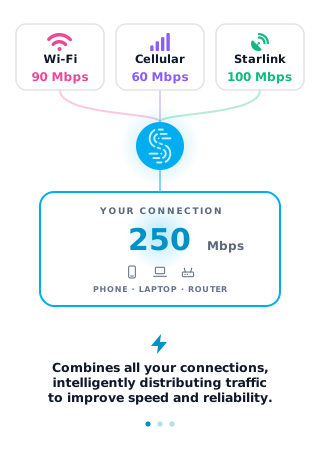
Speedify combines Wi-Fi, 4G/5G cellular, Ethernet, Starlink and satellite into one internet connection. Speedify sends your traffic over all of those internet connections at once and decides, packet by packet, which internet connection carries each packet. To make that decision, Speedify continuously tracks every internet connection’s round-trip time, jitter and packet loss.
Speedify takes those measurements in the background while your traffic flows, so nobody runs a test, and the numbers describe an ordinary day, bad hours included. Between 24 September and 7 October 2026, the Speedify Starlink Index collected 1,054,007 measurement periods from Starlink internet connections.
The Four Numbers on the Speedify Starlink Index
Latency is how long a round trip takes, in milliseconds, from the device running Speedify, over Starlink, to a Speedify server and back.
Jitter is the variation in latency from one measurement to the next, counted only while an internet connection works.
Packet loss is the share of data sent that never arrives.
Reliability is the share of time an internet connection had working two-way connectivity: packets reached the Speedify server and the replies came back. For a Starlink internet connection, reliability is the most useful of the four numbers. Starlink internet connections scored 96.75% between 24 September and 7 October 2026: about 47 minutes a day without a working internet connection. Fixed Starlink dishes averaged 38 minutes a day offline; Starlink dishes on RVs, boats and other mobile setups averaged 58.
Starlink reports average uptime above 99.9%. Both numbers can be true, because the two numbers measure different paths: Starlink measures the Starlink network, while the Speedify Starlink Index measures the whole path from your device to a Speedify server. A laptop at the edge of the Starlink router’s Wi-Fi range counts against the Starlink internet connection on the Speedify Starlink Index, because from the laptop the Starlink internet connection isn’t working.
Why the Speedify Starlink Index Has No Speed Number
Speedify sees the throughput your traffic used, not the capacity the Starlink internet connection had available, and measuring capacity would mean running speed tests. Speed on a Starlink internet connection depends mostly on the Starlink plan and on congestion in the local Starlink cell; Starlink publishes a US peak-hour median of nearly 200 Mbps download.
What a Starlink Dish Reports to Speedify Over the Local Network
A Starlink dish publishes diagnostic data on your local network at the IP address of 192.168.100.1: the share of the sky obstructed, the direction the Starlink dish points, whether the Starlink dish is a fixed or mobile installation, and the Starlink dish’s own ping to the Starlink ground station, which covers only the first hop. Speedify shows these readings in the Speedify Starlink Control Center, and the Speedify Starlink Index adds the readings up across 4,147 Starlink dishes. Speedify can only read a Starlink dish when the device running Speedify can reach 192.168.100.1.
- 70% of Starlink dishes had less than 1% of the sky obstructed; 8.6% had more than 10% obstructed. Starlink obstruction percentages compared breaks the share down by level.
- 19.4% of Starlink dishes pointed more than 90° away from the direction Starlink would choose. Those Starlink dishes still work.
What the Speedify Starlink Index Says About Adding a Second Internet Connection
The most important finding on the Speedify Starlink Index: 72% of Starlink users on Speedify (4,181 of 5,823) ran at least one other internet connection between 24 September and 7 October 2026. Of those second internet connections, 52.5% were 4G/5G cellular, 36.2% cable or DSL and 11.4% corporate networks.
Adding a second internet connection makes Starlink more reliable because Starlink and that other internet connection (4G/5G cellular, Wi-Fi etc.) fail for different reasons. An obstruction, rain fade or a congested Starlink cell takes out the Starlink internet connection; a weak or congested cell tower takes out the cellular internet connection. When the Starlink internet connection stops answering, Speedify moves your traffic to the cellular internet connection and your video call carries on. Two Starlink dishes share one Starlink network backend, so a Starlink-wide outage takes down both Starlink dishes at once. Speedify’s own guidance is to pair Starlink with a different kind of internet connection, such as 4G/5G cellular or DSL.
The Speedify Starlink Index doesn’t yet show how often both internet connections were down at once, the number that would show what a second internet connection buys.
Why Speedify Adds Latency, and How a Second Internet Connection Wins Time Back
The Starlink dish’s own reading, from the Starlink dish to the Starlink ground station, had a median of 23 ms on fixed Starlink dishes and 26 ms on mobile Starlink dishes. Starlink publishes 25.7 ms, the US peak-hour median Starlink still shows on starlink.com in October 2026, measured from the Starlink router to the internet. The two figures agree, although the Speedify Starlink Index figure covers 155 countries and Starlink’s figure covers only the US.
The end-to-end median for the same fixed Starlink dishes, from the device running Speedify to a Speedify server and back, is 45 ms. The extra 22 ms is the rest of the round trip, from the Starlink ground station across the internet to the Speedify server, plus Speedify’s own encryption and packet processing. Part of those 22 ms is the cost of the Speedify hop.
Speedify can’t lower the latency of a single internet connection. With a second internet connection, Speedify sends traffic over whichever internet connection answers faster at that moment and moves traffic off an internet connection the moment latency spikes. For video calls and live streams, Speedify’s Redundant mode sends the same packets over both internet connections and uses whichever copy arrives first. So during a latency spike on the Starlink internet connection, your apps can see lower latency than Starlink alone delivers.
Figure 1. Top: three latency figures, three stretches of the trip. Bottom: with a second internet connection, the copy that arrives first is the copy Speedify uses. Medians from the Speedify Starlink Index, 24 September to 7 October 2026; the Starlink figure comes from Starlink.
What Latency a Typical Starlink User on Speedify Sees
The Speedify Starlink Index headline for Starlink latency between 24 September and 7 October 2026 was 55 ms. The headline is a median over all measurement periods, so a Starlink dish online all day weighs far more than a laptop that joins for an hour. Take each user’s own median latency, then the median across users, and the typical user sees 85 ms.
Figure 2. Ten people, each standing for a tenth of the 4,616 Starlink users on Speedify with enough data, sorted by each user’s own median latency, 24 September to 7 October 2026.
Speedify’s support guide says 100 ms or lower works well and 300 ms or more is very noticeable. By that measure, half of these users sit below 100 ms, four in ten sit between 100 and 300 ms and may notice latency on calls and games, and one in ten sits above 300 ms, where latency is very noticeable. Starlink ping explained puts this per-user figure next to the Starlink dish’s own reading and Starlink’s published figure.
What the Speedify Starlink Index Can’t Tell You
The Speedify Starlink Index counts Speedify users, not all Starlink users. People install Speedify because the internet connection has to hold, so the numbers on the Speedify Starlink Index likely look worse than a typical Starlink owner’s numbers.
The other networks are these users’ second internet connections. Starlink next to a cellular carrier on the Speedify Starlink Index compares Starlink with the second internet connection Starlink owners actually run, not a ranking of carriers.
Two weeks is a short window. Between the windows ending 18 September and 7 October 2026, the downtime gap between mobile and fixed Starlink dishes went from 2 minutes to 20. Speedify treats a pattern as a finding only when several windows agree.
Small groups are left out. Networks under 50 users don’t appear, and fleet accounts are excluded.
Weather. The Speedify Starlink Index has no weather data, so the figures here can’t show how much rain or snow costs a Starlink internet connection.
Which Data Goes Into the Speedify Starlink Index
No browsing data, destinations or content: internet connection health only, added up across users before publication. Nothing on the Speedify Starlink Index can identify a person, a Starlink dish or a location. Speedify’s privacy policy has the details.
Why Speedify Publishes the Speedify Starlink Index
Speedify sells an app that adds a second internet connection to Starlink, which is why the Speedify Starlink Index also shows where Starlink does well: of the 3,374 Starlink dishes with enough data, half reported no dropped pings at all, and nine in ten dropped 2.91% of pings or fewer.
Speedify is for when your Starlink internet connection isn’t reliable enough, or fast enough for uploads and downloads. Speedify has limits too:
- Speedify doesn’t fix a Starlink dish. An obstructed Starlink dish stays obstructed; Speedify moves your traffic to your other internet connection while the obstruction lasts.
- Speedify needs a second internet connection to keep you online through a dropout.
- Speedify works best when the combined internet connections have similar bandwidth and latency; Speedify’s guide suggests setting a much slower internet connection to Backup priority.
If the Speedify Starlink Index measured something wrong, tell the Speedify team, especially if you query your Starlink dish’s gRPC interface with tools like starlink-grpc-tools and see different numbers.
Speedify
Get started with Speedify today.
Combine Wi-Fi, 4G/5G cellular, Ethernet, Starlink, and more into one faster, steadier connection. Free to try — no credit card required.
🚀 Speed
Faster uploads and downloads by bonding all your connections at once.
📶 Stability
Automatic failover in under a second when any connection drops.
🔒 Security
AES-256 encryption on every connection, on every network you join.


15M+ downloads worldwide. 75K+ five-star reviews on iOS and Android.