

Why Starlink Ping Looks Different in the Starlink App, a Speed Test and a Game
Normal Starlink ping is about 23 to 26 ms from the dish to the Starlink ground station and 45 to 85 ms for the whole trip to a server, and under 100 ms works well for calls and games.
On the Speedify Starlink Index for 29 September to 12 October 2026, a fixed Starlink dish’s own ping to the Starlink ground station had a median of 22.9 ms, close to the 25.7 ms Starlink publishes. Measured end to end through Speedify on the same fixed dishes, the median was 45 ms. Counting each of 4,758 Starlink users once, the typical user saw 85 ms; one user in four saw 45 ms or less, and one in ten saw more than 295 ms.
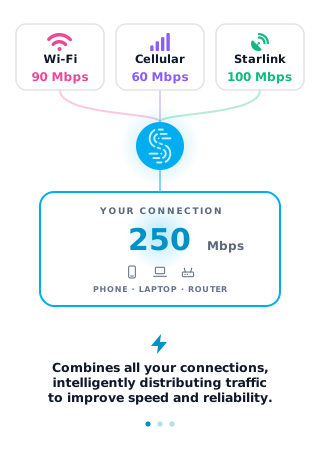
Starlink ping numbers differ because each one measures a different stretch of the trip, and some count different people. This article explains what each of the four ping numbers measures, how to check your own ping, what Starlink ping is good enough for calls and games, and how to lower your ping. Speedify is an app that combines Starlink with other internet connections, such as 4G/5G cellular, and measures every internet connection Speedify carries; the Speedify Starlink Index publishes those measurements.
The live Speedify Starlink Index updates every day, so today’s Speedify Starlink Index figures will differ from the numbers in this article.
What the Four Starlink Ping Numbers Measure
The dish’s own reading, 22.9 ms. A Starlink dish reports the round-trip time to the Starlink ground station, the first hop of the trip. The Starlink app shows a version of the same number, and so does the Speedify Starlink Control Center. Mobile dishes on RVs and boats read 26.0 ms.
Starlink’s published figure, 25.7 ms. Starlink publishes a US peak-hour median measured from the Starlink router to the internet. The dish’s reading and Starlink’s figure agree, although the Speedify Starlink Index covers 161 countries and Starlink’s figure covers only the US.
Speedify end to end, 45 ms. Speedify measures the whole round trip, from the device running Speedify, over Starlink, across the internet to a Speedify server and back. The extra 22 ms is the rest of the round trip past the Starlink ground station, plus Speedify’s own encryption and packet processing.
The typical Starlink user, 85 ms. Take every Starlink user’s own median latency, line the 4,758 users up from lowest to highest, and pick the user in the middle. That user sees 85 ms.
None of the four numbers is the ping a game shows. A game measures the trip to the game’s own server, which can be farther away or closer than a Speedify server.
How to Check Your Own Starlink Ping
Which of the four Starlink ping numbers above you’re looking at depends on where you look:
- The Starlink app’s Statistics page shows the dish’s own ping: the trip from the dish to the Starlink ground station, like the 22.9 ms above.
- A speed test shows the ping to a nearby test server, measured while the internet connection is idle. During a call or a big upload, ping is usually higher.
- A game shows the ping to the game’s own server, so a distant game server adds milliseconds that no Starlink setting can remove.
- Speedify’s dashboard shows a Latency graph for every internet connection side by side, so Starlink’s ping sits next to your cellular ping all day.
A Starlink app reading in the 20s or 30s next to a game ping above 100 ms means the extra delay comes after the dish: the route to the server, or the Wi-Fi inside your home.
How Starlink Ping Varies From One Starlink User to the Next
The spread is wide. One user in four sits at 45 ms or below, where Starlink feels like cable internet. Three in four sit at 185 ms or below. One in ten sits above 295 ms, 5 ms short of the 300 ms that Speedify’s support guide calls very noticeable. The Speedify Starlink Index doesn’t publish the cause of any one user’s number. Distance to the nearest Starlink ground station, the internet route from the Starlink point of presence to the server, and Wi-Fi inside the home all add milliseconds the dish never sees. A typical ping above 185 ms puts a setup in the slowest quarter, and the fixes below are the place to start.
Figure 1. Each Starlink user’s own median latency, 4,758 users, with the thresholds from Speedify’s support guide, plus the medians of other networks the same users ran. Speedify Starlink Index, 29 September to 12 October 2026.
The Speedify Starlink Index headline for Starlink latency from 29 September to 12 October 2026 was 55 ms. The headline counts every measurement period, so a dish online all day long weighs more than a dish online for an hour. Counting each person once moves the middle to 85 ms, because the users with higher latency contribute fewer measurement periods than the users online all day.
Starlink Ping Compared With Cable and Cellular
71.8% of Starlink users on Speedify also run a second internet connection, so the Speedify Starlink Index sees other networks during the same days. From 29 September to 12 October 2026, a large US cable network had a median of 35 ms, and the largest US cellular networks had medians between 75 and 95 ms.
Treat those figures as a comparison, not a ranking. The cellular internet connections are second internet connections for these Starlink users, often in places where cellular coverage is weak, and “cable” here means one cable network.
What Starlink Ping Is Good Enough for Gaming and Video Calls
Speedify’s support guide on latency uses two lines: 100 ms or lower works well for real-time apps, and 300 ms or more is very noticeable. Video calls tolerate higher latency than fast online games do. Nine in ten Starlink users on Speedify sit under 300 ms, and more than half sit under 100 ms. At the typical 85 ms, video calls and most online games work well; fast shooters and fighting games are the exception, because players notice latency well below 100 ms.
For gaming, the median matters less than the spikes. A median of 85 ms with a steady line plays better than 40 ms that jumps to 400 when a satellite passes behind a tree. From 29 September to 12 October 2026, jitter on the Speedify Starlink Index, the change in latency from one measurement to the next, averaged 1.2 ms while Starlink internet connections were working: the line is steady most of the time, and the spikes gamers notice come in short bursts. Fixing Starlink lag spikes in games covers what to do about the spikes.
How to Lower Your Starlink Ping
- Plug the computer or console into the Starlink router with an Ethernet cable. Wi-Fi inside the home adds delay and spikes on top of Starlink’s own ping.
- Clear the dish’s view of the sky. A blocked patch of sky causes a spike or a short dropout each time a satellite passes behind the obstruction. Starlink obstruction percentages compared shows where a dish stands.
- Pause big uploads, cloud backups and updates during calls and games. A busy upload fills the queue on the internet connection and pushes every ping up.
- Choose the nearest server when a game or app lets you choose. Distance to the server adds ping that no Starlink setting removes.
- Add a second internet connection, such as 4G/5G cellular, and run both through Speedify (see the next section).
What Speedify Can and Can’t Do About Starlink Ping
Speedify can’t lower the latency of a single internet connection. On Starlink alone, Speedify adds a hop to a Speedify server, and the 45 ms end-to-end median includes that hop.
With a second internet connection, Speedify sends traffic over whichever internet connection answers faster at that moment and moves traffic off an internet connection the moment latency spikes. For calls and streams, Speedify’s Redundant mode sends the same packets over both internet connections and uses the copy that arrives first, so a latency spike on Starlink doesn’t reach your apps. The free version of Speedify includes 5 GB of data a month, enough to watch Starlink’s ping next to a cellular internet connection’s ping at your own location before paying for anything.
What the Speedify Starlink Index Can’t Tell You About Starlink Ping
Latency is stored in 10 ms steps. Medians read 45, 55 or 85 because the Speedify Starlink Index rounds each measurement into a 10 ms bin.
A median hides spikes. Each person’s median is the middle of many measurements, so a lag spike lasting a second barely shows.
When in the day ping is worst. The Speedify Starlink Index has no hour-by-hour breakdown yet, so the figures here can’t say whether evenings are worse than mornings.
The Speedify Starlink Index counts Speedify users and measures to Speedify servers. A game server sits somewhere else, so your ping to the game server will differ.
Speedify
Get started with Speedify today.
Combine Wi-Fi, 4G/5G cellular, Ethernet, Starlink, and more into one faster, steadier connection. Free to try — no credit card required.
🚀 Speed
Faster uploads and downloads by bonding all your connections at once.
📶 Stability
Automatic failover in under a second when any connection drops.
🔒 Security
AES-256 encryption on every connection, on every network you join.


15M+ downloads worldwide. 75K+ five-star reviews on iOS and Android.