

Starlink Obstruction: Where One Dish Stands Among 4,263
On the Speedify Starlink Index for 29 September to 12 October 2026, 69.7% of 4,263 Starlink dishes had less than 1% of the sky blocked, and 8.7% had more than 10%. Small percentages still rank: a dish with 3% of the sky blocked has more sky blocked than 78% of the dishes.
The guides disagree on how much obstruction is OK: some say aim for under 2%, others say trouble starts at 5%. Starlink’s own guidance is a spot where nothing blocks the sky, and the Speedify Starlink Index can’t yet set a safe percentage above zero.
The short version: the data ranks a dish but doesn’t yet show how much downtime each level costs, so clearing the sky, or adding a second internet connection where the sky can’t be cleared, is the safe move.
This article shows where your dish stands, how to check the number, why a small obstruction can still cause dropouts, how to fix an obstruction, and how a second internet connection covers the obstructions you can’t clear. Speedify is an app that combines Starlink with other internet connections, such as 4G/5G cellular, and measures every internet connection Speedify carries; the Speedify Starlink Index publishes those measurements.
The live Speedify Starlink Index updates every day, so today’s Speedify Starlink Index figures will differ from the numbers in this article.
How Your Starlink Obstruction Percentage Compares With 4,263 Dishes
The obstruction percentage is the share of the dish’s field of view that something blocks: a tree, a chimney, a roof edge, the next RV. Each Starlink dish reports the percentage on the local network at 192.168.100.1, and the Speedify Starlink Index adds up the reports from every dish Speedify can reach. From 29 September to 12 October 2026:
- None blocked: 24.5% of dishes.
- Under 1%: 45.2%.
- 1 to 2%: 8.3%.
- 2 to 5%: 8.5%.
- 5 to 10%: 4.9%.
- More than 10%: 8.7%.
How to Check Your Starlink Obstruction Percentage
- Open the Starlink app.
- For a dish already installed, open the obstruction map. The app builds the map from the dish’s own connections, so the map needs time to fill in after the dish moves.
- Before installing or moving the dish, tap “Check for Obstructions” and scan the sky with your phone’s camera, at the height and spot where the dish will go.
- Find your percentage in the table above. Under 1% puts your dish with the 69.7% majority. Over 2% puts your dish in the worst 22%, and over 10% in the worst 8.7%.
- In Speedify, the Speedify Starlink Control Center shows the same reading next to your other internet connections.
Why a Small Starlink Obstruction Can Still Cause Dropouts
Starlink satellites in low Earth orbit cross the sky within minutes, and a Starlink dish uses electronic beam steering to track the satellite currently serving the dish. A blocked patch only matters when a satellite passes behind the patch, so the same 2% can be harmless in one spot and cause repeated dropouts in another. Where the obstruction sits in the sky matters as much as how big the obstruction is.
After a Starlink dish moves, the Starlink app needs time to rebuild the obstruction map and shows a message that the dish is still calibrating and gathering data on obstructions. The percentage settles once the map fills in. Reading the Starlink obstruction map explains what each patch means.
Starlink Dish Alignment: One Dish in Five Points More Than 90 Degrees Off
Each Starlink dish also reports how far the dish points from the direction Starlink would choose. From 29 September to 12 October 2026, 22.1% of dishes were within 5 degrees, another 22.2% between 5 and 10 degrees, and 19.1% pointed more than 90 degrees away. Those dishes still work.
Alignment matters to Starlink: Starlink’s business service level agreement only counts outages on a Standard dish aligned within 5 degrees and with an unobstructed view of the sky. Only 22.1% of dishes on the Speedify Starlink Index were within 5 degrees and only 24.5% had no sky blocked, so most dishes would miss at least one condition, yet still give the owners a working internet connection.
How to Fix an Obstructed Starlink Dish
- Raise the Starlink dish onto a pole or the roof ridge, above the tree line or roof edge the obstruction map shows.
- Move the Starlink dish toward open sky, then give the obstruction map time to rebuild.
- Trim the branch the obstruction map points at, not the whole tree.
- On a vehicle or boat, pick the parking spot or mount with the clearest sky. More options are in fixing Starlink dish obstruction and Starlink antenna placement.
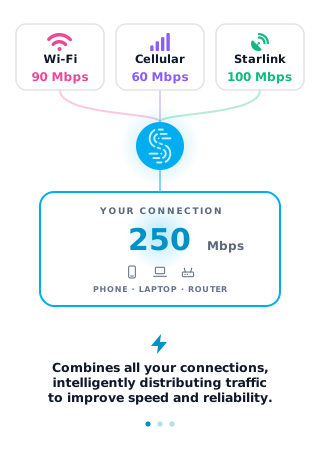
Some obstructions can’t be cleared: a neighbor’s tree, a campsite under pines, a boat in a marina. For an obstruction nobody can clear, a second internet connection such as 4G/5G cellular covers the moments when the satellite passes behind the block, and Speedify moves your traffic to the internet connection still answering. 71.8% of Starlink users on Speedify already run a second internet connection.
What the Speedify Starlink Index Can’t Tell You About Starlink Obstructions
How much downtime each obstruction level costs. The Speedify Starlink Index doesn’t publish downtime by obstruction level yet, and until the Speedify Starlink Index does, nobody should read a safe threshold from the numbers above.
Every dish. The Speedify Starlink Index only sees dishes Speedify can reach at 192.168.100.1, and counts Speedify users, who may have harder setups than a typical Starlink owner.
Where the block sits. A single percentage can’t tell a blocked patch in the busy part of the sky from a blocked patch in a part of the sky that satellites rarely cross.
Speedify
Get started with Speedify today.
Combine Wi-Fi, 4G/5G cellular, Ethernet, Starlink, and more into one faster, steadier connection. Free to try — no credit card required.
🚀 Speed
Faster uploads and downloads by bonding all your connections at once.
📶 Stability
Automatic failover in under a second when any connection drops.
🔒 Security
AES-256 encryption on every connection, on every network you join.


15M+ downloads worldwide. 75K+ five-star reviews on iOS and Android.