
Personal Hotspots Turn Your Phone’s 4G/5G Cellular Connection into Wi-Fi Anyone Can Use
A personal hotspot turns your phone’s 4G/5G cellular data into a Wi-Fi network your laptop or tablet can join. This guide explains how personal hotspots work, where their limits come from, and how to push past them.
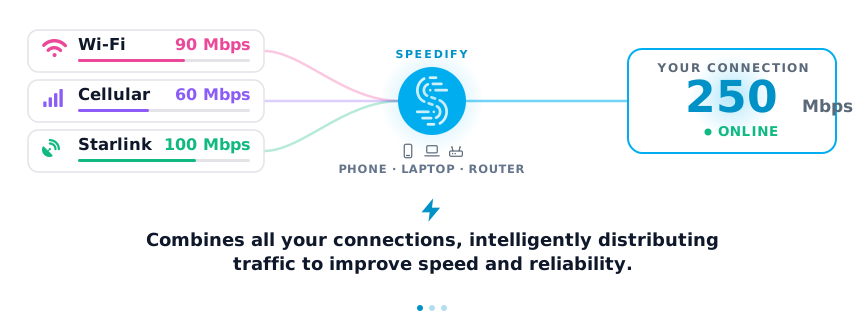
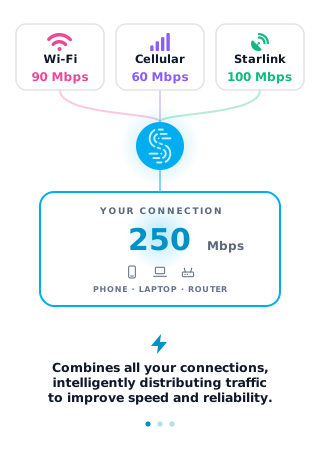
If you want more speed and reliability, Speedify is an app that combines two or more internet connections at once – such as the hotspots from two phones – so you get faster upload and download speeds and stay online if one connection drops out.
Speedify uses every internet connection your device has, at the same time
How do I use WiFi and 4G/5G cellular at the same time with Speedify?
Pick your two internet connections and your device below and we'll take you to the step-by-step setup guide.


The Basic Mechanics of a Personal Hotspot
A personal hotspot works by taking your phone’s cellular data connection and rebroadcasting it as a local Wi-Fi network. Your phone acts as a wireless router: it receives data from your carrier’s cellular tower over LTE or 5G, then distributes that data to any device that connects to the hotspot over Wi-Fi.
From the perspective of your laptop or tablet, connecting to a personal hotspot looks exactly like connecting to any other Wi-Fi network. But behind the scenes, every request those connected devices make is being routed through your phone to your carrier’s network and back — adding your phone as an intermediary in the chain.
How Your Phone Connects to the Cellular Provider
4G/5G Cellular Radios and the Tower Connection
Your phone contains a cellular radio that maintains a connection to the nearest tower on your carrier’s network. That connection uses one of several network technologies: 4G LTE, 5G Sub-6, or 5G mmWave, depending on what your carrier has deployed in your area and what your phone supports. The tower connects your phone to the carrier’s broader network infrastructure, which then reaches the public internet.
When your hotspot is active, your connected devices’ internet traffic passes through this cellular link. Your phone handles the routing between its local Wi-Fi network and the 4G/5G cellular interface, essentially doing what a home router does, but over a cellular connection instead of a wired broadband line.
The Role of NAT
Your phone uses Network Address Translation (NAT) to manage traffic between the devices connected to your hotspot and the cellular network. Each device connected to your hotspot gets a local IP address on the hotspot’s mini-network. Your phone maps all of their traffic through its single cellular IP address, keeps track of which device made which request, and routes responses back accordingly. This is the same mechanism home routers use to let multiple devices share a single internet connection.
Tethering vs. Wi-Fi Hotspot
Personal hotspots most commonly use Wi-Fi, but that’s not the only option. USB tethering connects your phone directly to a computer via a cable, which typically delivers lower latency and more stable throughput than Wi-Fi. Bluetooth tethering is also possible but generally slower. Wi-Fi hotspots are the most convenient option for sharing a connection with multiple devices simultaneously — though they add the overhead of the Wi-Fi radio alongside the cellular radio already running. On an iPhone, here is how to get more from Wi-Fi tethering.
Where Personal Hotspot Performance Limits Come From
Carrier Throttling
Most mobile plans treat hotspot data as a separate allocation from regular on-device data and apply different speed rules to it. Even plans marketed as unlimited routinely cap hotspot speeds at 5–15 Mbps, or throttle them down after a monthly threshold. This isn’t a function of the underlying cellular technology; LTE and 5G connections can move data much faster than that. It’s a deliberate policy applied by the carrier at the network level. The phone’s cellular connection may be operating normally while hotspot traffic is getting throttled separately.
4G/5G Cellular Tower Congestion
Cellular bandwidth is shared infrastructure. Every device connected to a given tower is competing for a share of that tower’s total capacity. In low-traffic areas, this rarely matters — available bandwidth is abundant. In dense urban environments, at events, or during peak usage hours, towers can get congested enough to slow every connection significantly. A hotspot is subject to whatever congestion the local tower is experiencing, with no way to route around it as long as you’re on that carrier.
Signal Quality
The actual throughput of your hotspot depends heavily on signal quality to the tower. Distance, building materials, interference, and network congestion all affect signal strength. A weak signal forces the cellular radio to use more robust but slower encoding schemes to maintain the connection — which directly limits how fast data can move. Even with 5G service showing on your phone, a weak signal to the nearest 5G tower can deliver speeds well below what a strong LTE connection would provide.
Thermal Throttling on the Device
Running a personal hotspot puts significant demands on your phone. The cellular radio is transmitting continuously, the Wi-Fi radio is active, the CPU is routing traffic between them, and the battery is draining — or generating heat if you’re charging. Most smartphones will throttle performance, including the cellular radio, when they reach temperature limits. Long hotspot sessions can degrade speeds steadily as the device heats up, even when carrier conditions are fine.
What Affects the Devices Connected to Your Personal Hotspot
Everything connected to your hotspot shares a single cellular link. The more devices connected and the more data they’re pulling simultaneously, the more they’re all competing for the same bandwidth. A single device streaming video, running cloud backups, or downloading a large file can consume most of a hotspot’s available bandwidth — leaving everything else on the hotspot with noticeably degraded performance.
Latency is also typically higher on a cellular hotspot than on a fixed broadband connection. Cellular connections add round-trip time at several points in the path — the radio link to the tower, the carrier’s internal routing, and the path to the internet. This is usually manageable for web browsing and most applications, but can be noticeable in latency-sensitive uses like video calls or real-time collaboration.
How Speedify’s Pair & Share Feature Improves How Personal Hotspots Work
Understanding how a personal hotspot works makes clear why a single one has limits: one 4G/5G cellular radio, one carrier, one tower, one data plan. Speedify is an app that helps you combine multiple internet connections simultaneously: Wi-Fi, Ethernet, Starlink, other satellite, and tethered smartphones. It routes traffic packet-by-packet across all available connections based on real-time performance data: latency, jitter, packet loss, and available bandwidth.
Speedify’s Pair & Share feature extends that bonding capability specifically to the cellular connections between paired phones. Instead of each phone keeping its hotspot data to itself, Speedify’s Pair & Share feature lets paired devices share and consume each other’s cellular connections simultaneously — combining multiple personal hotspots together for faster upload and download speeds for everyone in the group.
How Speedify’s Pair & Share Feature Works
One-Time Pairing
All phones need to be running Speedify and connected to the same local Wi-Fi network. Pairing is a one-time process: devices find each other automatically, establish encrypted peer-to-peer tunnels, and remember the relationship for future sessions. No passwords to share, no setup to repeat.
All Phones Share and Use Internet Data Simultaneously
Once paired, each phone acts as both a connection provider and a connection consumer at the same time. Phone A contributes its cellular connection to Phone B; Phone B contributes its cellular connection to Phone A. Both devices are now drawing bandwidth from two cellular connections at once, with Speedify’s channel bonding engine continuously routing packets across whichever connection is performing better at that instant.
This is the key distinction from simply connecting to someone else’s hotspot. Standard hotspot sharing is one-directional — one device gives, the other takes. With Speedify’s Pair & Share feature, both devices give and take at the same time, combining multiple personal hotspots together for faster upload and download speeds for everyone.
Seamless Automatic Failover
Speedify monitors both connections continuously. If one carrier drops signal or hits congestion, traffic shifts automatically to the other — without dropping active sessions. Video calls stay up. Uploads don’t restart. The failover is invisible because it happens at the packet level before the application layer ever notices a problem.
Getting More Out of Your Personal Hotspot
A personal hotspot is a genuinely useful tool — but its limits are baked into how it works at the carrier and hardware level. More bandwidth, more redundancy, and coverage across two carriers all require more than one connection. Speedify’s Pair & Share feature is built specifically for that: combining multiple personal hotspots together for faster upload and download speeds for everyone, with automatic failover and the coverage diversity of two carriers working in parallel.
Download Speedify and try Speedify’s Pair & Share feature today. You can also learn more about how Speedify’s channel bonding technology works under the hood, or explore Speedify’s Pair & Share feature for teams and enterprise use cases.
Speedify
Get started with Speedify today.
Combine Wi-Fi, 4G/5G cellular, Ethernet, Starlink, and more into one faster, steadier connection. Free to try — no credit card required.
🚀 Speed
Faster uploads and downloads by bonding all your connections at once.
📶 Stability
Automatic failover in under a second when any connection drops.
🔒 Security
AES-256 encryption on every connection, on every network you join.


15M+ downloads worldwide. 75K+ five-star reviews on iOS and Android.