
Zoom Not Working? Solve It with Speedify: Combine Multiple Internet Connections Together – Like Starlink, Wi-Fi, 4G, 5G, and DSL
Before you blame Zoom for today’s failure, separate two very different problems: Zoom itself being down for everyone, which no app on your device can fix, and your own internet connection losing data so meetings freeze or never start. The second is far more common. If your meeting keeps dropping partway through, see how to stop Zoom dropping mid-meeting.
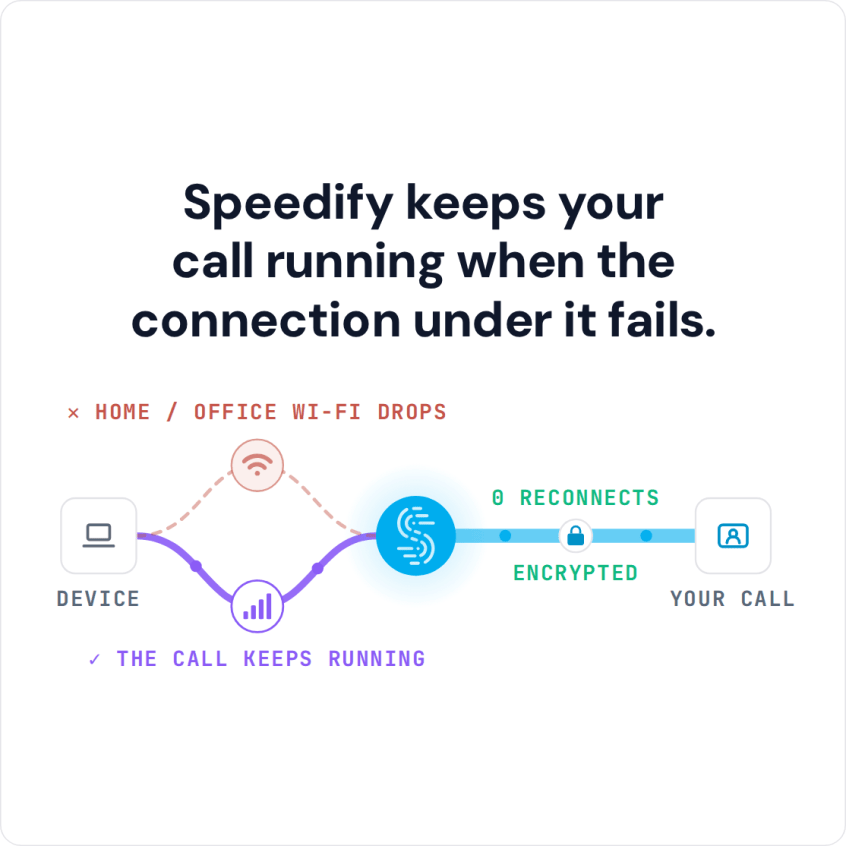
Speedify is an app that runs your internet over Wi-Fi, 4G/5G cellular, Ethernet, Starlink and satellite internet connections simultaneously, so a dip on one of them does not cut you off. Speedify can only keep you online through a drop when it has two or more internet connections to work with, for example Wi-Fi plus your phone’s 4G/5G cellular. On a single connection, Speedify works as an encrypted VPN and cannot stop that connection from dropping. What follows shows you how to check which of the two you are facing, how to troubleshoot Zoom, and how using Speedify stops your internet connection being the cause next time.
What Causes Zoom to Stop Working?
The symptoms of an unstable connection in using Zoom include:
- latency
- frozen screen
- poor quality audio and video
- meeting getting disconnected
If you’re having at least one of these symptoms, you’re experiencing a streaming emergency.
Is Zoom fully functional? Check out their service status page to confirm.
If you’re connecting to Zoom from work on an enterprise Internet connection, most probably the tech support team is already scrambling to fix it. It doesn’t hurt to give them a nudge, anyway.
When you have issues like Zoom not connecting while at home or on the go, then you must refer to your Internet infrastructure and your ISP. Here are the most popular causes:
- You’re too far away from the Wi-Fi router
- You have poor / slow cellular coverage
- Your network hardware needs an update or a restart
- There are temporary ISP infrastructure issues
- There are peering issues with Zoom servers
Zoom Troubleshooting Steps When Zoom Is Not Working
Start with Zoom itself. Update the Zoom app to the latest version, then test your microphone and speakers in Zoom’s audio settings. A wrong microphone or speaker choice can leave a meeting silent even on a good internet connection.
Then read the message Zoom shows. A banner saying “Your internet connection is unstable” or the error “Please check your network connection” means the internet connection is the problem, not the Zoom app, and the steps below apply.
Next, test your internet speed to see whether it is fast enough for Zoom video calls: Zoom needs at least 2 Mbps upload and 2 Mbps download.
Assuming that nothing is wrong with the Zoom service itself, here’s the quickest way to troubleshoot and fix Zoom not connecting errors:
- Move closer to the Wi-Fi router or, better yet, use a wired Ethernet connection if possible.
- Move around till you get better cellular coverage, if no other connections are available.
- Close other apps and downloads that use your bandwidth, then restart your modem, router and the device you’re running Zoom on (computer, smartphone). You may also update your router’s firmware, if that’s available.
- Check if your ISP is having temporary issues. They should have a status page or at least a social media account to communicate that.
- If you have 2 or more Internet connections available, use them at once. Most likely, you have 4G/5G cellular available on your smartphone, so you can combine that with your home Internet. You’ll need an app that combines internet connections, like Speedify, for that.
How Speedify Keeps Zoom Working When One Connection Drops
The Speedify team tested Zoom on a laptop and on a smartphone while running Speedify, simulating bad Internet conditions. The results showed Speedify could keep the average Zoom video call bandwidth on both devices in a good range around the target bandwidth. And this happened both in situations where the connections were good and when one of them went bad.
So how does Speedify achieve that? Speedify combines internet connections, which allows you to use multiple Internet connections at once. On your smartphone, Speedify combines Wi-Fi and 4G/5G cellular. On a computer, there’s more flexibility about the number and type of connections.
Speedify also reroutes data when something happens to one of your connections. When you stumble upon a bad Wi-Fi hotspot, or one connection suddenly goes out, Speedify intelligently and automatically reroutes your data through the other available connection(s) in milliseconds and keeps the same public IP address, so the Zoom call keeps going.
The beauty of it is that Speedify does more than just manage your Internet connections. Speedify also encrypts all of the data you send and receive from your device, like a VPN. This helps keep your private information and conversations secure from digital eavesdroppers and cyber thieves.
Speedify
Get started with Speedify today.
Speedify combines Wi-Fi, 4G/5G cellular, Ethernet, Starlink and satellite into one faster, more reliable internet connection. Free to try: 5 GB a month with a free account. No credit card required.
🚀 Speed
Faster uploads and downloads, because Speedify uses all your internet connections at once.
📶 Stability
If one internet connection drops, Speedify moves your traffic to the others in milliseconds.
🔒 Security
AES-256 encryption on every internet connection, on any network you join.



15M+ downloads worldwide. 75K+ five-star reviews on iOS and Android.