

The Best Backup Internet Options for Remote Workers
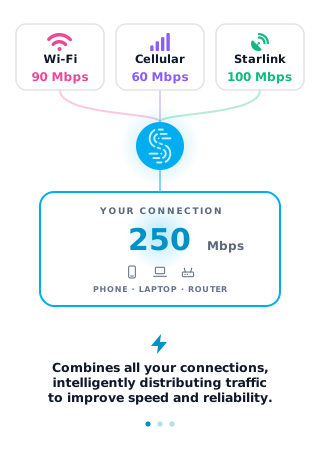
Speedify turns a second internet connection, cellular, a neighbor’s guest Wi-Fi, a hotspot, into an active backup rather than a cold spare that has to be switched on manually. Speedify’s channel bonding technology keeps both internet connections live at once, so work traffic shifts to whichever line is healthy without anyone noticing the switch happen.
<1 sec
With Speedify, your internet stays on when one connection fails.
When one of your internet connections drops, Speedify shifts your traffic to your remaining connections in under a second — so calls don’t cut out and downloads don’t stall.
Should you have a backup 4G, 5G, Starlink, or cable internet connection?
Yes — every internet connection goes down, including Starlink, which drops for ~34 minutes a day on average. A backup connection from a different provider means one outage never takes you fully offline. The most common options are a 4G/5G cellular hotspot, a cable or DSL line, or a second satellite dish.
4G/5G cellular
Works anywhere. Just a SIM or hotspot — no installation needed.
Learn more →Cable / DSL
Best for fixed locations. Different network, so outages rarely overlap.
Learn more →Second Starlink
Adds redundancy and throughput for remote sites or heavy usage.
Learn more →Speedify bonds any two connections into one — automatic failover, more speed, no dropped calls.
Try Speedify free →

Backup internet options compared: hotspot, second ISP, tethering, Starlink
A phone hotspot is the most common backup, cheap to set up and available almost everywhere with cellular coverage, though data caps limit how long it can carry a full workday. A second ISP, cable alongside DSL, or fiber alongside fixed wireless, gives the most independence from a single provider’s outages, at the cost of paying for two subscriptions.
Tethering a laptop directly to a phone works in a pinch but ties up the phone and drains its battery fast. Starlink adds a genuinely independent backup path for anyone far enough from cell towers that a hotspot isn’t a reliable option either.
Cold failover vs always-on bonding
Cold failover means a backup connection sits idle until something detects the primary is down, then switches over, a process that often takes long enough to drop an active call or freeze a video stream mid-frame. Always-on bonding keeps both connections carrying traffic simultaneously, so there’s no detection delay and no reconnection handshake to wait through.
This matters most for anyone trying to build reliable internet while working from anywhere, since a bonded setup with Speedify’s Streaming Mode keeps video calls smooth through exactly the kind of brief interruption that would otherwise force a reconnect.

NEW!
Miri X510 Bonding Router
POWERED BY SPEEDIFY
Bond up to 7 Links Simultaneously
Combine wired, Wi-Fi, 5G, and LTE connections plus Pair & Share with other Speedify users.
Battery-powered Portability
How Speedify turns any backup internet into seamless failover
Speedify treats a hotspot, a second ISP line, or Starlink as an active part of the connection rather than something waiting in reserve. Speedify fails over in under a second when the primary line degrades or drops, and because both connections were already carrying some traffic, there’s no visible interruption for the person on the call.
All of this happens encrypted under a strict no-logs policy, so adding a backup connection doesn’t mean exposing work traffic to whatever network it happens to ride.
Cost and data considerations, and recommended setups by situation
A hotspot-based backup costs the least upfront but requires watching data caps closely, since bonding pulls from both connections rather than one, and heavy video use adds up fast on a limited plan. A second wired ISP costs more monthly but has no data cap to worry about, which suits anyone on video calls most of the day. Starlink sits at the higher end of the cost range but pays off for remote workers in areas where cellular coverage is weak enough that a hotspot wouldn’t help anyway.
- Identify the primary connection and its typical failure pattern, outages, congestion at certain hours, or both.
- Pick a backup that covers that specific weakness: a second ISP for outages, cellular for local congestion.
- Download Speedify and add both connections as bonded sources.
- Set the backup connection’s priority so bonding leans on it appropriately given its cost or data limits.
Bonding needs two working connections to do anything useful, and it won’t turn a slow backup into a fast one. What it does reliably is remove the gap between a primary connection failing and a person actually noticing, which is often the difference between a client never knowing there was a problem and a call that visibly drops.
Backup Internet for Remote Workers: FAQ
Does Speedify work with a mobile hotspot as the only backup connection?
Speedify bonds a mobile hotspot with a primary line without issue, and that combination covers most remote workers whose main risk is an ISP outage.
How does Speedify decide how much traffic goes to the backup connection?
Speedify measures latency, loss, and throughput on each connection continuously and adjusts the split automatically, favoring whichever connection performs better at that moment.
Will Speedify drain a phone’s battery faster when it’s used as a backup hotspot?
Speedify itself doesn’t change how a hotspot uses phone battery beyond normal hotspot operation, though keeping the connection actively bonded means the phone stays in hotspot mode longer than an idle cold-standby setup would.
Can Speedify secure work traffic when it’s routed over a home Wi-Fi backup or public network?
Speedify encrypts traffic under a strict no-logs policy across every connection it bonds, so a backup network doesn’t need to be trusted the way it would without Speedify running.
Alex and the Speedify team are always exploring the latest in networking and security technology—like 5G, 6G, WiFi 7, laser and satellite internet—and sharing it in new discussion content across YouTube, TikTok, Instagram, and LinkedIn every week.
Got a tech question? Let's go deeper! Pop into Speedify Office Hours live every Wednesday at 10 AM Eastern. Speedify CEO Alex Gizis and our network engineers are standing by to break down your questions about networks, tech updates, and Speedify features.

Speedify
Get started with Speedify today.
Combine Wi-Fi, 4G/5G cellular, Ethernet, Starlink, and more into one faster, steadier connection. Free to try — no credit card required.
🚀 Speed
Faster uploads and downloads by bonding all your connections at once.
📶 Stability
Automatic failover in under a second when any connection drops.
🔒 Security
AES-256 encryption on every connection, on every network you join.


15M+ downloads worldwide. 75K+ five-star reviews on iOS and Android.