

Use Two Starlink Dishes for Speed and Reliability with Speedify
Get a second Starlink if going offline costs you money, if your household regularly needs more speed than one Starlink dish gives in the evening, or if Starlink is the only fast internet where you live. If one Starlink dish is fine most of the time, adding 4G/5G cellular is usually the cheaper fix.
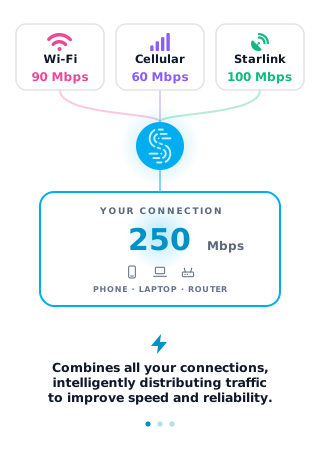
Either way, a second Starlink dish only helps if you use both at once. You can connect two Starlink dishes together with Speedify, which uses both Starlink internet connections at the same time, for more speed and fewer drops.
Speedify combines multiple Starlink dishes for failover and faster uploads and downloads
Starlink Internet Connection Drops Happen to Everyone
Speedify measures thousands of Starlink users in more than 140 countries. In September 2026, fixed Starlink dishes went offline for about 38 minutes a day on average, and Starlink dishes on RVs and boats for about 46 minutes a day.
All Starlink dishes also see short dropouts roughly every 15 seconds as the Starlink internet connection switches from one moving satellite to the next. Even a perfectly installed Starlink dish goes offline, and about 7 in 10 Starlink users on Speedify use Starlink together with a second internet connection, like 4G/5G cellular.
What One Starlink Dish Gives You
Before you decide on a second Starlink dish, look at what one gives you. Starlink says one Starlink dish gets downloads of 45 to 280 Mbps, with most people getting over 100 Mbps, and uploads of 10 to 30 Mbps. The delay is usually 25 to 60 milliseconds on land.
That’s enough for most homes. It gets tight if your work depends on the internet, if several people upload, stream and make video calls at the same time, or if you can’t afford a drop in the middle of a call.
The Weak Spots of One Starlink Dish
One Starlink dish has the same weak spots as any single internet connection. A second Starlink dish covers the last two. The first three hit both Starlink dishes at once, so a second one only softens them:
A busy Starlink network: when many people near you are online at the same time, usually in the evening, everyone’s speed drops. Rural areas are often less busy than suburbs.
Weather: heavy rain, snow and storms weaken the satellite signal, which causes slowdowns or short drops.
Starlink network updates: SpaceX, the company that runs Starlink, sometimes works on its satellites, which can affect service in some areas for a while.
One thing that can break: if your only Starlink dish breaks or gets damaged, you’re offline until it’s fixed or replaced.
The top speed of one Starlink dish: a household or business running several video calls, large file transfers and cloud backups at once can use up everything one Starlink dish has.


Should you get a second Starlink? Besides work or a business that can’t go offline, it pays off in these situations:
You create and stream video: uploading large video files and live streaming need the upload speed of both Starlink dishes.
You have a big household: several people working from home, students on video calls and a lot of streaming can use up one Starlink dish.
How Two Starlink Dishes Work Together
Plugging in a second Starlink dish doesn’t double your speed. Your devices still use one Starlink internet connection at a time. To use both at once, you need a router or an app that combines internet connections, like Speedify, which runs on computers, phones and tablets, and on routers for the whole house.
Both Starlink dishes at once: Speedify sends your internet traffic over both Starlink dishes at the same time, encrypted. Your devices see one fast internet connection.
More speed: you get nearly the full speed of both Starlink dishes combined. There’s always a little lost along the way, so two Starlink dishes won’t give you exactly twice the speed of one.
Automatic switching: if one Starlink dish has a problem, Speedify moves all your traffic to the other one, without dropping your calls or downloads.
The better Starlink dish gets more: Speedify checks both Starlink dishes all the time and sends more of your traffic through whichever one is doing better at that moment.
Should You Get a Second Starlink or Use Starlink with a Different Internet Connection?
Depending on where you live and what you need, a different kind of internet connection used together with your Starlink dish may do more for less money. Two Starlink dishes still use the same Starlink network, so an outage of the whole Starlink network takes both down. A different kind of internet connection doesn’t go down with it.
Starlink and 4G/5G cellular: a phone hotspot or a cellular modem uses a completely different network from Starlink, so the two rarely fail at the same time. With Speedify’s cellular sharing, phones on the same Wi-Fi can add their 4G/5G cellular data too.
Starlink and fixed wireless: if a local provider offers internet by radio link from a nearby tower, using it together with Starlink gives you a strong spare.
Starlink and cable, DSL or fiber: where you can get both, using Starlink together with a wired line gives you the best protection against going offline.
What a Second Starlink Costs
Before you use two Starlink dishes together with Speedify, count what a second Starlink costs you:
- The Starlink kit: a second Starlink dish costs several hundred dollars. Check starlink.com for the price in your country.
- A second subscription: each Starlink dish needs its own monthly plan.
- Power and mounting: a second Starlink dish uses more electricity and needs its own spot with a clear view of the sky.
If going offline costs you income, the downtime and lost work a second Starlink dish prevents can be worth more than these costs.
Making the Decision: Should You Get a Second Starlink?
Whatever you add, a second Starlink dish or a different kind of internet connection, you need to use it together with your first Starlink dish at the same time. That’s what Speedify does. Then:
Get a second Starlink if:
- Going offline hurts your work or your income
- You regularly use up all the speed of one Starlink dish
- Starlink is the only fast internet where you live
- You run a business that has to stay online


Try another kind of internet connection first (4G/5G cellular, fixed wireless, cable or DSL) if:
- You can get another internet provider to use together with your Starlink dish
- One Starlink dish is fast enough most of the time
- Two Starlink subscriptions don’t fit your budget
Speedify
Get started with Speedify today.
Combine Wi-Fi, 4G/5G cellular, Ethernet, Starlink, and more into one faster, steadier connection. Free to try — no credit card required.
🚀 Speed
Faster uploads and downloads by bonding all your connections at once.
📶 Stability
Automatic failover in under a second when any connection drops.
🔒 Security
AES-256 encryption on every connection, on every network you join.


15M+ downloads worldwide. 75K+ five-star reviews on iOS and Android.