

Speedify Combines Two or More Starlink Dishes into One Faster, More Reliable Internet Connection
Yes, you can use two Starlink dishes together, and the second Starlink dish doesn’t have to sit idle as a spare. Starlink doesn’t combine the speeds of two Starlink dishes for you, but Speedify does: it uses both Starlink internet connections at the same time, for nearly the full download and upload speed of both.
Below: what it takes to run two Starlink dishes at once, how Speedify sees and uses both, who it helps, and what you need to set it up.
Speedify combines multiple Starlink dishes for failover and faster uploads and downloads
Starlink Internet Connection Dropouts Happen to Everyone
Speedify measures thousands of Starlink users in more than 150 countries. From 29 September to 12 October 2026, fixed Starlink dishes went offline for about 37 minutes a day on average, and Starlink dishes on RVs and boats for about 61 minutes a day.
Starlink also switches each dish to a new satellite every 15 seconds, and a switch can cause a short dropout. Even a perfectly installed Starlink dish goes offline, and about 7 in 10 Starlink users on Speedify use Starlink together with a second internet connection, like 4G/5G cellular.
Running Two Starlink Dishes at Once: Subscriptions, Status and Using Both
Nothing stops you from installing two Starlink dishes at one place. Each Starlink dish needs its own subscription, and one Starlink account can hold several Starlink dishes under one login.
The hard part is using both at once. A typical router or computer sends your traffic over one internet connection at a time and treats the second Starlink dish as a spare. Watching both is tricky too: every Starlink dish uses the same address, 192.168.100.1, so from one computer you can reach the status page of only one of them at a time. Speedify talks to each Starlink dish separately, so the status of both shows up at once, and it uses both instead of keeping the second as a spare. For a closer look at how Speedify handles the shared address, see how to manage two Starlink dishes at once with Speedify.
How Speedify Uses Two Starlink Dishes at the Same Time
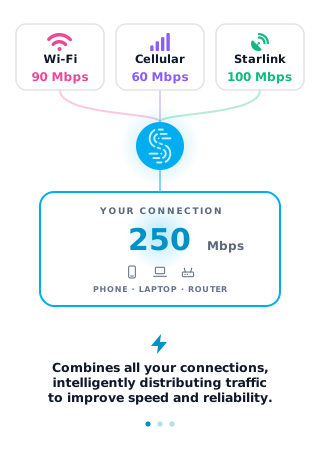
Speedify uses all your internet connections at the same time. It splits your internet traffic across both Starlink dishes and sends each piece over whichever Starlink dish is doing better at that moment, so the two work as one internet connection. When both Starlink dishes are doing well, you get nearly the full download and upload speed of both combined.
This isn’t a router that puts each app on one Starlink dish. Speedify uses both Starlink dishes for the same download or upload at the same time. If something blocks one Starlink dish or it drops out, Speedify moves all your traffic to the other one without interrupting your video calls, uploads or VPN connection.
Both Starlink dishes still use the same Starlink network, so an outage of the whole Starlink network takes both down. Every Starlink dish also switches satellites on the same 15-second schedule, so the short drop at each switch hits both dishes at the same moment. A 4G/5G cellular connection added to Speedify keeps you online through both.
Who Gains from Using Two Starlink Dishes Together: Three Examples
Three examples, from a home office to a construction site, show who gets the most from two Starlink dishes used together with Speedify:
A remote worker in the countryside. Someone working from a property with no cable or fiber depends on Starlink for every video call. A tree branch partly in the way of the Starlink dish can freeze a call at the wrong moment. A second Starlink dish in a different spot, used together with Speedify, keeps the call going when one Starlink dish stutters, because Speedify is already sending the call over both.
A live streamer broadcasting from the road. A creator streaming live from a remote place can’t stop to reconnect: a short drop ends the stream. Two Starlink dishes used together with Speedify give the upload speed live video needs, and the second Starlink dish holds the stream together if the first one is blocked or fails.
A remote construction site. A construction company running a site office miles from the nearest cell tower has no wired internet and often weak cellular. One Starlink dish covers the site until it breaks or the weather turns, and then the whole site goes offline. Two Starlink dishes used together with Speedify keep payroll, design files and site cameras online when one Starlink dish fails.
What You Need to Use Two Starlink Dishes with Speedify
- Two Starlink subscriptions, one for each Starlink dish.
- A device that can connect to both Starlink dishes. A laptop or desktop computer that can connect to two networks at once (for example Wi-Fi and Ethernet), or a router that works with Speedify and takes several internet connections, to cover your whole home or office.
- Speedify on that device. Speedify runs on Windows, macOS, iOS, Android, Linux and OpenWrt routers.
Connect both Starlink dishes, open Speedify, set both Starlink internet connections to Primary, and Speedify starts using both Starlink dishes right away. For where to place the two dishes, see subscriptions and spacing for multiple Starlink dishes.
Two Starlink Dishes Work Better Together with Speedify
On its own, a second Starlink dish is a spare you switch to after something breaks. Used together with Speedify, two Starlink dishes become one internet connection that runs on both at the same time, adds up their speed, and keeps you online when one Starlink dish fails. See why a second Starlink dish is worth adding. Speedify makes your Starlink faster, more reliable, and more secure, whether you run one Starlink dish or several.
Speedify
Get started with Speedify today.
Speedify combines Wi-Fi, 4G/5G cellular, Ethernet, Starlink and satellite into one faster, more reliable internet connection. Free to try: 5 GB a month with a free account. No credit card required.
🚀 Speed
Faster uploads and downloads, because Speedify uses all your internet connections at once.
📶 Stability
If one internet connection drops, Speedify moves your traffic to the others in milliseconds.
🔒 Security
AES-256 encryption on every internet connection, on any network you join.


15M+ downloads worldwide. 75K+ five-star reviews on iOS and Android.