

Speedify Keeps Your Starlink Online Even When Antenna Placement Isn’t Perfect
Starlink antenna placement is the biggest thing that decides how fast and steady your Starlink internet connection is. The antenna is the Starlink dish itself. Starlink sells three main antenna types, and placement matters for all of them. Mount it high, with a clear view of the open sky, and you get fewer drops and steadier speeds.
Below: where to put a Starlink dish for the best speeds, how to check a spot before you drill, and what to do when no spot on your property has a fully clear view.
Speedify combines Starlink internet connections with no extra hardware needed
Starlink Internet Connection Drops Happen to Everyone
Speedify measures thousands of Starlink users in more than 140 countries. In September 2026, fixed Starlink dishes went offline for about 38 minutes a day on average, and Starlink dishes on RVs and boats for about 46 minutes a day.
All Starlink dishes also see short dropouts roughly every 15 seconds as the Starlink internet connection switches from one moving satellite to the next. Even a perfectly installed Starlink dish goes offline, and about 7 in 10 Starlink users on Speedify use Starlink together with a second internet connection, like 4G/5G cellular.
Where to Place a Starlink Antenna for the Best Speeds
A Starlink dish follows the satellites moving overhead, so it needs a clear view of the open sky above it, not of the horizon. The basics:
- Mount it high and in the open. The higher the Starlink dish sits above nearby trees, chimneys and rooflines, the less of the sky they block. With two Starlink dishes, mount the two antennas apart, each with its own clear view of the sky.
- Face the right part of the sky. In the Northern Hemisphere, a Starlink dish looks mostly toward the northern sky, and in the Southern Hemisphere, toward the southern sky. Keep the sky in that direction as open as you can.
- Check before you drill. Check for Obstructions in the Starlink app scans the sky from where you stand and shows how much of it is blocked. Hold your phone exactly where the Starlink dish will go, at the same height, before you mount anything.
- On boats and vehicles, keep it away from other antennas. Radar and other transmitters can interfere with the Starlink dish.
Aim for no obstruction at all. Even a small blocked area causes short drops, and those drops are what freeze video calls and stall uploads.
Why Your Starlink Internet Connection Still Drops with a Good Antenna Placement
A good spot cuts the obstructions. It can’t remove every drop. Your Starlink dish switches to a new satellite about every 15 seconds, and each switch can cause a short drop, even under a clear sky. Heavy rain and snow weaken the signal wherever the Starlink dish sits. And one Starlink dish is still one thing that can fail.
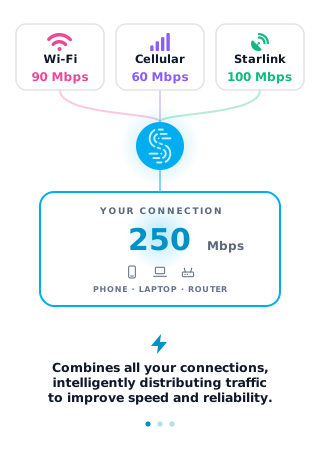
Speedify uses every internet connection you have at the same time. Add a 4G/5G cellular connection, a second Starlink dish, or any other internet connection, and Speedify uses them together with your Starlink dish. Speedify also has a Starlink Control Center where you can watch your Starlink dishes, read their obstruction maps and line up two Starlink dishes so they work better together.
If your Starlink dish drops during a satellite switch or because something blocks it, Speedify moves your traffic to your other internet connection, so what you’re doing keeps going. There’s more on the switches in how Speedify prevents disconnections from Starlink satellite switches.
When the Best Spot for Your Starlink Dish Still Isn’t Good Enough
Here are three situations where antenna placement alone won’t stop the drops, but using Starlink together with a second Starlink dish or another internet connection will:
A rural home surrounded by trees. If your only mounting spot is partly blocked by tall trees, you can’t move the forest. With a 4G/5G cellular connection, or a second Starlink dish on a clearer side of the roof, a blocked view on one no longer drops your whole internet connection.
A remote worker living in a van. If you work from a different campsite every week, you can’t find a perfectly clear spot each time. Speedify uses your Starlink dish together with a cellular hotspot, so a so-so spot still holds your video call together.
A remote lodge or field office. If there’s only one usable spot on the roof, surrounded by hills, you’re stuck with the sky that spot sees. A second Starlink dish mounted at a different angle, used together with the first through Speedify, covers the part of the sky the first one can’t see.
How to Add a Second Internet Connection to Your Starlink with Speedify
- Install Speedify. Speedify runs on Windows, macOS, iOS, Android, Linux and OpenWrt routers.
- Connect both internet connections. Plug in your Starlink dish and your second internet connection, whether that’s 4G/5G cellular, another Starlink dish or wired internet. To cover your whole network, use a router that works with Speedify.
- Set both to Always in Speedify. Speedify then uses both internet connections at the same time, and switches right away if one drops. To save cellular data, set the cellular connection to Backup instead, so Speedify uses it only when Starlink drops.
Good Starlink Antenna Placement Plus Speedify Gives You the Most Reliable Starlink Internet Connection
Put your Starlink dish in the highest spot with the clearest view you can, check it with Check for Obstructions in the Starlink app, and face it toward the open sky. Then add a second internet connection, so the drops that placement can’t prevent stop mattering. Speedify needs that second internet connection: with one Starlink dish alone, it can’t stop the drops. Download Speedify to use both.
Speedify
Get started with Speedify today.
Combine Wi-Fi, 4G/5G cellular, Ethernet, Starlink, and more into one faster, steadier connection. Free to try — no credit card required.
🚀 Speed
Faster uploads and downloads by bonding all your connections at once.
📶 Stability
Automatic failover in under a second when any connection drops.
🔒 Security
AES-256 encryption on every connection, on every network you join.


15M+ downloads worldwide. 75K+ five-star reviews on iOS and Android.