

Speedify’s Starlink Control Center Helps You Aim Each Starlink Dish So Your Starlink Dishes Work Better Together
To align a Starlink dish, give it the clearest view of the sky you can, and check the obstruction map in the Starlink app for anything blocking it. To align two or more Starlink dishes, don’t point them all the same way: aim each one at a different part of the sky, or the second Starlink dish sees the same obstructions as the first and adds little.
Speedify, an app that uses all of your internet connections at the same time, including two or more Starlink dishes, has a setting for exactly this in its Starlink Control Center, called Bonding Alignment. It works out a separate target direction for each Starlink dish. Below: what the setting changes, how to realign your Starlink dishes with it, and why it gets you faster, steadier internet.
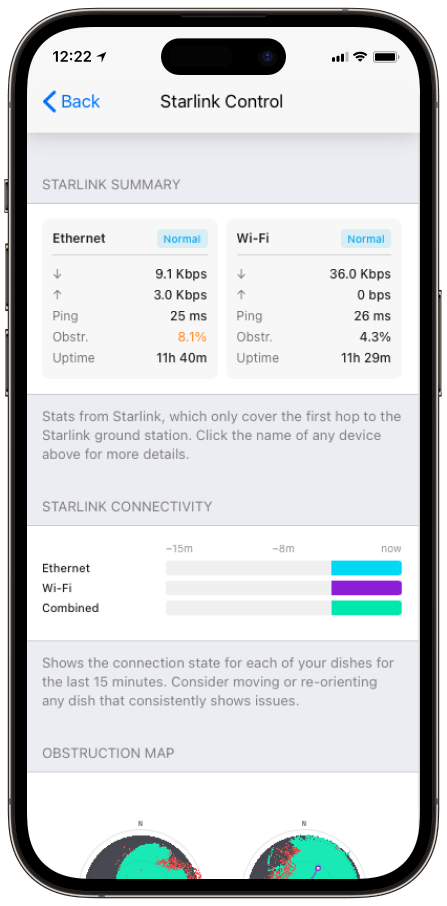
Monitor your Starlink dish performance inside Speedify.
Starlink Internet Connection Dropouts Happen to Everyone
Speedify measures thousands of Starlink users in more than 150 countries. From 29 September to 12 October 2026, fixed Starlink dishes went offline for about 37 minutes a day on average, and Starlink dishes on RVs and boats for about 61 minutes a day.
Starlink also switches each dish to a new satellite every 15 seconds, and a switch can cause a short dropout. Even a perfectly installed Starlink dish goes offline, and about 7 in 10 Starlink users on Speedify use Starlink together with a second internet connection, like 4G/5G cellular.
What the Bonding Alignment Setting in Speedify Changes
- A separate target for each Starlink dish. With Bonding Alignment on, the Alignment Wizard gives each Starlink dish its own target direction, instead of the same one it would give a single Starlink dish. Once both are aimed, Speedify’s Setup Analysis report shows which Starlink dish still has a problem.
- A different part of the sky for each Starlink dish. The targets are worked out so your Starlink dishes cover separate parts of the sky.
- No change for a single Starlink dish. Bonding Alignment only does something when two or more Starlink dishes are connected.
How to Realign Two Starlink Dishes with Bonding Alignment
- Turn on Bonding Alignment in the Alignment section of Speedify’s Starlink Control Center.
- Select the first Starlink dish on the Dish Orientation card to open the Alignment Wizard, Speedify’s step-by-step tool for aiming a Starlink dish, and turn the Starlink dish until it reaches its new target direction. The wizard beeps faster as you get closer, so you can aim your Starlink dish by ear.
- Do the same for each of your other Starlink dishes.
Why Aiming Starlink Dishes at Different Parts of the Sky Cuts Dropouts
Two Starlink dishes aimed at the same sky see the same obstructions, so one tree or roofline cuts both at once, and the second Starlink dish adds little. Two Starlink dishes aimed at different parts of the sky are blocked by different things, so an obstruction on one is less likely to hit the other at the same moment. Satellite switches are the exception: every Starlink dish switches satellites on the same 15-second schedule, so both Starlink dishes drop for a moment together, however they are aimed.
Starlink itself says more than one Starlink dish is worth using where one can’t see the whole sky, and Bonding Alignment makes sure your Starlink dishes split that sky between them instead of fighting over the same part of it.
How Speedify Uses Two Starlink Dishes Aimed Apart
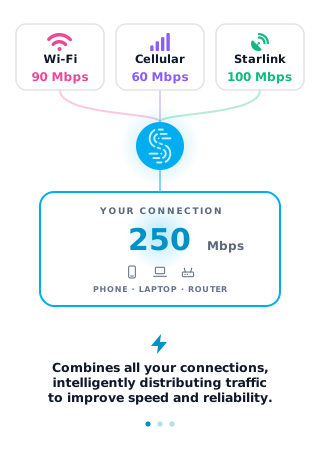
Once your Starlink dishes are aimed apart, Speedify sends your traffic over both at the same time, so you get the upload and download speed of both combined. If one drops, Speedify switches your traffic to the other automatically, so your internet keeps going through obstructions that would interrupt a single Starlink dish. For the short dropouts at each satellite switch, which hit both Starlink dishes at once, add 4G/5G cellular.
Speedify works the same way with any mix of Wi-Fi, 4G/5G cellular, Ethernet and Starlink. With one Starlink dish and nothing else, Speedify can’t make downloads and uploads faster or stop dropouts: it needs a second internet connection.
Who Gets the Most from Bonding Alignment
- Boats, broadcast trucks and mobile teams. Anywhere two Starlink dishes share a roof or a deck and each needs to pull its own weight.
- Remote sites with only part of the sky open. Splitting two Starlink dishes across the open sky you have beats pointing both at the same gap.
- Anyone adding a second Starlink dish for failover. Aiming the second Starlink dish at different sky is what makes it a real second internet connection, not a copy of the first.
Align Your Starlink Dishes Apart, Then Use Them Together with Speedify
Bonding Alignment makes sure your Starlink dishes cover different parts of the sky. Speedify then uses them together as one internet connection that’s faster and harder to knock offline than either Starlink dish alone. For more on how that works, see how Speedify combines internet connections.
Speedify
Get started with Speedify today.
Combine Wi-Fi, 4G/5G cellular, Ethernet, Starlink, and more into one faster, steadier connection. Free to try — no credit card required.
🚀 Speed
Faster uploads and downloads by bonding all your connections at once.
📶 Stability
Automatic failover in under a second when any connection drops.
🔒 Security
AES-256 encryption on every connection, on every network you join.


15M+ downloads worldwide. 75K+ five-star reviews on iOS and Android.