

Speedify Keeps You Online While You Troubleshoot a Dead Starlink Internet Connection
When Starlink stops working, the cause is usually one of a few things: a Starlink outage, a loose cable, a Starlink dish that needs a restart, a blocked view of the sky, bad weather, or a Starlink router problem. Speedify’s engineers walk through every way Starlink can fail in a video.
Starlink Internet Connection Drops Happen to Everyone
Speedify measures thousands of Starlink users in more than 140 countries. In September 2026, fixed Starlink dishes went offline for about 38 minutes a day on average, and Starlink dishes on RVs and boats for about 46 minutes a day.
All Starlink dishes also see short dropouts roughly every 15 seconds as the Starlink internet connection switches from one moving satellite to the next. Even a perfectly installed Starlink dish goes offline, and about 7 in 10 Starlink users on Speedify use Starlink together with a second internet connection, like 4G/5G cellular.
Speedify keeps you online through Starlink outages and bad weather
Step 1: Check Whether Starlink Is Not Working Due to a Starlink Outage
- Open the Starlink app, or go to dishy.starlink.com in a browser while connected to the Starlink router.
- Look at the reason the Starlink dish reports for being offline, such as “no signal received”, “obstructed”, or a service outage. If it reports a weak signal, see what to do about low Starlink SNR.
- Check the Starlink Help Center for service status.
If it’s a Starlink outage: Wait for service to return. There’s nothing to fix on your end. To stay online during a Starlink outage, see the last section.
If the Starlink dish is online but your devices have no internet: Go to Step 6.
Otherwise: Continue to Step 2.
Step 2: Check Starlink Power and Cables
- Confirm the Starlink dish and router have power.
- Make sure the cable from the Starlink dish to the Starlink router is firmly plugged in at both ends.
A partly unplugged Starlink dish cable is one of the most common causes of Starlink not working.
Step 3: Restart Your Starlink Dish
- Unplug the Starlink power supply.
- Wait 30 seconds.
- Plug the power supply back in and give the Starlink dish a few minutes to reconnect to satellites.
Step 4: Check for Obstructions
Check for trees or roofs blocking the Starlink dish’s view of the sky. Use the obstruction map in the Starlink app to see what’s in the way, and move the Starlink dish if needed.
Step 5: Check the Weather
Heavy rain or snow can weaken the satellite signal temporarily. Snow on the Starlink dish blocks it until the built-in heater melts it or you brush it off.
Step 6: Check the Starlink Router and Wi-Fi
- Unplug and replug all router connections.
- Plug the Starlink router power supply into a different outlet.
Step 7: Swap the Starlink Cable or Reset the Starlink Router
- Swap the Starlink dish cable if you have a spare.
- Factory reset the Starlink router if nothing else works. This erases your Wi-Fi name and password, so write them down first.
Step 8: Contact Starlink Support
If the Starlink internet connection still isn’t back, the Starlink dish or cable may have failed. Contact Starlink support for a repair or replacement.
Who Is Most Affected by Starlink Not Working?
- Rural and remote users: With no wired backup internet connection, one Starlink dish going down means no internet at all.
- RV and boat users: A moving Starlink dish loses and reconnects to satellites more often, so brief Starlink dropouts are routine.
- Remote workers using a single Starlink dish: A dropped call or stalled upload during the workday is the cost of relying on one Starlink internet connection.
Stay Online While You Fix Starlink with Speedify
Every step above takes time, and with only one Starlink internet connection you’re offline the whole time. Speedify solves that.
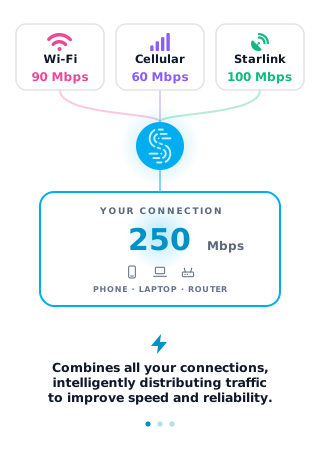
Speedify combines Starlink with 4G/5G cellular, Wi-Fi, wired Ethernet, or a second Starlink dish into one reliable internet connection. When the Starlink dish drops out, Speedify automatically moves your calls, streams and downloads to your other internet connections, so they keep running while you fix the Starlink problem.
If you already use Speedify with Starlink, the Starlink Control Center in the Speedify app shows your Starlink dish’s stats. To track how long your Starlink internet connection stays up and catch drops as they happen, see how to monitor Starlink outages and uptime with Speedify, or learn how Speedify combines internet connections.
Speedify
Get started with Speedify today.
Combine Wi-Fi, 4G/5G cellular, Ethernet, Starlink, and more into one faster, steadier connection. Free to try — no credit card required.
🚀 Speed
Faster uploads and downloads by bonding all your connections at once.
📶 Stability
Automatic failover in under a second when any connection drops.
🔒 Security
AES-256 encryption on every connection, on every network you join.


15M+ downloads worldwide. 75K+ five-star reviews on iOS and Android.