

Speedify Keeps You Online While You Troubleshoot a Dead Starlink Internet Connection
This guide works through the checks in order, from fastest to most involved. It also shows how Speedify saves you time on troubleshooting Starlink issues by using a second internet connection – Wi-Fi, 4G/5G cellular, wired Ethernet or even a second Starlink – to carry your internet traffic.
Starlink disconnects all the time for ALL Starlink users. The Speedify Starlink Index report found that Starlink connections are down for an average of ~33 min per day. Plus, all Starlink dishes experience small drops and packet loss every 15 seconds, when the moving Starlink satellites hand off the connection to the next satellite overhead.
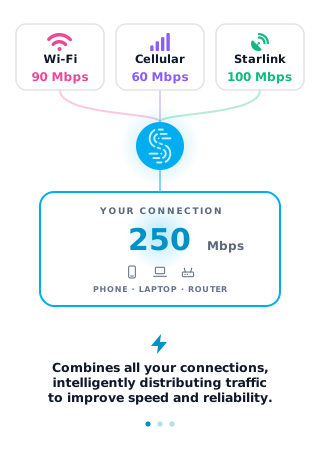
The best way to fix Starlink's connection drops is to combine your Starlink connection with another internet connection, such as 4G/5G cellular, cable, fiber, DSL, or another Starlink connection. Speedify makes this possible with channel bonding.
Daily Starlink downtime
~33 min
Starlink connections are unreachable for an average of 33 minutes every day — across 6,228 real-world dishes. That’s 2.3% of connected time.
Check These Starlink Basics First
- Power and cables. Confirm the router has power and the cable running from the dish to the router is seated at both ends. A partly unplugged dish cable is one of the most common reasons a connection drops.
- A reboot. Unplug the Starlink power supply, wait 30 seconds, and plug it back in. The dish takes a few minutes to reacquire satellites after a restart.
- Obstructions. A tree, mast, or roofline blocking the dish’s view of the sky causes brief, repeating dropouts. The Starlink app’s obstruction map shows where the view is blocked.
- Weather. Heavy rain or snow can degrade the signal temporarily. Snow sitting on the dish blocks it until the dish’s heater clears it or you brush it off.
- The Starlink app. Open the Statistics section in the Starlink app, or type dishy.starlink.com into a browser while connected to the Starlink router, to see uptime, outages, and the specific reason the dish reports for going offline.
- The Speedify app. If you’re using Speedify to combine two Starlink dishes together or a Starlink plus 4G/5G cellular, wired Ethernet or another Wi-Fi, you can find more about your Starlink stats in Speedify’s Starlink Control Center.
Is It Your Starlink Dish or a Starlink Outage?
Before you take anything apart, find out whether the problem is yours or Starlink’s. The Starlink app names the reason a dish is offline, for example no signal received, obstructed, or a stated outage. If the app reports a service outage, or thousands of other users are reporting one at the same time, the problem is on Starlink’s side and the fix is to wait. Starlink posts service status and troubleshooting steps in the Starlink Help Center.
If the app shows your dish online but devices still have no internet, the issue is more likely your router or Wi-Fi than the dish itself.
When a Reboot and a Clear View Don’t Fix It
If the basics check out and the dish still won’t connect, work through the cable and router next. Swap the Starlink dish cable if you have a spare, reseat the router connections, and try a different power outlet. A factory reset is a last resort and wipes your Wi-Fi network name and password, so note those down first. If none of that restores service, the dish or cable may have failed, and Starlink support is the next stop.
Who Runs Into Starlink Downtime Most
- Rural and remote users. With no wired backup available, a single dish going down means no internet at all.
- RV and maritime users. A moving dish loses and reacquires satellites more often, so brief dropouts are routine.
- Anyone working from a single Starlink. A dropped call or a stalled upload during a workday is the cost of relying on one connection.
Speedify and Starlink: a Dead Dish Doesn’t Have to Mean No Internet
Every fix above takes time, and during that time a single-connection setup is offline. Speedify removes that gap. Speedify combines Starlink with 4G/5G cellular, Wi-Fi, or a second dish into one bonded connection, and when the dish drops out, Speedify’s automatic failover carries your traffic on the remaining connections at the packet level, so calls and streams keep running while you troubleshoot.
To watch a Starlink dish’s uptime and catch drops as they happen, see how to monitor Starlink outages and uptime with Speedify, or learn how Speedify’s channel bonding technology works.
Alex and the Speedify team are always exploring the latest in networking and security technology—like 5G, 6G, WiFi 7, laser and satellite internet—and sharing it in new discussion content across YouTube, TikTok, Instagram, and LinkedIn every week.
Got a tech question? Let's go deeper! Pop into Speedify Office Hours live every Wednesday at 10 AM Eastern. Speedify CEO Alex Gizis and our network engineers are standing by to break down your questions about networks, tech updates, and Speedify features.

Speedify
Get started with Speedify today.
Combine Wi-Fi, 4G/5G cellular, Ethernet, Starlink, and more into one faster, steadier connection. Free to try — no credit card required.
🚀 Speed
Faster uploads and downloads by bonding all your connections at once.
📶 Stability
Automatic failover in under a second when any connection drops.
🔒 Security
AES-256 encryption on every connection, on every network you join.


15M+ downloads worldwide. 75K+ five-star reviews on iOS and Android.