
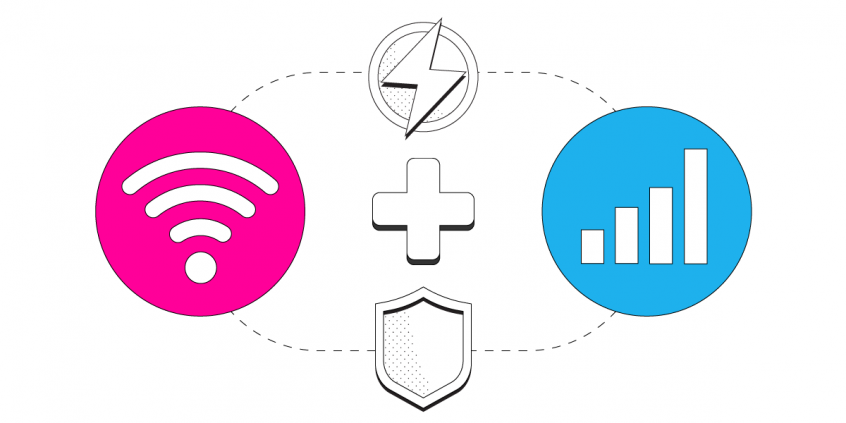
Internet Speed Test: 4G / LTE, and WiFi – Who Wins?
On paper Wi-Fi and 4G LTE are evenly matched – both are specified up to 1,000 Mbps. In practice they behave nothing alike, because a Wi-Fi network is shared with everyone else in the building and a cellular connection is shared with everyone else on the tower.
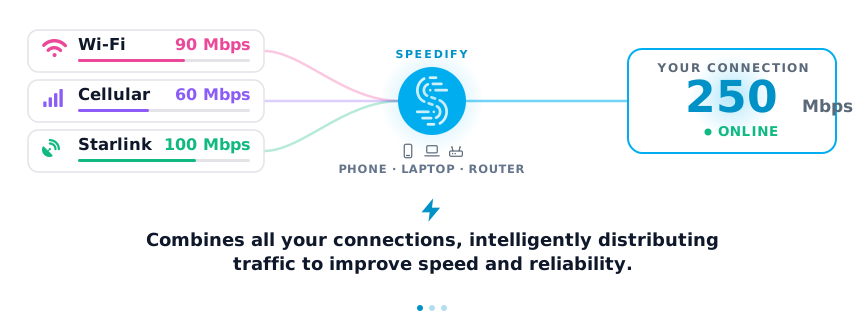
Which means the honest answer to “which is faster” is whichever one is having a better minute. Speedify is an app for your phone, computer or tablet that uses Wi-Fi and cellular data at the same time, so their speeds add together and the choice stops mattering. Take a look at what the speed tests showed, what really decides which connection wins, and how to run both at once.
With Speedify, your internet stays on when one connection fails.
When one of your connections drops, Speedify automatically routes your traffic to your remaining connections — so calls don't cut out and downloads don't stall.
How do I use WiFi and 4G/5G cellular at the same time with Speedify?
Pick your two internet connections and your device below and we'll take you to the step-by-step setup guide.


WiFi vs Mobile Data Speed – What Determines Who’s Faster?
There are several key factors involved in the speed you will actually get from a WiFi or 4G LTE connection. Apart the obvious technology differences, when determining the actual connection speed, you have to look at:
- infrastructure: does it support the new technologies? Is it constantly being updated? How many simultaneous connections does it support?
- coverage: are there enough hotspots / cell towers to get good coverage?
- interferences: due to buildings, walls, other wireless equipment, etc.
- client usage: static or moving around? How many people are connected to the same hotspot or cell tower?
For example, let’s assume a client commutes to work by bus. They can connect to the bus’ WiFi network, as can the other passengers. They can also use their 4G LTE connection. Given they will be on the move, their cellular connection will most likely be faster. That’s mainly because other passengers connect to the bus’ WiFi network and get a slice of the bandwidth.
WiFi Is Usually Faster than 4G LTE Mobile Data. However…
A recent OpenSignal study [PDF] proved that mobile networks are killing Wi-Fi for speed around the world in 33 countries at least. Things should be reconsidered, according to them – for example, why does a smartphone automatically assume that a WiFi network is faster than the mobile data connection?
There are so many situations where WiFi speed is much worse than mobile data. And it pretty much has to do with stumbling upon a bad (slow, non functional) WiFi hotspot to which your smartphone sticks – a.k.a. sticky WiFi.
WiFi vs Mobile Data Speed: What Smartphone Manufacturers Are Doing
Phone manufacturers are constantly trying to make them smarter when it comes to managing your connectivity. Features like iPhone’s WiFi Assist or Samsung’s Adaptive WiFi try to solve the issue. Unfortunately they don’t – the best they can do is switch between connections when hitting certain transfer or latency thresholds.
But what’s the goal here? Just determining which is faster – WiFi or mobile data – and then using that? Or getting the fastest speed in any given scenario? If you’re interested in the latter one, you need Speedify to combine both WiFi and mobile data at once into a super-connection.
Speedify Solves the WiFi vs Mobile Data Speed Choice: Uses Both for Combined Speed and Reliability and Security
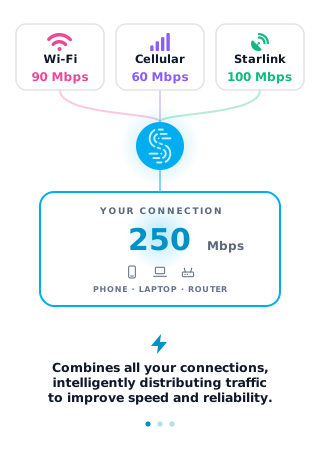
Speedify is a fast bonding VPN app that uses channel bonding technology to combine connections at once. It can bond 2 or more Internet links together at the same time on your computer or mobile device.
Just get Speedify on your device and make sure you enable both WiFi and mobile data on your smartphone. Speedify will use them both, as necessary, to give you the best Internet experience for your needs.
Real world situation: if the WiFi connection is bad or drops, Speedify will intelligently route traffic through mobile data. When WiFi connectivity is back, Speedify will begin to use that.
Being powered by VPN technology, Speedify also protects your private data from hackers and snoops. Everything is encrypted using the latest technologies and the service doesn’t collect any personal data about the online activities.
What are you waiting for? Don’t choose between WiFi and cellular data when it comes to speed. Use them both for their combined speed! Get Speedify today!
Speedify
Get started with Speedify today.
Combine Wi-Fi, 4G/5G cellular, Ethernet, Starlink, and more into one faster, steadier connection. Free to try — no credit card required.
🚀 Speed
Faster uploads and downloads by bonding all your connections at once.
📶 Stability
Automatic failover in under a second when any connection drops.
🔒 Security
AES-256 encryption on every connection, on every network you join.


15M+ downloads worldwide. 75K+ five-star reviews on iOS and Android.