

Fix Internet Issues on Windows with Speedify by Combining Starlink, Wi-Fi, Ethernet, 4G / 5G Cellular
A Windows PC can sit there reporting a healthy network while no website opens. Two causes dominate: a network adapter driver that stopped talking properly to Windows after an update, and a router that hands the PC a bad address, or none at all, because it has run out of addresses to give.
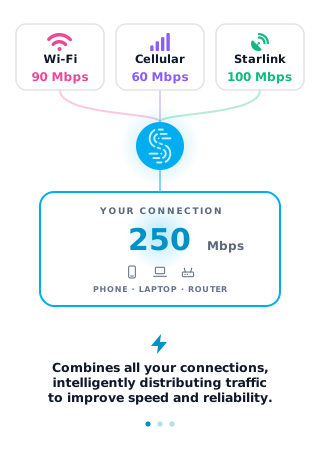
Speedify is a software app for Windows that draws on Wi-Fi, wired Ethernet, a tethered phone’s 4G/5G cellular data, Starlink and other internet connections at the same time. The sections below list the Windows repairs in order, then show what using Speedify does differently – your PC stays online because a second internet connection is already carrying the traffic.
Speedify keeps your devices online when Wi-Fi drops.
Why Your PC Internet Keeps Dropping
Losing internet connectivity on your Windows PC involves hardware, driver, and OS-level factors that differ significantly from mobile devices. Your computer manages network connections through multiple layers – physical hardware, device drivers, TCP/IP stack, and application-level protocols – each capable of failing independently. When your PC appears connected but can’t access the internet, isolating which layer failed determines your fix.
The most common culprits involve outdated network drivers, router DHCP exhaustion, DNS resolution failures, and Windows network configuration corruption. Each requires different troubleshooting approaches rather than generic restart solutions.
Common Reasons a PC Has No Internet Connection
Outdated or Corrupted Windows Network Drivers
Your network adapter requires updated drivers to communicate properly with Windows and your router. Corrupted drivers cause the adapter to appear active while failing to establish valid TCP/IP connections. Windows may not automatically update network drivers, leaving you vulnerable to compatibility issues after OS updates. Driver conflicts between chipset manufacturers (Realtek, Intel, Qualcomm) and your motherboard can create silent failures.
DHCP Server Exhaustion or Misconfiguration
Your router’s DHCP server assigns IP addresses to connected devices. When the DHCP pool becomes exhausted or the server malfunctions, new devices connecting receive invalid addresses like 169.254.x.x (automatic private IP). Your PC appears connected but has no valid gateway to access external networks.
DNS Server Failures and Configuration Issues
Your PC translates website URLs into IP addresses through DNS servers specified by your router or ISP. If these servers become unreachable or misconfigured, website loading fails despite valid network connectivity. DNS failures often appear as complete internet outages when they’re actually resolver-level problems.


Windows Network Stack Corruption
Windows manages network communications through the TCP/IP stack, which can become corrupted through incomplete updates, conflicting software installations, or malware. This corruption prevents proper packet routing even when physical connections exist. The issue persists across reboots because it affects core Windows files.
Damaged Ethernet Cable and Port Issues
Wired Ethernet cables degrade over time, developing micro-fractures that interrupt signal transmission intermittently. Similarly, motherboard Ethernet ports can develop corrosion or loose solder connections that fail under certain data loads. These hardware issues produce consistent but unreliable connectivity.
Router Firmware Bugs and Configuration Faults
Routers require periodic firmware updates that occasionally introduce connectivity regressions. Additionally, misconfigured router settings, such as incorrect subnet masks, disabled DHCP, or restrictive firewall rules, prevent specific devices from accessing the internet while allowing others to connect normally.
Windows Firewall and Third-Party Firewall Conflicts
Windows Firewall blocks legitimate applications from network access when rules become misconfigured. Third-party firewalls can create conflicting rules that supersede Windows settings, resulting in unpredictable connectivity. These issues often affect specific applications rather than producing complete outages.
How People Usually Fix Internet Connection Problems on Windows PC
Restart Your Router / Modem
Power off your router / modem completely, wait 30 seconds, then power on the modem first. After the modem fully initializes (all lights stabilized), power on the router. This reinitializes all network hardware and clears temporary state corruption that survives standard reboots.
Update or Reinstall Windows Network Drivers
Visit Device Manager (Win + X > Device Manager), locate your network adapter under “Network Adapters”, right-click, and select “Update Driver”. Choose “Search automatically for updated driver software”. If that fails, uninstall the driver completely, restart Windows, and let it auto-detect and reinstall the adapter.
Flush DNS Cache and Reset TCP/IP Stack
In Windows, open Command Prompt as Administrator and execute: ipconfig /flushdns and ipconfig /release followed by ipconfig /renew. For deeper issues, run netsh int ip reset resetlog.txt which rebuilds the entire TCP/IP stack. Restart your PC after these commands.
Change DNS Servers to Public Alternatives
In Windows, go to Settings > Network & Internet > Wi-Fi > Manage Known Networks (or Ethernet settings) > Advanced Options > DNS Servers. Set DNS to 8.8.8.8 and 8.8.4.4 (Google DNS) or 1.1.1.1 and 1.0.0.1 (Cloudflare DNS). This bypasses potentially misconfigured ISP DNS servers.
Disable and Re-enable Network Adapter
Open Device Manager, find your network adapter, right-click, and select “Disable Device.” Wait 10 seconds, then right-click again and select “Enable Device.” This forces Windows to reinitialize all network driver communications without a full system restart.
Run Windows Network Diagnostics
Go to Settings > Network & Internet > Status > Network Reset or run the “Troubleshoot problems” wizard from Network Settings. Windows performs systematic checks on your adapter, drivers, and connectivity stack, often identifying and correcting issues automatically.
Reset Network Settings Completely
In Settings > Network & Internet > Advanced Network Settings > Network Reset, select “Reset Now.” This removes all VPN profiles, wireless network profiles, and network adapters, forcing Windows to reconfigure from scratch. You’ll need to reconnect to Wi-Fi and reconfigure any VPN settings afterward.
Getting Uninterrupted Internet on PC Using Speedify
These fixes address individual outages but don’t prevent disconnections from hardware failures, network transitions, or coverage gaps. Speedify solves this differently by combining multiple internet connections (Starlink and other satellite, Wi-Fi, 4G / 5G cellular, wired Ethernet, tethered smartphones) on your Windows PC to improve internet stability, speed and security on your computer.
How Speedify Fixes Internet Not Working on PC
Speedify combines your Wi-Fi, wired Ethernet, 4G / 5G cellular connection, tethered smartphones, Starlink and other satellite into one stable pipeline. Instead of switching between internet connections, Speedify uses all simultaneously, splitting data traffic across the internet connections. If one of them drops during a video call, the other(s) continue(s) the stream seamlessly. Your Windows PC never loses internet.
How Speedify Works
Speedify operates at the OS level, creating a local VPN tunnel that manages packet distribution. Speedify monitors real-time metrics on all active connections: latency, jitter, packet loss, and bandwidth availability. The software automatically routes each data packet through whichever connection offers superior performance at that instant. If your Wi-Fi encounters interference, for example, your tethered smartphone will automatically compensate that without dropping active connections.
Speedify Installation and Configuration
Download Speedify from the official website and install on your PC. Create an account, open the app and slide the switch to connect. The interface shows real-time speeds on all connections, allowing you to monitor network performance instantly. Configure your preferences in settings, such as which network to prioritize when all are available.
Real-World Benefits of Speedify for Windows Users
PC users report maintaining video conferences while experiencing temporary network issues, uninterrupted downloads even when one connection drops, and combined bandwidth exceeding either connection alone. For remote workers and professionals dependent on stable connectivity, the reliability improvements justify the subscription cost.
Extending Reliability with Speedify’s Pair & Share Feature
Beyond combining your PC’s connections, Speedify’s Pair & Share feature extends connection stability to other devices. This feature lets you combine multiple personal hotspots together to increase bandwidth and signal strength for everyone.
How Speedify’s Pair & Share Feature Works
Speedify’s Pair & Share works almost like a turbocharged personal hotspot. Instead of just one device sharing its connection with others, once paired, all devices can share and receive each other’s connections simultaneously. It’s possible to share cellular data between multiple devices, including PCs, Macs, iPhones and Androids. Use multiple phones as hotspots for internet access and get increased bandwidth and mobile failover.
Who Can Benefit the Most from Speedify’s Pair & Share Feature
For teams traveling together, Speedify’s Pair & Share feature eliminates the need for multiple devices to maintain separate reliable connections. A journalist can use their bonded Android smartphone to share internet with a photographer’s camera uploading images, or a consultant can maintain stable video conferencing on a laptop through their phone’s connection. Everyone benefits from the same multi-network redundancy.
The feature proves particularly valuable in areas with inconsistent coverage, where no single network provides consistent throughput. Secondary devices no longer experience the dropouts that plague traditional personal hotspots.
Speedify
Get started with Speedify today.
Combine Wi-Fi, 4G/5G cellular, Ethernet, Starlink, and more into one faster, steadier connection. Free to try — no credit card required.
🚀 Speed
Faster uploads and downloads by bonding all your connections at once.
📶 Stability
Automatic failover in under a second when any connection drops.
🔒 Security
AES-256 encryption on every connection, on every network you join.


15M+ downloads worldwide. 75K+ five-star reviews on iOS and Android.