

Fix Wi-Fi Issues on MacOS with Speedify by Combining Wi-Fi, Starlink, Ethernet, 4G / 5G Cellular
When a Mac shows full Wi-Fi bars and still will not load a page, the stored network settings are often the culprit: macOS keeps old credentials that no longer match the router, so the Mac joins the network, fails the password check and quietly gives up. A Wi-Fi chip waking from sleep behaves the same way.
Speedify is an app for macOS that uses Wi-Fi, wired Ethernet, a tethered phone’s 4G/5G cellular data, Starlink and other internet connections all at once. Read on for the Mac fixes people actually use, and for what using Speedify changes – your Mac keeps working while its Wi-Fi is failing.
Speedify keeps your devices online when Wi-Fi drops.
Wi-Fi cuts out for all kinds of reasons: a weak signal, a tired router, a phone clinging to the wrong access point. Speedify bonds your Wi-Fi with any second connection, often 4G/5G cellular, and switches the moment one drops. Nothing has to reconnect.
Why Your Mac Wi-Fi Keeps Dropping
Losing Wi-Fi connectivity on your Mac involves hardware, firmware, and OS-level factors unique to Apple’s architecture. Your Mac manages wireless connections through several interdependent systems – the Wi-Fi chipset, driver layer, System Services daemon, and network preferences – each capable of failing independently.
When your Mac shows a Wi-Fi signal but can’t access the internet, identifying which layer failed determines your resolution. The most common culprits involve corrupted network preferences, outdated firmware, kernel panics in the Wi-Fi driver, and interference from Bluetooth or AirDrop services. Each requires targeted troubleshooting rather than generic restart solutions.
Common Reasons for Mac Wi-Fi Not Working
Corrupted Wi-Fi Preferences and Plist Files in macOS
macOS stores Wi-Fi configuration data in preference files (plist) within ~/Library/Preferences/. These files occasionally become corrupted during system updates or forced shutdowns, causing your Mac to maintain cached network credentials that no longer authenticate properly. The Wi-Fi menu shows your network, but connection attempts fail silently.
Wi-Fi Firmware Desynchronization
Your Mac’s Wi-Fi chipset runs proprietary firmware that occasionally becomes desynchronized with macOS. This happens after major system updates or when the chipset enters sleep states improperly. The firmware doesn’t reinitialize correctly, resulting in a module that appears to function but fails to establish actual connections.
Bluetooth Interference and Coexistence Issues
Your Mac’s Wi-Fi and Bluetooth radios share the 2.4GHz spectrum, requiring careful coexistence management. Occasionally this coexistence layer fails, causing Bluetooth to dominate the spectrum or preventing proper Wi-Fi channel negotiation. Active Bluetooth connections significantly degrade Wi-Fi performance, and disconnecting Bluetooth sometimes fails to restore Wi-Fi priority.


Wi-Fi Driver Kernel Panics
macOS Wi-Fi drivers occasionally encounter conditions causing kernel panics: operating system level crashes that affect only the Wi-Fi subsystem. These panics typically resolve after restart, but if they recur systematically, the driver itself has developed a persistent fault. System logs show repeated “IOWLan” panics indicating driver failures.
Aggressive Power Management Settings
macOS implements aggressive power management that sometimes puts the Wi-Fi module into sleep states from which it doesn’t properly wake. Advanced Energy Saver settings can disable Wi-Fi connectivity when the display sleeps, and these settings occasionally remain active even after being “disabled” in System Preferences.
DHCP Server Lease Expiration and Renewal Failures
Your Mac caches DHCP lease information that occasionally expires without proper renewal. If the DHCP renewal process fails, your Mac retains an expired IP address configuration, resulting in a “connected but no internet” state. This differs from complete disconnection and requires forcing lease renewal.
DNS Configuration Inheritance from Router
macOS inherits DNS settings from your router’s DHCP server. If the router broadcasts incorrect or unreachable DNS servers, your Mac resolves them during initial connection but connectivity fails when you attempt to access websites. The connection layer functions perfectly; the DNS layer fails silently.
How People Usually Fix Mac Wi-Fi Not Working
Restart Your Mac’s Wi-Fi Module
Hold Option key and click the Wi-Fi icon in the menu bar, then click “Turn Wi-Fi Off.” Wait 10 seconds, then click the Wi-Fi icon again and select your network. This forces macOS to completely reinitialize the Wi-Fi driver without restarting the entire system.
Remove and Rejoin Wi-Fi Networks on macOS
Go to System Preferences > Network > Wi-Fi > Advanced. Select your network and click the minus icon to remove it. Click OK, then connect to the network again by selecting it from the Wi-Fi menu. This clears corrupted connection cache while maintaining your preferred network list.
Reset SMC and NVRAM on Your Mac
For Intel Macs: Shut down completely, then press and hold Control + Option + Shift + Power for 10 seconds. Release all keys and restart. For Apple Silicon Macs: Shut down, press and hold the power button for 10 seconds, then release. This resets hardware-level settings including Wi-Fi firmware initialization, resolving firmware desynchronization.
Delete Corrupted Network Preference Files
Open Finder, press Command + Shift + G to open Go to Folder, and navigate to ~/Library/Preferences/. Find and move these files to Trash: com.apple.airport.preferences.plist, com.apple.network.eap.user.plist, and SystemConfiguration/preferences.plist. Restart your Mac and reconfigure Wi-Fi networks.
Disable Bluetooth Temporarily
Go to System Preferences > Bluetooth and click “Turn Bluetooth Off.” If Wi-Fi immediately stabilizes, Bluetooth interference was the culprit. Leave Bluetooth disabled during important tasks, or update macOS as Apple periodically releases driver improvements addressing coexistence issues.
Renew DHCP Lease and Flush DNS
Open Terminal and execute: sudo dscacheutil -flushcache to clear DNS cache, then ipconfig set en0 DHCP to renew your IP lease (en0 is typically your Wi-Fi interface; verify with ipconfig). These commands force macOS to renegotiate network configuration from scratch.
Update macOS to Latest Version
Go to System Preferences > Software Update and install available updates immediately. Apple releases frequent Wi-Fi driver improvements and firmware patches that resolve persistent connectivity issues. Staying current prevents known driver bugs affecting your specific Mac model and Wi-Fi chipset.
Getting Uninterrupted Internet on Mac Using Speedify
These fixes address individual outages but don’t prevent future disconnections from interference, firmware issues, or network transitions. Speedify solves this differently by combining multiple internet connections (Starlink and other satellite, Wi-Fi, 4G / 5G cellular, wired Ethernet, tethered smartphones) on your Mac to improve internet stability, speed and security on your computer.
How Speedify Fixes Wi-Fi Not Working on Mac
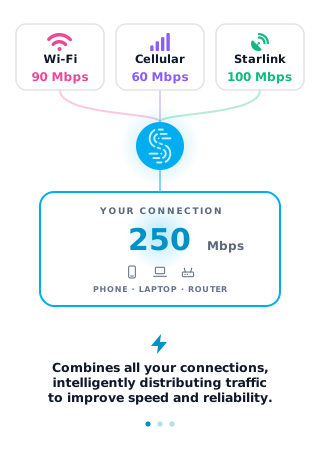
Speedify combines your Wi-Fi, wired Ethernet, 4G / 5G cellular connection, tethered smartphones, Starlink and other satellite into one stable pipeline. Instead of switching between internet connections, Speedify uses all simultaneously, splitting data traffic across the internet connections. If one of them drops during a video call, the other(s) continue(s) the stream seamlessly. Your Mac never loses internet.
How Speedify Works
Speedify operates at the OS level, creating a local VPN tunnel that manages packet distribution. Speedify monitors real-time metrics on all active connections: latency, jitter, packet loss, and bandwidth availability. The software automatically routes each data packet through whichever connection offers superior performance at that instant. If your Wi-Fi encounters interference, for example, your tethered smartphone will automatically compensate that without dropping active connections.
Speedify Installation and Configuration
Download Speedify from Mac App Store and install on your PC. Create an account, open the app and slide the switch to connect. The interface shows real-time speeds on all connections, allowing you to monitor network performance instantly. Configure your preferences in settings, such as which network to prioritize when all are available.
Real-World Benefits of Speedify for Mac Users
masOS users report maintaining video conferences while experiencing temporary network issues, uninterrupted downloads even when one connection drops, and combined bandwidth exceeding either connection alone. For remote workers and professionals dependent on stable connectivity, the reliability improvements justify the subscription cost.
Extending Reliability with Speedify’s Pair & Share Feature
Beyond combining your Mac’s connections, Speedify’s Pair & Share feature extends connection stability to other devices. This feature lets you combine multiple personal hotspots together to increase bandwidth and signal strength for everyone.
How Speedify’s Pair & Share Feature Works
Speedify’s Pair & Share works almost like a turbocharged personal hotspot. Instead of just one device sharing its connection with others, once paired, all devices can share and receive each other’s connections simultaneously. It’s possible to share cellular data between multiple devices, including PCs, Macs, iPhones and Androids. Use multiple phones as hotspots for internet access and get increased bandwidth and mobile failover.
Who Can Benefit the Most from Speedify’s Pair & Share Feature
For teams traveling together, Speedify’s Pair & Share feature eliminates the need for multiple devices to maintain separate reliable connections. A journalist can use their bonded iPhone to share internet with a photographer’s camera uploading images, or a consultant can maintain stable video conferencing on a laptop through their phone’s connection. Everyone benefits from the same multi-network redundancy.
The feature proves particularly valuable in areas with inconsistent coverage, where no single network provides consistent throughput. Secondary devices no longer experience the dropouts that plague traditional personal hotspots.
Speedify
Get started with Speedify today.
Combine Wi-Fi, 4G/5G cellular, Ethernet, Starlink, and more into one faster, steadier connection. Free to try — no credit card required.
🚀 Speed
Faster uploads and downloads by bonding all your connections at once.
📶 Stability
Automatic failover in under a second when any connection drops.
🔒 Security
AES-256 encryption on every connection, on every network you join.


15M+ downloads worldwide. 75K+ five-star reviews on iOS and Android.