

Get a Speedify Self-Hosted Server for Faster Upload and Download Speeds
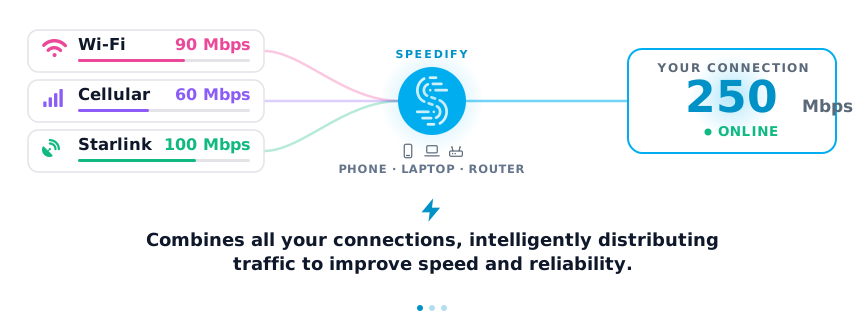
Speedify combines your Wi-Fi, 4G/5G cellular, Ethernet, Starlink and other satellite for faster upload and download speeds, and more reliable and secure internet.
Speedify Self-Hosted Private Servers let you run your own private Speedify server infrastructure on any cloud provider or physical hardware you control. A Speedify Self-Hosted Server gives you complete control over server setup, maintenance, and location. The Speedify Self-Hosted Server, where you choose your own server hosting, is set up and maintained by you.
With Speedify, your internet stays on when one connection fails.
When one of your connections drops, Speedify automatically routes your traffic to your remaining connections — so calls don't cut out and downloads don't stall.
How do I use WiFi and 4G/5G cellular at the same time with Speedify?
Pick your two internet connections and your device below and we'll take you to the step-by-step setup guide.


How Speedify’s Channel Bonding Technology Works
Speedify splits your internet traffic across Wi-Fi, 4G/5G cellular, Ethernet, Starlink and other satellites into data packets and reassembles them using a cloud server. That server is the other half of the bonding equation. Without it, there’s no bonding, only failover.
When you use Speedify, your internet traffic flows through Speedify’s servers in data centers around the world. The server does the work of combining what your internet connections send, then forwards your traffic to its destination.
A Speedify Self-Hosted Private Server does exactly the same job: it just runs in infrastructure you control.
What Changes When You Self-Host Your Speedify Bonding Private Server
When you run your Speedify Self-Hosted Server, there are some changes as opposed to using Speedify’s public (shared) or Speedify Dedicated servers:
Internet traffic routing. Your Speedify bonded traffic flows through your Speedify Self-Hosted Private Server, not Speedify’s own servers. What that self-hosted private server can see, log, and route is under your control, not Speedify’s.
IP address. Internet traffic appears to come from your Speedify Self-Hosted Server’s IP address. If you’re operating in a context where IP reputation or source IP management matters, that’s important.
Location. You choose where the Speeedify Self-Hosted Server runs. If Speedify’s closest public (shared) or Dedicated server adds 80ms of latency to your connections, a Speedify Self-Hosted Server, where you choose your own server hosting in a closer data center, can change that.
Compliance scope. For regulated industries, internet traffic goes through your own server infrastructure, which hosts the Speedify Self-Hosted Server. You already have certifications for your server infrastructure.
What Stays the Same for All Types of Speedify Servers: Public (Shared), Dedicated and Self-Hosted
Speedify’s channel bonding technology, encryption, and client software work identically on all types of Speedify servers your clients connect to. You’re not giving up any of the Speedify core features by using any of the Speedify server options: Speedify Public (Shared) Servers, Speedify Dedicated Servers or Speedify Self-Hosted Servers.
Speedify Is Used on Millions of Devices Worldwide
Speedify has powered stronger Internet for millions of consumers since 2014
15M
Millions of Speedify downloads worldwide, and growing every day5⭐️
More than 75,000 5-star reviews for Speedify in the iOS and Android app stores82
Points of Speedify presence in datacenters around the globe500TB
Hundreds of terabytes of fast, secure data streamed every week via SpeedifySpeedify Partners
Speedify partners with these amazing organizations to deliver better internet and next-generation networking technology to their customers and employees.


Who Should Consider Getting a Speedify Self-Hosted Server
Use a Speedify Self-Hosted Server, where you choose your own server hosting, when:
- Your business has requirements on where the internet data goes through in terms of cloud infrastructure
- You operate networks that are isolated from the public internet, or where internet access is restricted and controlled
- You need bonded internet connections in a geographic region where Speedify’s own server network doesn’t provide acceptable latency
- Your compliance framework requires you to own and audit the infrastructure handling your network traffic
- You’re already running Speedify as part of a bonding router or SD-WAN deployment and want the server component on-premises
If none of those apply, Speedify’s Dedicated Servers provide the same performance benefits without you having to run your own server.
Why Speedify Self-Hosted Server’s Location Affects Bonding Performance
Speedify’s bonding technology works by splitting packets across multiple internet connections and reassembling them at the Speedify Self-Hosted Server. For this to work, the Speedify Self-Hosted Server has to receive packets from all the connections, put them in order, and forward the reassembled data to its destination.
Data packets from different internet connections arrive at different times. Some internet connections are faster, some are slower, and that varies moment to moment. The Speedify Self-Hosted Server has to hold data packets from the faster connections briefly while waiting for data packets from slower internet connections. Otherwise it would just discard the advantage of the slower internet connection entirely.
This waiting window is related to latency. Higher latency between client and Speedify Self-Hosted Server means more variation in arrival times, which means the server has to buffer more aggressively to compensate. The result is higher end-to-end latency for your internet connections and, in some configurations, slower internet upload and download speeds.
Where to Deploy Your Speedify Self-Hosted Servers
Place your Speedify Self-Hosted Server as close as possible, in network terms, to where your Speedify clients are. “Close” here means round-trip latency, not physical distance. A Speedify Self-Hosted Server in the same city connected via a direct fiber path is “closer” than a Speedify Self-Hosted Server in the same building connected through a congested network.
For most business deployments, this means:
- If your Speedify clients are in a single office or campus, a server in the same building or in a nearby data center is ideal
- If Speedify clients are distributed across a region, a cloud instance in the nearest data center region typically works well
- If Speedify clients are spread across multiple continents, consider whether a single Speedify Self-Hosted Server or multiple Speedify Self-Hosted Servers (possibly combined with Speedify’s existing server network) better serves your users.
What compliance frameworks actually demand
The specifics vary by framework, but the recurring themes are consistent:- Control over data location: rules such as the EU’s GDPR and various national localization laws restrict where personal data can be processed and stored.
- Limited third-party access: frameworks like the HIPAA Security Rule expect you to know and control who can touch protected data, which is hard to attest when traffic crosses a vendor’s shared servers.
- Auditability: you need to demonstrate where data flowed, not just assert it.
- Defined security controls: encryption standards, access policies, and network rules you can document.
How a Speedify Self-Hosted Server supports compliance
A Speedify Self-Hosted Server changes the model. Bonded traffic terminates on a server your organization runs, on hardware you own or rent, in the jurisdiction you choose. That gives a compliance team the things a review asks for:- Data stays in-country: place the server in the exact region your obligations require, and traffic terminates there rather than on a vendor’s network.
- No uncontrolled third party in the path: traffic does not flow through a server Speedify operates on your behalf.
- Your own controls: apply your established provisioning, monitoring, and security workflows to the server.
- Strong encryption in transit: Speedify secures bonded traffic with AES-256 encryption from each device to your server.
Why data residency drives the decision to self-host servers
Data residency is the requirement that data stay inside a particular country or jurisdiction. If you are regulated, the question is not whether your traffic is encrypted – it is where that traffic was processed and who could have reached it on the way. With a commercial VPN the honest answer is usually that you cannot say, because the provider picks the servers and therefore the jurisdiction.
Speedify is an app that combines several internet connections at once, and its Self-Hosted Servers let you run the server end inside your own jurisdiction on infrastructure you control, so the answer becomes something you can evidence. We explain why data residency forces the decision to self-host, and what you get alongside the compliance benefit.
How a Speedify Self-Hosted Server keeps traffic in your jurisdiction
A Speedify Self-Hosted Server is the piece that makes this verifiable. Instead of bonded traffic terminating on Speedify’s shared network, it terminates on a server your organization runs, in the region you choose, on hardware you control. The data path stays inside your environment from each device’s connections all the way to the endpoint. Because you pick where the server lives, you can place it in the exact country or data center your obligations require. You apply your own security policies and network rules, and traffic never flows through a third-party server you did not select. That is the specific assurance a compliance review looks for. The connectivity does not change. Speedify still uses channel bonding to combine Wi-Fi, 4G/5G cellular, Ethernet, Starlink and satellite into one connection, with the same packet-level distribution, automatic failover, and AES-256 encryption used across the rest of Speedify. The only difference is where the server sits and who controls it.What you need first
A Speedify Self-Hosted Server has modest requirements, so a small cloud instance or a spare physical box is usually enough:- CPU: 2 or more cores (x86_64).
- RAM: 4GB.
- Storage: 20GB.
- Operating system: Ubuntu is preferred.
- Runtime: Docker installed.
- Network: a static, publicly reachable IP address.
- Open ports: 8443/TCP and the UDP range 32768 to 65535.
The setup at a glance
- Prepare the server: stand up a host that meets the requirements above, with Docker installed and the required ports open. This can be bare metal in your own data center, a VM at any cloud provider, or a colocation facility.
- Add the Docker Compose file: drop in the Speedify Self-Hosted Server Docker Compose configuration.
- Bring the container up: run
docker compose up -dto start the server. - Activate it: scan the activation QR code from the container logs to link the server to your Speedify account and license.
- Connect: the Speedify client now uses channel bonding to combine Wi-Fi, 4G/5G cellular, Ethernet, Starlink and satellite straight to your server.
Speedify Business Solutions
Speedify Teams
Speedify for Routers

Speedify Embedded Solutions and Integrations
Embed Speedify software into your app or hardware products and leverage the core channel bonding technology of Speedify in new and interesting ways.