

Speedify Improves Internet Upload and Download Speeds to a Slow Starlink by Combining It With Another Starlink, 4G/5G Cellular, Wired Ethernet, Wi-Fi
This guide covers what actually slows Starlink down, how to check each cause, and how Speedify improves real-world internet upload and download speeds by combining Starlink with another internet connection, such as a second Starlink, Wi-Fi, 4G/5G cellular, wired Ethernet.
Starlink disconnects all the time for ALL Starlink users. The Speedify Starlink Index report found that Starlink connections are down for an average of ~33 min per day. Plus, all Starlink dishes experience small drops and packet loss every 15 seconds, when the moving Starlink satellites hand off the connection to the next satellite overhead.
The best way to fix Starlink's connection drops is to combine your Starlink connection with another internet connection, such as 4G/5G cellular, cable, fiber, DSL, or another Starlink connection. Speedify makes this possible with channel bonding.
Speedify Starlink Index — real-world performance from 6,228 Starlink users: 2.3% downtime, about 33 minutes a day for always-on connections
Your Starlink loses connection every day.
Speedify’s Starlink Index reports Starlink performance data from a sample of thousands of real-world Starlink dishes.
Daily Starlink downtime
~33 min
2.3% of connected time unreachable
Avg packet loss
0.17%
vs 0.08% on T-Mobile
71% of Starlink users ran at least one other internet connection — 4,400 of 6,228 users. Cellular is the most common backup.
What Slows a Starlink Internet Connection Down
- Peak-hour congestion. Speeds drop in the evening when more dishes in your cell are active at once. This is the most common reason a connection that was fast last week feels slow now.
- Obstructions. A partly blocked view causes packet loss and retransmits, which read as slow speeds even when the raw connection looks fine. The obstruction map in the Starlink app shows the blocked sky.
- Weather. Heavy rain or snow scatters the signal and lowers throughput until it clears.
- Your Wi-Fi, not the dish. Distance from the router, walls, and the number of connected devices often cap speed before the dish does. A wired test next to the router separates the two.
- Deprioritization. On a congested Starlink cell, residential traffic can be slowed behind higher-priority plans during busy periods, and it happens sooner once a plan’s priority data runs out.
How to Find Your Real Starlink Internet Speed
Run a speed test from the Starlink app’s Statistics section first, which measures the dish itself rather than the path through your Wi-Fi. Then run a test from a laptop near the router and again from where you actually use the Starlink connection. A big gap between the app test and the device test points at Wi-Fi, not Starlink. A low number on all three at the same time each evening points at congestion.
Quick Fixes for a Slow Starlink
Clear any obstructions the map flags, move the router away from walls and metal, and reboot the dish to pick up the best available satellites. If speeds only sag at peak hours or only when the household is busy, you have hit the ceiling of a single connection, and no amount of repositioning adds capacity that the link doesn’t have.
Who Feels Slow Starlink Speeds Most
- Busy households. Several people streaming and calling at once split one connection’s capacity.
- Remote workers. Video calls and large uploads suffer first when throughput dips.
- Evening users. Peak-hour congestion lands hardest on anyone whose heaviest use is at night.
Speedify and Starlink: Combine Internet Connections Instead of Settling for One
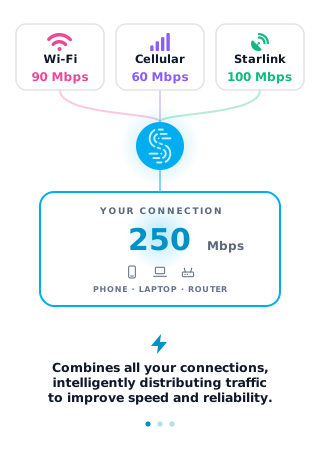
Repositioning a Starlink dish only recovers speed Starlink already has. Speedify adds capacity Starlink doesn’t. Speedify combines Starlink with 4G/5G cellular, Wi-Fi, or a second Starlink dish into one bonded connection and splits your traffic across all of them at the packet level. A slow evening on the Starlink dish is offset by upload and download bandwidth from the other available internet connections that are combined together with Speedify. When one link degrades, Speedify shifts traffic to the faster ones automatically.
For placement tuning that recovers Starlink’s own speed first, see Starlink antenna placement with Speedify, then learn how Speedify’s channel bonding technology combines connections.
Alex and the Speedify team are always exploring the latest in networking and security technology—like 5G, 6G, WiFi 7, laser and satellite internet—and sharing it in new discussion content across YouTube, TikTok, Instagram, and LinkedIn every week.
Got a tech question? Let's go deeper! Pop into Speedify Office Hours live every Wednesday at 10 AM Eastern. Speedify CEO Alex Gizis and our network engineers are standing by to break down your questions about networks, tech updates, and Speedify features.

Speedify
Get started with Speedify today.
Combine Wi-Fi, 4G/5G cellular, Ethernet, Starlink, and more into one faster, steadier connection. Free to try — no credit card required.
🚀 Speed
Faster uploads and downloads by bonding all your connections at once.
📶 Stability
Automatic failover in under a second when any connection drops.
🔒 Security
AES-256 encryption on every connection, on every network you join.


15M+ downloads worldwide. 75K+ five-star reviews on iOS and Android.