

Speedify Keeps Remote Work Stable on Starlink by Combining It With 4G/5G Cellular, Wi-Fi, Ethernet
Yes, you can work from home on Starlink. Starlink says most users get downloads over 100 Mbps and uploads of 10 to 30 Mbps, enough for video calls and internet phone calls. The trouble is the moments that matter: the call that freezes mid-sentence, the upload that stalls before a deadline, the screen share that drops during the one meeting you can’t miss.
Below: why Starlink drops calls and stalls uploads, what you can fix yourself, and how Speedify keeps your calls and uploads steady by using Starlink together with another internet connection, like 4G/5G cellular, Wi-Fi or wired Ethernet.
Speedify keeps you online through Starlink outages and bad weather
Starlink Internet Connection Drops Happen to Everyone
Speedify measures thousands of Starlink users in more than 140 countries. In September 2026, fixed Starlink dishes went offline for about 38 minutes a day on average, and Starlink dishes on RVs and boats for about 46 minutes a day.
All Starlink dishes also see short dropouts roughly every 15 seconds as the Starlink internet connection switches from one moving satellite to the next. Even a perfectly installed Starlink dish goes offline, and about 7 in 10 Starlink users on Speedify use Starlink together with a second internet connection, like 4G/5G cellular.
Why Starlink Drops Calls and Stalls Uploads When You Work from Home
- Short drops during satellite switches. Your Starlink dish switches satellites about every 15 seconds. A switch at the wrong moment freezes a video call or drops you from a meeting.
- Slow uploads. Starlink uploads run at 10 to 30 Mbps, while downloads run at 45 to 280 Mbps. Uploads are what carry your camera, your screen share and your file uploads.
- Busy times. When many people near you are online, Starlink slows down, usually in the evening, and a late call with a client in another time zone can land right in it.
- Weather and obstructions. A storm or a tree blocking your Starlink dish’s view of the sky turns a normal workday into a stretch of frozen calls.
What You Can Fix Yourself to Work from Home on Starlink
- Connect your work computer to the Starlink router with an Ethernet cable, so a weak Wi-Fi signal doesn’t add to the problem.
- Clear anything the obstruction map in the Starlink app flags.
- Pause cloud backups and large downloads during meetings, so they don’t use up your upload speed.
- Check whether your Starlink plan slows down at busy times. When the Starlink network is busy, Priority plans are served first and Residential Lite is always slowed first.
- Protect work data on shared or public Wi-Fi with a VPN that works well on Starlink.
These steps get you the most out of your Starlink internet connection. They don’t give your calls a second way through, so one satellite switch or a busy evening can still interrupt a call.
Keep Video Calls and Uploads Steady on Starlink with Speedify
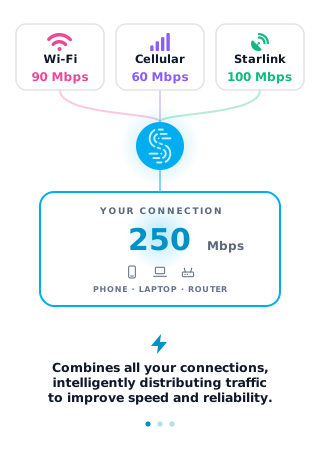
Speedify uses Starlink together with 4G/5G cellular, Wi-Fi or wired Ethernet, and sends your traffic over all of them at the same time. When Starlink drops for a moment during a satellite switch, the other internet connection keeps carrying your call, and your uploads get the upload speed of both internet connections combined. When one internet connection weakens, Speedify moves your traffic to the stronger one automatically, so your workday doesn’t stop with it.
That matters most if your job runs on calls and screen shares, if you work with clients, or if Starlink is the only fast internet connection where you live. Speedify needs that second internet connection: with Starlink alone, it can’t stop the drops.
For the details, see how Speedify combines internet connections, then read how Speedify fixes Starlink dropouts in Zoom and Teams.
Speedify
Get started with Speedify today.
Combine Wi-Fi, 4G/5G cellular, Ethernet, Starlink, and more into one faster, steadier connection. Free to try — no credit card required.
🚀 Speed
Faster uploads and downloads by bonding all your connections at once.
📶 Stability
Automatic failover in under a second when any connection drops.
🔒 Security
AES-256 encryption on every connection, on every network you join.


15M+ downloads worldwide. 75K+ five-star reviews on iOS and Android.