

Are Data Centers Really the Bad Guys with the Environment?
Use Speedify to Increase Your Upload and Download Speeds: Combine Wi-Fi, 4G / 5G Cellular, Ethernet, Starlink and Other Satellites
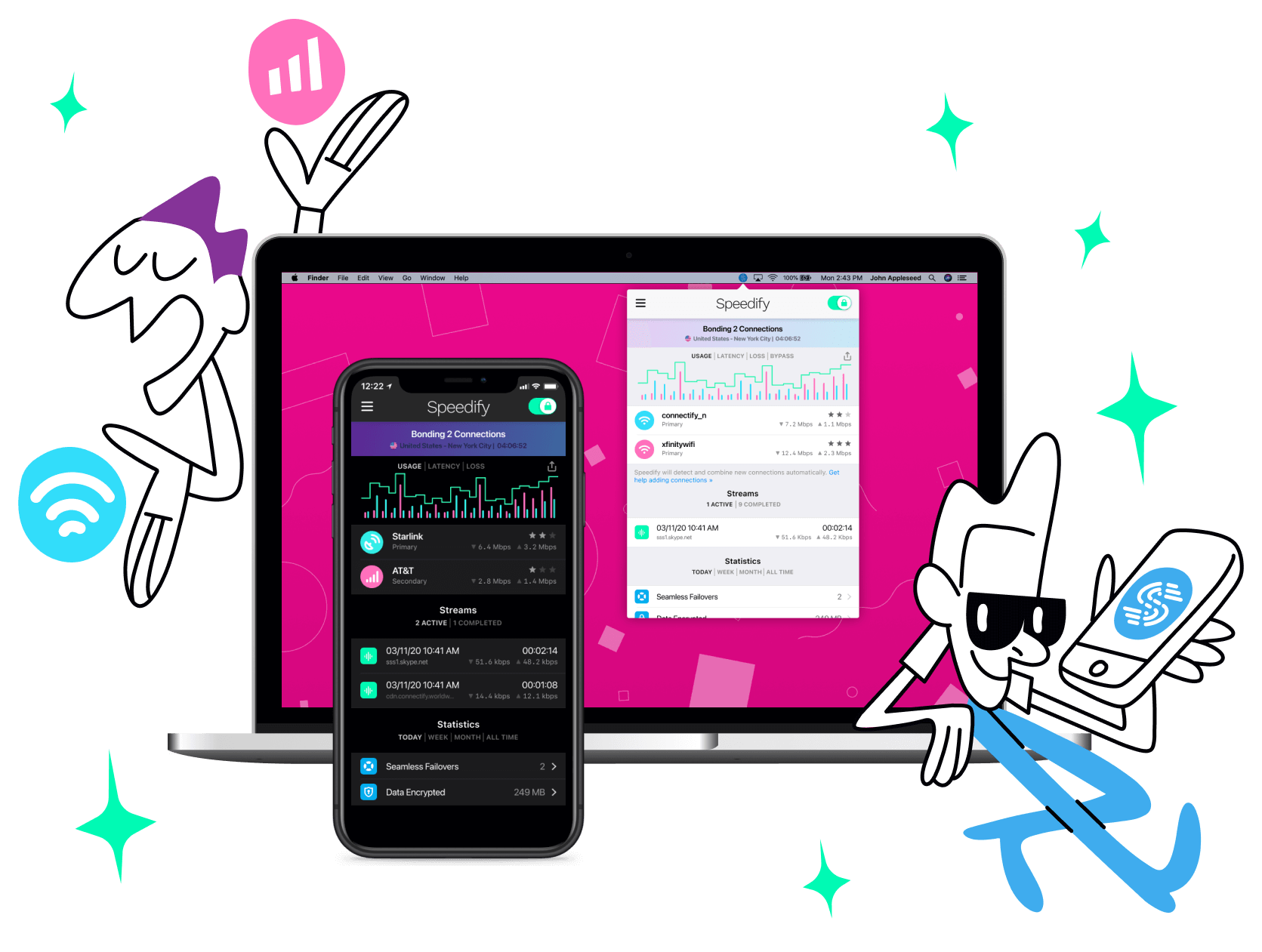
Speedify combines Wi-Fi, 4G / 5G cellular, Ethernet, Starlink, and other satellites for faster internet uploads and downloads
Speedify is the only software app that combines Wi-Fi, 4G / 5G cellular, Ethernet, Starlink and other satellites at once for secure, faster, and more reliable internet uploads and downloads so you stay online without interruptions.
Speedify will automatically detect and start using any available Internet connections on your device while intelligently distributing your online traffic between them for optimal performance. If you need help we have quick start guides available for most common set ups.
Speedify wirelessly joins multiple phone personal hotspots together for faster internet upload and download speeds
Speedify's Pair & Share feature enables you to connect to multiple hotspots at the same time for faster upload and download speeds and more reliable internet for everyone. Speedify's Pair & Share feature allows you to wirelessly share 4G / 5G cellular connections back and forth between multiple Speedify users on the same local network when live streaming from an event, calling from the commute or sharing from the field.
Speedify is the only app that allows you to share 4G / 5G cellular data between PCs, Macs, iPhones and Androids. Use multiple iPhones and Android phones as hotspots for internet access and get faster upload and download speeds and mobile failover for all paired devices.
See how you can use Speedify to combine different Internet connections:


Cloud Giants Are Efficient
Alex Gizis: There are something like a hundred million servers in the cloud today. Everything I read talks about how much unbelievable amounts of power and water that these servers are consuming. So are the servers in the cloud like significantly worse? For the environment than companies running their own servers.
Brian Prodoehl: So it's true that data centers use a lot of power and they use a lot of water just to keep everything cool and not melting down and starting a fire. So just looking from the outside at a big data center, it's easy to think that this is a nightmare for the environment.
But if you think of running a million Shopify stores, AWS is able to do that really efficiently, where if you had a million people with an old PC in their closet, serving up their website in their shop. That would be a lot more power. That'd be a lot worse. It's a lot more e-waste. It's a lot more energy consumption. It's way better than people hosting their website in their closet or whatever.
And the same thing. Somebody with a bigger install than just hosting their website. I mean, having somebody trying to do that and really just hosting a database and a website and some internal apps on some big rack in their office, Amazon's able to do that way more efficiently too.
So I think as a whole, better than if everybody was hosting this stuff themselves.
Why Big Companies Excel at Environmental Efficiency
Alex Gizis: Yeah, it's always an interesting thing to me. I mean, I think a lot of people tend to think big company is evil. But when it comes to environmentalism, the big companies have the scale, where reducing their electricity bill one, two, three percent, that can be billions.
Brian Prodoehl: Right, and you see that in how they design their boards and stuff, they're trying to Maximize space and maximize efficiency and cooling and power and all that stuff. You see that in even their hardware design. So, absolutely.
Alex Gizis: Yeah, you were telling me they're designing their own processors now? Tell me about those.
Brian Prodoehl: Yep, so Amazon actually has their line of ARM processors that have a ton of cores and are able to host a whole lot of like EC2 instances, that sort of thing. And so they're actually pushing down to get more performance per watt actually by making their own chips.
Speedify and Its Server Cloud
Alex Gizis: So, you're running the whole Speedify cloud of servers. Where is that? Does Speedify have a data center somewhere?
Brian Prodoehl: We are actually in over a hundred data centers around the world. We rent servers. We let people deal with the cooling and powering and stuff and we happily rent servers from them. And that lets us be in a bunch of cities, even within big cities, we're in multiple data centers in that city.
In case one of them has a problem or in case one of them happens to be faster for wherever you live in, in that area, it helps us a lot to not be actually in it.
Alex Gizis: I mean, it's right in the name, Speedify. You're clearly obsessed with Speed. Which means obsessed with low latency. So you always have to have servers close to the customer.
Brian Prodoehl: Yes. Which means in cities like New York or London, being in three different data centers makes a big difference for people.
Distributed Resources Optimize Resource Utilization
Alex Gizis: So how much more efficient are these big cloud data centers versus running it in your own closet?
Brian Prodoehl: I've read that AWS is about. 3.6 times more efficient than a company that's hosting their own stuff.
So probably take it outside of the closet. But people that actually have kind of a mini data center in their thing, Amazon's almost four times more efficient than that.
Alex Gizis: It's interesting. Cause the whole point is that it's greed, right? Amazon, it's so much money they make if they managed to use a couple of percent less electricity, right? Makes a big difference. So, so pure greed turns them into environmentalists.
So in the end, you think that these big cloud service providers like AWS are actually a net win for the environment?
Brian Prodoehl: I think in general, yes, but it might still be a net negative because it's so much easier just to spin something up in AWS. And forget about it. Or to scale something up and now you've got eight servers hosting this thing instead of one because of some weird thing that happened once.
Now you have eight servers running forever and you just sort of move on and forget about it. So if that was running in your closet...
Alex Gizis: You got a lot of goofy little apps and services. Which if people had to leave a whole server running, maybe they wouldn't.
Brian Prodoehl: Exactly. So I think over time there's a big push towards making things serverless.
The Serverless Revolution
Alex Gizis: Let's talk about serverless for a second. Because serverless is software that runs on a server, right?
Brian Prodoehl: It's serverless that you don't have a server. You put files up somewhere that are gonna do something and when they need to do something, then Amazon or whoever else comes along and they obviously have the server component, they'll execute what needs to happen.
And so you can have a serverless website where no requests are coming in, nothing's going on, it's just files sitting on a box, and then as soon as somebody tries to access your website, that's when something steps in and deals with their response.
Alex Gizis: So it's much more you don't have to wear your pretty head about the server than serverless.

Connectivity Tech Discussions
Our Connectivity Tech Discussions Between Two Palms video series shines the spotlight on Alex and technical guests, diving deep into caonversations about the latest Internet technology, including Starlink satellite, WiFi 7, Apple, fiber optics, new routers, remote connectivity, and networking protocols.
Join us and let's talk tech!