

Starlink Gaming and Streaming Break for Different Reasons
Starlink is good for streaming and mostly good for gaming: Netflix recommends 15 Mbps for 4K, Starlink says users typically get 45 to 280 Mbps, and on the Speedify Starlink Index for 29 September to 12 October 2026, Starlink’s median latency was 55 ms with jitter averaging 1.2 ms. The catch for gaming is short dropouts, about 46 minutes a day offline on average, and the spread between users: one Starlink user in ten had a typical latency above 295 ms.
A movie and an online match on the same Starlink internet connection react differently to the same dropout. The movie keeps playing. The match freezes, rubber-bands, and can drop you back to the lobby. The difference isn’t speed. The difference is the buffer.
The short version: Starlink’s speed and latency suit both, and the dropouts are what separate a stream from a game. The free fixes come first, then a second internet connection for the dropouts that remain.
This article explains why streams and games react differently to a dropout, what the Speedify Starlink Index shows for gaming, the free fixes, and how a second internet connection keeps a game connected through a dropout. Speedify is an app that combines Starlink with other internet connections, such as 4G/5G cellular, and measures every internet connection Speedify carries; the Speedify Starlink Index publishes those measurements.
The live Speedify Starlink Index updates every day, so today’s Speedify Starlink Index figures will differ from the numbers in this article.
Why a Video Stream Rides Out Short Starlink Dropouts
Netflix, YouTube and other streaming apps download video into a buffer ahead of playback. When Starlink drops for a few seconds, the player keeps playing the buffered video and refills the buffer once the internet connection returns. A long dropout or a congested evening drains the buffer and the spinning wheel appears, but a gap shorter than the buffer goes unnoticed.
Speed is rarely the problem for watching. Netflix recommends 5 Mbps for Full HD and 15 Mbps for 4K, and Starlink says most users get more than 100 Mbps down. Uploading is tighter: Starlink lists typical upload speeds of 10 to 30 Mbps, which matters for live streaming, not for watching.
Streaming out, from a camera or a console, is different: a live broadcast keeps only a small buffer on the sending side, so a dropout cuts the stream for viewers. Live streaming over Starlink needs the same care as gaming.
Why an Online Game Can’t Ride Out a Starlink Dropout
An online game sends your inputs to the game server and receives the game state back dozens of times a second, at the game server’s tick rate. Nothing buffers the game state: a dropout of two seconds becomes two seconds of standing still, then a jump when the game catches up. If the dropout outlasts the game server’s timeout, the game server disconnects you.
Latency adds to the problem. Speedify’s support guide says 100 ms or lower works well and 300 ms or more is very noticeable. Fast shooters and fighting games feel latency well below 100 ms; turn-based games tolerate several hundred milliseconds.
What the Speedify Starlink Index Says About Starlink for Online Gaming
The averages look good for gaming. From 29 September to 12 October 2026, Starlink’s median latency on the Speedify Starlink Index was 55 ms, jitter averaged 1.2 ms, and packet loss averaged 0.187%.
The spread is where gamers differ. Counting each of 4,758 Starlink users once, one user in four saw a typical latency of 45 ms or less, fine for nearly any game, while half saw 85 ms or more and one in ten saw more than 295 ms. Two players on the same Starlink network can see typical latency 250 ms apart.
Dropouts follow the same pattern. Starlink users on Speedify were offline 46 minutes a day on average, but two thirds of Starlink dishes dropped 0.1% of pings or fewer, while one dish in ten dropped more than 2.86%. Fixed dishes averaged 37 minutes a day offline against 61 for dishes on RVs, boats and portable setups, so a fixed dish with a clear view of the sky does better than the average.
Free Fixes for Starlink Gaming Lag Before Adding a Second Internet Connection
- Plug the console or PC into the Starlink router, or into your own router, with an Ethernet cable. Wi-Fi adds latency, jitter and retransmissions on top of whatever Starlink delivers.
- Clear the Starlink dish’s view of the sky. A blocked patch of sky causes a dropout every time a satellite passes behind the obstruction; fixing an obstructed dish helps games more than anything else.
- Pause cloud backups and big downloads while you play.
- If your router supports Quality of Service, give the console priority. More in fixing Starlink lag spikes in games.
Where Speedify Helps With Gaming on Starlink, and Where Speedify Doesn’t
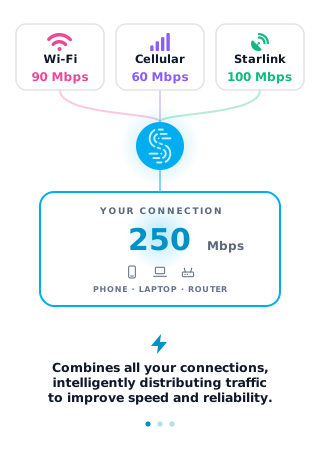
Speedify can’t lower Starlink’s latency, and Speedify adds a hop to a Speedify server. What Speedify can do is keep a second internet connection, such as 4G/5G cellular, active at the same time. When Starlink drops, Speedify moves the game’s traffic to cellular, and in Redundant mode Speedify sends every packet over both internet connections and uses whichever copy arrives first.
71.8% of Starlink users on Speedify already run a second internet connection, and for gamers the second internet connection is the difference between a lag spike and a disconnect. Is Starlink good for gaming covers the setup.
What the Speedify Starlink Index Can’t Tell You About Online Gaming
The Speedify Starlink Index measures the trip to Speedify servers, not to game servers. A game server farther away adds latency the Speedify Starlink Index never sees.
Averages hide the moment. The Speedify Starlink Index summarizes each measurement period, so a half-second spike in the middle of a fight barely moves a number.
The Speedify Starlink Index counts Speedify users. People who install Speedify tend to be the people whose internet connection has to hold.
Speedify
Get started with Speedify today.
Combine Wi-Fi, 4G/5G cellular, Ethernet, Starlink, and more into one faster, steadier connection. Free to try — no credit card required.
🚀 Speed
Faster uploads and downloads by bonding all your connections at once.
📶 Stability
Automatic failover in under a second when any connection drops.
🔒 Security
AES-256 encryption on every connection, on every network you join.


15M+ downloads worldwide. 75K+ five-star reviews on iOS and Android.