

A Starlink Speed Test Sees 20 Seconds. The Day Has 86,400.
A good Starlink speed test result falls inside the range Starlink says users typically see: 45 to 280 Mbps down, 10 to 30 Mbps up and 25 to 60 ms of latency on land, with most users above 100 Mbps down.
What the test misses is the rest of the day. A speed test measures about 20 seconds, and on the Speedify Starlink Index for 29 September to 12 October 2026, Starlink users on Speedify were offline about 46 minutes a day on average, so a Starlink internet connection can pass a speed test and still freeze a video call that afternoon.
A speed test is a photo. Reliability is the whole day, and the Speedify Starlink Index measures the whole day, every day, across thousands of Starlink dishes.
The short version: a speed test answers whether the Starlink plan delivers the promised speed, not whether the Starlink internet connection stays up. For reliability, check the Starlink app’s statistics or a tool that measures all day, and cover the dropouts with a second internet connection.
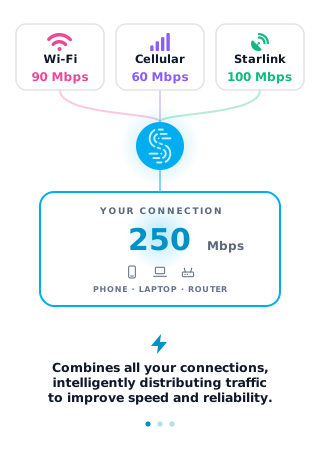
This article shows how to run a Starlink speed test and read the result, what the test misses, better ways to check reliability, and how a second internet connection covers the dropouts a speed test never sees. Speedify is an app that combines Starlink with other internet connections, such as 4G/5G cellular, and measures every internet connection Speedify carries; the Speedify Starlink Index publishes those measurements.
The live Speedify Starlink Index updates every day, so today’s Speedify Starlink Index figures will differ from the numbers in this article.
How to Run a Starlink Speed Test and Read the Result
- Open the Starlink app and tap Speed Test, then Start. The default test measures the Starlink router to the internet.
- Tap Advanced for two more tests: Device to Internet, which includes your Wi-Fi, and Device to Router, which measures the Wi-Fi alone. If Device to Router is lower than the default test, your Wi-Fi is the bottleneck.
- Compare the result with Starlink’s own figures: 45 to 280 Mbps down and 10 to 30 Mbps up is the typical range, and most users see more than 100 Mbps down.
What a Starlink Speed Test Measures, and for How Long
A speed test opens several parallel data streams to a nearby test server, pushes as much data as possible for a few seconds each way, and reports the result in megabits per second, with a ping figure measured while the line is idle. The number is real. The number describes about 20 seconds.
Speed tests also tend to flatter. A test that hits a dropout usually fails or gets run again, and people share the good run. The test server is chosen for being close, which a game server or a video call often isn’t.
What a Starlink Speed Test Misses, Measured on the Speedify Starlink Index
Dropouts. The average Starlink user on Speedify was offline 46 minutes a day, but a 20-second test covers 0.02% of the day, so a speed test rarely lands on a dropout.
Latency spread. The ping on a speed test is a single moment. Counting each of 4,758 Starlink users once, the typical user’s own median latency was 85 ms, and one in ten sat above 295 ms.
Problem dishes. Two thirds of 3,510 Starlink dishes dropped 0.1% of pings or fewer, while one in ten dropped more than 2.86%. A dish in the worst tenth can still pass a speed test.
Speedify’s own method avoids speed tests altogether: Speedify measures internet connection health all day, which is why the Speedify Starlink Index has no speed number and four reliability numbers: latency, jitter, packet loss and working time.
When a Starlink Speed Test Is the Right Tool
A speed test is the right check for a speed question: whether the plan delivers what the plan promises, whether evenings are slower than mornings, whether a new router helped. Run the test at different times of day and on a wired device. Starlink publishes a US peak-hour median close to 200 Mbps download as a reference. Testing and monitoring Starlink speed covers the details, and slow Starlink speeds covers what to do with a bad result.
Better Ways to Check Starlink Reliability Than a Speed Test
- The Starlink app’s statistics show outages, ping and obstruction over hours and days, not seconds.
- The Speedify Starlink Control Center shows the dish’s ping, obstruction and outages next to every other internet connection on the device.
- Monitoring Starlink outages and uptime walks through an all-day log.
- Open-source tools such as starlink-grpc-tools read the Starlink dish’s gRPC interface at 192.168.100.1 directly and log a history.
A day of history answers what a speed test can’t: how often Starlink drops, for how long, and at what time.
What the Speedify Starlink Index Can’t Tell You About Starlink Speed
Speed. The Speedify Starlink Index sees how much data people moved, not how much data people could have moved, so the Speedify Starlink Index doesn’t report speed. For speed, a test is still the tool.
Everyone’s day. The Speedify Starlink Index counts Speedify users, averaged across thousands of homes, vehicles and offices; your day may be better or worse.
Covering the Starlink Dropouts a Speed Test Never Sees
If the speed is fine and the calls still freeze, the problem is the gaps, and the fix for gaps is a second internet connection, such as 4G/5G cellular. Speedify keeps both internet connections running and moves traffic to the internet connection still answering when Starlink drops. 71.8% of Starlink users on Speedify run a second internet connection.
Speedify
Get started with Speedify today.
Combine Wi-Fi, 4G/5G cellular, Ethernet, Starlink, and more into one faster, steadier connection. Free to try — no credit card required.
🚀 Speed
Faster uploads and downloads by bonding all your connections at once.
📶 Stability
Automatic failover in under a second when any connection drops.
🔒 Security
AES-256 encryption on every connection, on every network you join.


15M+ downloads worldwide. 75K+ five-star reviews on iOS and Android.