

Why Is Your Starlink Internet Connection Slow or Dropping Out?
When Starlink is slow, the cause is usually one of a few things: a busy Starlink network in the evening, a blocked view of the sky, bad weather, a Starlink dish or router that needs a restart, weak Wi-Fi inside your home, too many devices online at the same time, or a Starlink plan that gets lower priority.
Starlink Internet Connection Drops Happen to Everyone
Speedify measures thousands of Starlink users in more than 140 countries. In September 2026, fixed Starlink dishes went offline for about 38 minutes a day on average, and Starlink dishes on RVs and boats for about 46 minutes a day.
All Starlink dishes also see short dropouts roughly every 15 seconds as the Starlink internet connection switches from one moving satellite to the next. Even a perfectly installed Starlink dish goes offline, and about 7 in 10 Starlink users on Speedify use Starlink together with a second internet connection, like 4G/5G cellular.
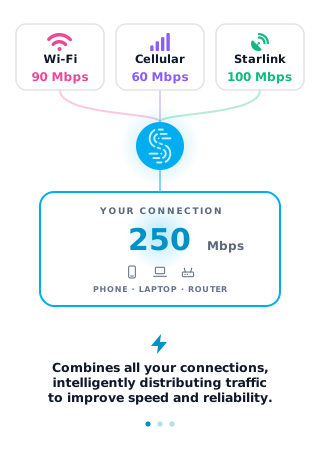
Speedify adds a second internet connection to Starlink for faster uploads and downloads, and failover
Step 1: Check Whether Starlink Is Slow Today for Everyone
- Run a speed test in the Starlink app or with the free speed test at fast.com.
- Run it again in the early morning, at midday, and between 6 and 11 PM.
- Check the Starlink Help Center for service status.
A speed test shows about 20 seconds of your Starlink internet connection. To see what a Starlink internet connection does across a whole day, including the dropouts a speed test misses, read how Speedify measures Starlink without running a speed test.
If the Starlink internet connection is only slow between 6 and 11 PM: many people near you are using Starlink at the same time. Go to Step 9, and see the last section to stay fast in the evening.
Otherwise: Continue to Step 2.
Step 2: Check for Obstructions Blocking Your Starlink Dish’s View of the Sky
Trees, buildings, chimneys or snow in the Starlink dish’s view of the sky slow the Starlink internet connection down. To see whether your Starlink dish’s obstruction percentage is high, compare it with 4,263 Starlink dishes on the Speedify Starlink Index.
- In the Starlink app, use Check for Obstructions and follow the steps to see what’s in the way.
- Move or raise the Starlink dish if something blocks the view. Mount it as high as you can, on the roof or on a pole.
- Check again when the seasons change: leaves in summer and snow in winter can block the view.
- Make sure the Starlink dish is level, and let it point itself instead of turning it by hand.
Step 3: Check Whether Bad Weather Is Weakening the Satellite Signal
Heavy rain, snow, wind or ice can block the satellite signal or move the Starlink dish. In major storms, Starlink users report outages of 15 to 60 minutes. Once it’s safe, clear snow, ice and dirt off the Starlink dish.
Step 4: Restart Your Starlink Dish, Router and Other Equipment
- Unplug the Starlink dish, the Starlink router, and any other router or network equipment you use.
- Wait 2 to 3 minutes, then plug everything back in.
- Check that every cable is firmly plugged in and not damaged.
Step 5: Update the Software on Your Starlink Dish and Router
- Open the Starlink app and check for software updates.
- If you use your own router, install its latest updates too.
- Updates fix some slow speeds, especially on older, first-generation Starlink dishes.
Step 6: Connect Your Computer or TV to the Starlink Router with an Ethernet Cable
- Use the Starlink Ethernet Adapter to plug a computer or TV straight into the Starlink router with a cable.
- A cable skips Wi-Fi problems like walls and distance from the Starlink router.
Step 7: Move Your Starlink Router or Extend Your Wi-Fi to Every Room
- Put the Starlink router in the middle of your home, 3 to 6 feet off the floor, near the rooms where you use the internet most.
- Keep it out of cabinets and away from thick walls, metal furniture and microwaves, which block Wi-Fi. Leave space around it so it doesn’t overheat.
- In a large home, the Starlink router’s Wi-Fi may not reach every room. Add Starlink Mesh, Starlink’s own Wi-Fi extender, or a Wi-Fi system with several units, such as Eero, Google Nest or Orbi.
- If Wi-Fi can’t reach a room, a powerline adapter sends the internet through your home’s electrical wiring.
Step 8: Reduce the Number of Devices Using Your Starlink Internet Connection
- Disconnect devices you aren’t using, like security cameras and smart TVs.
- Pause large downloads and updates, then check whether the Starlink internet connection gets faster.
Step 9: Check Whether Your Starlink Plan Slows Down When the Network Is Busy
- When the Starlink network is busy, Starlink serves some plans first: Local Priority and Global Priority, then Residential Max. Residential 200 Mbps, Residential 100 Mbps and the Roam plans (Roam 100GB, Roam 300GB and Roam Unlimited, Starlink’s plans for travel and camping) are more likely to slow down. Residential Lite slows down the most.
- On Residential 100 Mbps or 200 Mbps, the number is also your top download speed.
- On Local Priority or Global Priority, check whether you’ve used up your priority data. After that, Starlink limits you to 1 Mbps download and 0.5 Mbps upload.
- In some countries the Starlink Mini can’t be used on a Residential plan, so many Starlink Mini owners are on a Roam plan.
- Plan names depend on your country. If your Starlink internet connection is slow in crowded places most evenings, a plan higher up this list may help.
Step 10: Check Your Own Router’s Settings (If You Use One)
If you use your own router instead of the Starlink router, a wrong setting or a slow router can hold back your Starlink internet connection.
- In the router’s settings, change DNS to Google (8.8.8.8 and 8.8.4.4) or Cloudflare (1.1.1.1), then restart the router.
- If the router has a Quality of Service (QoS) setting, use it to put video calls and streaming first.
Step 11: Contact Starlink Support
- If the Starlink internet connection is still slow after the steps above, open the Starlink app and go to Support, then Troubleshoot.
- Submit a ticket if the Starlink dish seems faulty, for example if it doesn’t move or won’t connect.
- Starlink support can replace faulty Starlink equipment.
Why Does Starlink Lag So Much?
- Distance to the satellites: Starlink satellites are more than 340 miles up, so Starlink always has a little more delay than cable or fiber internet.
- A busy Starlink network: many Starlink users in your area slow things down, most of all between 6 and 11 PM.
- Weather: heavy rain, snow or storms can cause delays and dropouts.
- Obstructions: trees or buildings in the Starlink dish’s view cause sudden lag.
- Equipment problems: an overheating Starlink dish, old software or faulty hardware.
- Distance to the ground station: Starlink sends your data from the satellite to a Starlink ground station, a site on Earth that connects to the rest of the internet. The farther away the nearest one is, the more delay you get.
Will Starlink Get Better Over Time?
Yes. SpaceX, the company that runs Starlink, keeps adding and upgrading Starlink satellites:
- More satellites: SpaceX plans more than 40,000, so busy areas get less crowded.
- Newer satellites: better hardware and faster speeds.
- Less lag: satellites that pass data to each other with lasers, so your data takes a shorter path.
- More coverage: fewer gaps near the poles and the equator.
- More ground stations and regular software updates.
Who Notices Slow Starlink the Most?
- RV owners and Starlink Mini users on Roam plans: Starlink serves Roam plans after Residential Max, so speeds drop most in crowded places. For campground and off-grid use, see Starlink for RV camping and boondocking.
- Homes in busy areas: speeds drop most between 6 and 11 PM, when many people nearby use Starlink at the same time.
- People who work from home on one Starlink internet connection: a slow evening or a storm means frozen video calls and stalled uploads.
Stay Fast When Starlink Slows Down, with Speedify
Some slowdowns, like a busy Starlink network in the evening or a storm, aren’t something you can fix at home. For those, it helps to have a second internet connection ready, like your phone’s 4G/5G cellular data or a DSL line.
Speedify combines Starlink with that second internet connection and uses both at the same time, instead of switching between them. You get nearly the full speed of both internet connections combined, and your internet stays up as long as one of them is working. See how Speedify combines internet connections.
Speedify is the only app you can install straight on your phone or computer to combine internet connections. If you’d rather have a router do it for your whole home, use the Miri X510 router with Speedify.
Speedify
Get started with Speedify today.
Combine Wi-Fi, 4G/5G cellular, Ethernet, Starlink, and more into one faster, steadier connection. Free to try — no credit card required.
🚀 Speed
Faster uploads and downloads by bonding all your connections at once.
📶 Stability
Automatic failover in under a second when any connection drops.
🔒 Security
AES-256 encryption on every connection, on every network you join.


15M+ downloads worldwide. 75K+ five-star reviews on iOS and Android.