
The Connectivity Gap That Puts Lives on the Line
A hurricane takes out the cell towers, or a wildfire burns past the fibre, and the mobile command center becomes the only data link police, fire and EMS have. Two thirds of US first responders report dispatch outages, and most command vehicles still run on one link at a time behind a failover that has to notice a failure before it can act.
Speedify is software that runs a vehicle across every connection it has at once (several cellular carriers, Starlink and other satellite internet, and any Wi-Fi in reach), so when one connection goes down, traffic moves to the others instead of triggering a reconnect. That needs two or more working internet connections; on a single connection Speedify works as an encrypted VPN.
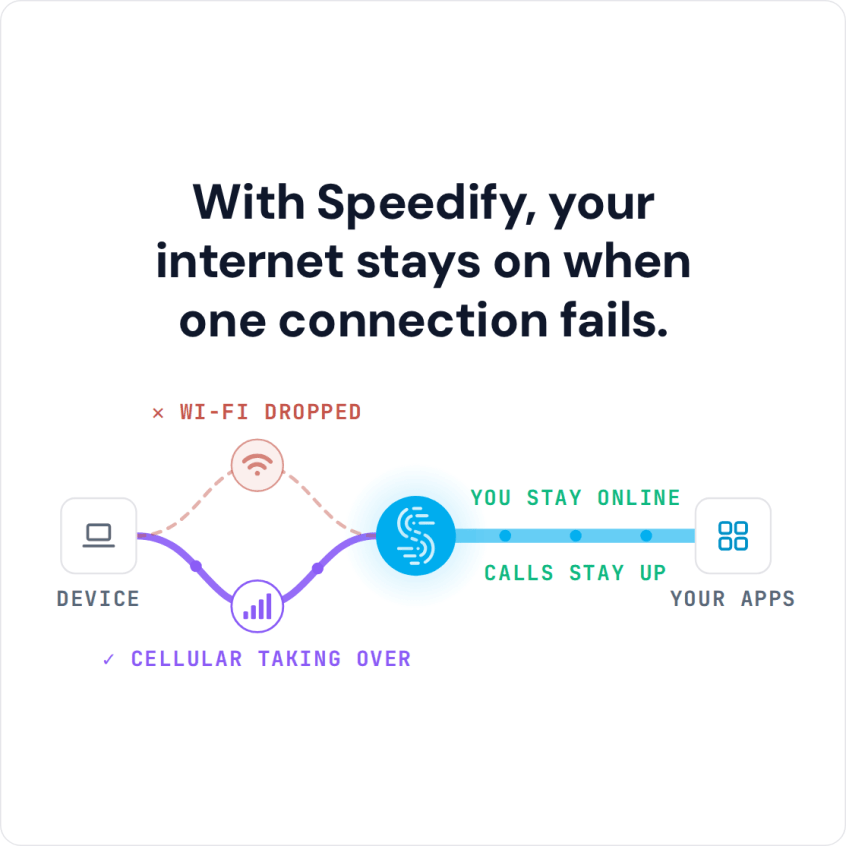
With Speedify, your internet stays on when one connection fails.
This article explains why traditional failover falls short for a command center, what channel bonding does differently, and how to deploy it across a fleet.
Watch now
How Speedify combines internet connections on any hardware
Get started with Speedify for your business
Speedify offers three commercial paths. They work together, and most enterprise customers use two or more.
01
Speedify Teams
Speedify on every supported OS for every team member
Centralized dashboard for billing, user provisioning, and usage analytics
CSV import/export and a RESTful management API
02
Speedify for Routers
License for supported OpenWrt routers
Powered by Speedify hardware lineup ready to deploy out of the box
Miri, GL.iNet and other partner models
Covers every device on the network, with no per-device install
03
Embed Speedify into your product
A · DIY
Build it yourself with the Speedify SDK.
Integrate Speedify into your iOS, Android, Windows, macOS, Linux or QNX product. Full developer documentation, sample code and supported integration paths. Your team owns the build, and the Speedify SDK handles combining the internet connections.
B · CUSTOM ENGINEERING
Have the Speedify team build it for you.
Why Traditional Failover for Mobile Command Centers Falls Short for Connectivity
Conventional approaches like cellular routers with “primary‑backup” failover or session‑based load balancing keep traffic on one link until it breaks, then scramble to reconnect. That switchover can take 3 to 30 seconds, an eternity when you are livestreaming a burn victim hand‑off or guiding evacuations by drone feed. Packet loss, jitter and brown‑outs degrade just as many calls as outright drops.
Moreover, MCCs rarely park where coverage is ideal. A typical setup may juggle Band 14 LTE, commercial 5G, a roof‑mounted Wi‑Fi mesh to the incident perimeter, and satellite or Starlink for backhaul. Each link has distinct latency, throughput and congestion profiles that change every few minutes as vehicles, weather and network load shift.
Combining Every Link at the Packet Level
Channel bonding attacks the problem at the packet level, slicing every flow into micro‑chunks and spreading them across all available links simultaneously. If one link dies or merely slows down, traffic continues to flow over the remaining paths so the session stays up.
Speedify, a software‑defined bonding platform, pushes this concept further:
- Hardware‑agnostic deployment: Runs on Windows, macOS, Linux, iOS, Android, and inside routers or single‑board computers; no proprietary appliance lock‑in.
- Optimized for Starlink and satellite connections : Speedify shows telemetry information from Starlink and other supported satellite systems in order to make troubleshooting easier, if needed.
- Peer-to-peer cellular sharing: share and combine 4G / 5G cellular connections between phones, tablets, computers and routers to create a faster, more reliable connection for everyone.
- True packet‑level aggregation: Up to 95 % link‑utilization efficiency, automatically weighting faster pipes without manual policy tweaking.
- Automatic failover and prioritization: Real‑time streams (e.g. body‑cam video or VoIP) are marked and shielded from bulk traffic, while Speedify’s encryption layer doubles as a VPN for data security.
- Cloud or on‑prem “Speed Servers”: Choose global PoPs for low‑latency hand‑off or spin up private instances on premise.
Because Speedify is pure software, agencies can trial it on existing Toughbooks, multi-WAN routers or even a Raspberry Pi mounted in a Pelican case; then scale licenses fleet‑wide without forklift upgrades. For national‑level organizations, the same SDK can be baked into custom apps that run on drones, vehicular modems or rugged tablets, ensuring every device inside the command bubble benefits from the bonded pipe.
Real‑World Payoff for First Responders when Using Speedify for Mobile Command Centers Connectivity
- Livestreams that keep running: Wildland teams stream HD drone video back to the task‑force HQ even as the truck slips between 5G and L‑band satellite.
- Voice and push‑to‑talk latency: Packet‑level steering keeps voice usable during high‑footprint data bursts such as GIS layer pulls.
- Reduced on‑scene infrastructure: With multiple modems and a small antenna array, the vehicle combines all of their bandwidth without towing a separate microwave mast.
Deploying Speedify in Your Mobile Command Fleet
- Install Speedify or the Powered‑by‑Speedify firmware on your existing router, laptop or mini‑PC.
- Add up to 31 connections: Band 14, commercial LTE/5G, Wi‑Fi mesh, Ethernet backhaul, Starlink or Ka‑band VSAT.
- Select a Speed Server tier (public cloud, dedicated instance, or on‑prem).
Speedify Is Used on Millions of Devices Worldwide
Speedify has made internet connections faster and more reliable for businesses and individuals since 2014.
15M+
Speedify downloads worldwide75K+
5-star reviews for Speedify on iOS and Android82
Speedify server points of presence in 50+ cities on 6 continents500TB+
Of internet traffic carried by Speedify every weekSpeedify Partners
Speedify works with these companies to bring faster, more reliable internet and networking technology to their customers and employees.


Bottom Line for Mobile Command Center Connectivity Powered by Speedify
In mission‑critical operations, “It works most of the time” is a luxury first responders cannot afford. Packet‑level channel bonding turns multiple fragile links into one resilient, high‑capacity pipe: no proprietary boxes, no vendor lock‑in. As MCC deployments grow across the United States, Canada, the U.K., Germany and Australia, agencies that embrace software bonding will be the ones whose video holds up, whose CAD keeps responding, and whose teams stay safer in the field.
Ready to ruggedize your connectivity? Explore Speedify’s Channel Bonding solutions to keep your mobile command centers, and the communities you protect, connected.
Security: encryption, dedicated servers, and FIPS-restricted environments
Public safety networks carry sensitive location, personnel, and operational data that cannot be exposed to interception. Speedify encrypts traffic between each device and the Speedify server (DTLS 1.2 with AES-256-GCM or ChaCha20-Poly1305) and keeps no record of the sites visited, though it does record connection metadata such as IP address, device ID, connection time and data used. Dedicated Servers give agencies a static IP address and predictable routing. Command staff get the same encryption whether the connection runs over commercial cellular, a private LTE network, or Starlink.Deploying across vehicles and teams: a field-readiness checklist
Rolling Speedify out across a fleet of response vehicles and portable command kits follows a consistent process:- Equip each vehicle with a Powered by Speedify router connected to multiple cellular modems and, where relevant, a Starlink terminal.
- Confirm redundant mode is set for command-critical traffic like dispatch calls and live video.
- Download Speedify on laptops and tablets carried by individual team members for their own bonded connection.
- Test failover in the field before an incident, not during one.
- Confirm dedicated server routing meets the agency’s data handling requirements.
Mobile Command Center Connectivity: FAQ
Can Speedify keep a live video feed connected if a cellular tower goes down mid-incident? Speedify says it moves traffic to another connection in milliseconds. If a second carrier or Starlink is connected, the feed typically continues without a manual reconnect. Does Speedify meet FIPS or other compliance requirements? Speedify has no published FIPS validation, so agencies with a FIPS requirement should confirm with Speedify before relying on it. Traffic is encrypted with DTLS 1.2 and AES-256-GCM or ChaCha20-Poly1305. Agencies with strict data residency rules can ask about a Dedicated Server or a Self-Hosted Server. How many response vehicles can run Speedify at once? Each vehicle runs its own bonded connection independently, so an entire fleet can use Speedify simultaneously without depending on a shared backbone. What internet connections does Speedify bond in a mobile command post? Speedify bonds Wi-Fi, 4G/5G cellular, Ethernet, Starlink and other satellite connections together, using whichever combination is physically available at the location.Speedify Business Solutions
Speedify Teams
Speedify for Routers

Speedify Embedded Solutions and Integrations
Add Speedify to your own app or hardware with the Speedify SDK. Your product then combines internet connections, fails over automatically when one drops, and encrypts the traffic, using the same technology as the Speedify app.